
Quick Summary:
This guide explains what manufacturing is. You will also learn how businesses turn raw materials into finished products, along with their history, importance, types, and how digital tools support better decisions.
By the end of this guide, you'll understand the following:
- The manufacturing meaning in simple business terms.
- How raw materials, labour, machines, and planning work together.
- How to record and manage these transactions properly.
- Which production model fits different business needs.
- How digital systems support better manufacturing decisions.
Manufacturing can look straightforward on paper. Materials come in, the team makes the product, and the order goes out. That is the clean version. In daily work, a delayed delivery, wrong stock count, or failed quality check can throw the whole job off.
The money side needs checking too. Raw material prices move, power interruptions cut into production hours, and customers still expect the correct order on time. Clear planning, stock records, costing, quality checks, and basic discipline keep the process from drifting.
What is Manufacturing?
Manufacturing means taking raw materials or parts and turning them into finished goods. This can be done by hand, with machines, through assembly, or through a production formula.
The manufacturing meaning is simple when you look at a real process. A food business may buy rice in bulk, clean it, pack it into 500 g and 1 kg units, add labels, and send the packs to stores. Raw stock becomes something customers can buy.
Someone on the floor needs to know whether the stock record still matches the job and the dispatch note. If half of the update sits in a spreadsheet and the rest is buried in WhatsApp, mistakes get missed.
History of Manufacturing
Manufacturing began with handwork. Skilled workers made goods in small workshops, often one item at a time. Output depended on the worker’s time, tools, and experience.
The Industrial Revolution changed that pattern. Factories, machines, steam power, and assembly methods made it possible to produce more goods at lower cost. Factories became faster once electricity and conveyor belts entered the picture. Later, automated machines helped businesses make larger quantities with fewer quality differences between batches.
Today, the shop floor still does the making. The planning often happens through digital records that show materials, batches, purchases, output, and costs.
Why is Manufacturing Important?
Manufacturing supports jobs, suppliers, logistics, exports, and local industry. A single production business can create activity across many other businesses.
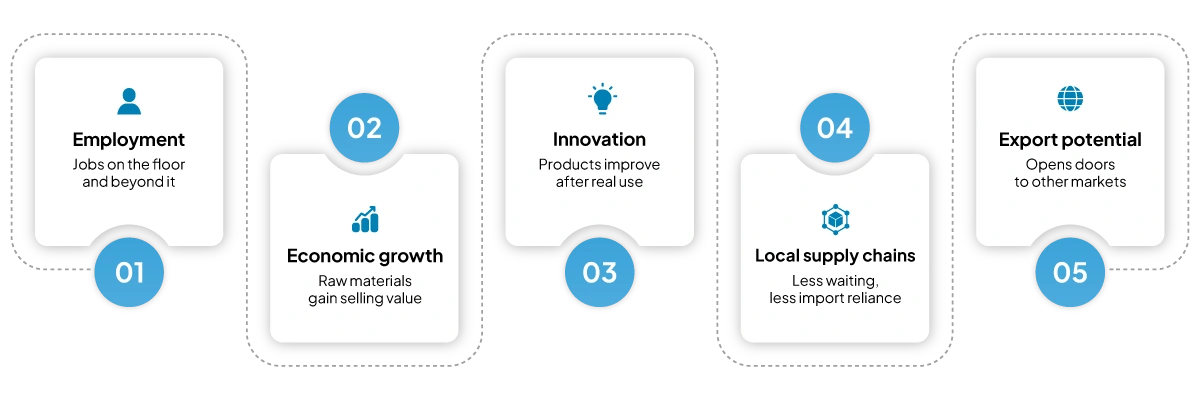
1. Creates Employment Opportunities
A manufacturing unit needs people on the floor and behind the scenes. Machine operators, shift supervisors, warehouse staff, buyers, dispatch teams, and sales staff all play a part in getting goods made and delivered.
The work also spreads outside the factory. Packaging suppliers, transporters, repair teams, and distributors often get regular business from manufacturers.
2. Supports Economic Growth
Manufacturing gives raw materials a higher selling value. Raw grain may be sold as it is, but cleaned, packed, branded food products usually earn more because extra work has been added.
That difference supports wages, supplier bills, equipment purchases, and expansion. It also gives local buyers more finished goods without depending only on imports.
3. Drives Innovation and Industrial Development
Manufacturers usually improve products after seeing how customers use them and where production causes trouble. A small change to the pack size, shelf life, or production method can make the product easier to stock and easier to sell.
4. Strengthens Local Supply Chains
Local manufacturing reduces waiting time and cuts some reliance on distant suppliers. This becomes useful when shipments are delayed, currency rates move, or imported stock becomes harder to source.
Nearby retailers and distributors also benefit because stock can reach them faster when demand changes.
5. Increases Export Potential
Manufacturing can open the door to export sales once a business has a product people can buy in other markets. That could be processed food, car parts, or packaged goods as long as the quality is consistent and the price still makes sense.
Interesting Fact: In Q4 2025, global manufacturing output grew by 0.5% from the previous quarter, while year-on-year growth stood at 3.7%.
Source:United Nations
How Manufacturing Works: From Raw Materials to Finished Products
Manufacturing follows a chain of steps. One weak step can affect the next, so planning has to start before production begins.
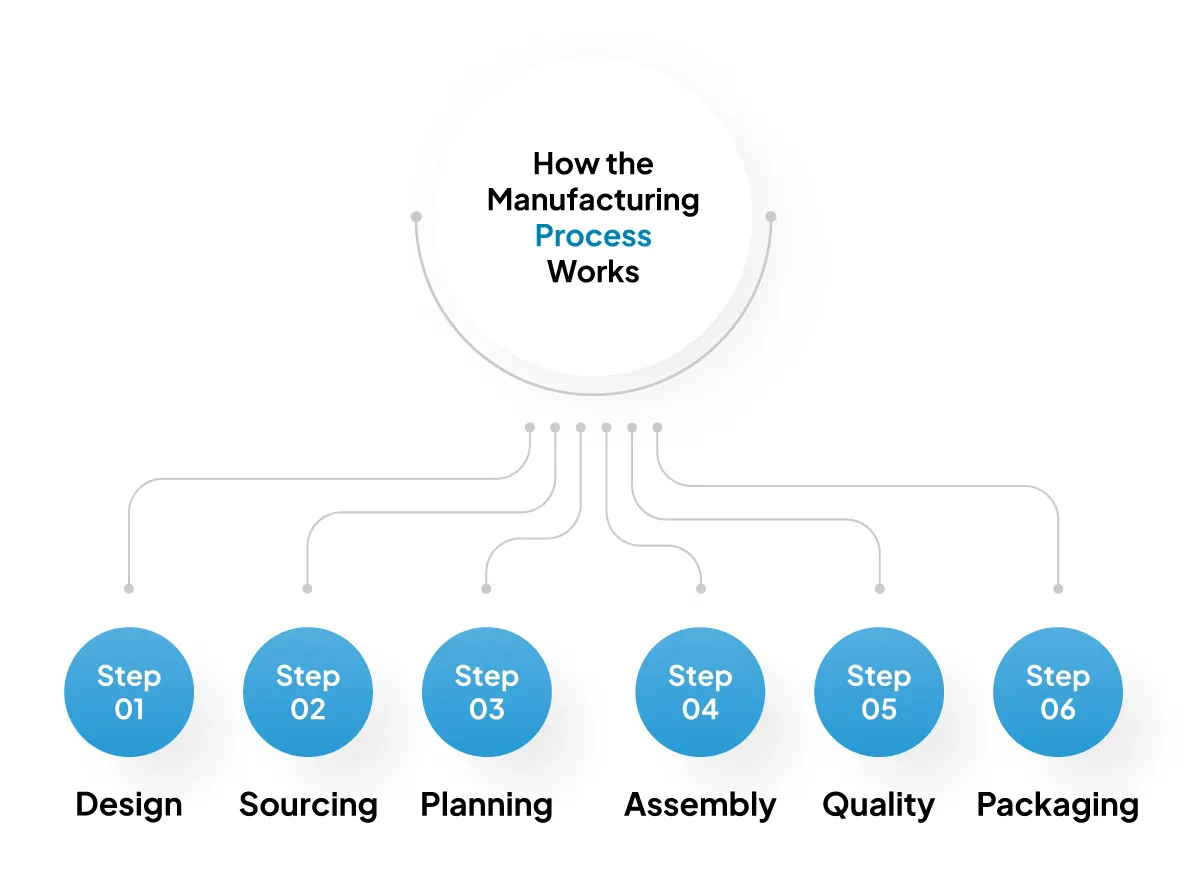
1. Product Design and Development
The process starts with deciding what product to make. It should be practical to make, easy to repeat, and priced in a way that protects profit.
2. Sourcing Raw Materials
After the product is finalised, the next job is getting the right materials. A manufacturer may need ingredients, fabric, metal, plastic, labels, packaging, or spare parts.
Price matters, but so do timing and quality. One late or unusable material can hold up the whole run.
3. Production Planning
Production planning is where the job is worked out before the floor starts. The team checks what has to be made, how much stock is available, which machines are free, and when the order is due.
4. Manufacturing and Assembly
This is the making stage. Depending on the product, the work may involve cutting, mixing, stitching, filling, moulding, machining, packing, or putting parts together.
5. Quality Control
Quality control checks finished goods against required standards. This can include size, weight, safety, expiry, packaging, and defect checks.
Checks should happen during production as well. Finding a fault early is cheaper than rejecting a full batch later.
6. Packaging and Distribution
After quality approval, goods are packed, labelled, and either stored or dispatched. Packaging protects the product and gives buyers key details such as weight, batch number, expiry date, or instructions.
Finished stock then moves to the chosen sales channel.
The Main Types of Manufacturing
Types of manufacturing depend on the product, order size, process, and level of customisation. A food packer, furniture maker, and chemical producer will each need a different setup.
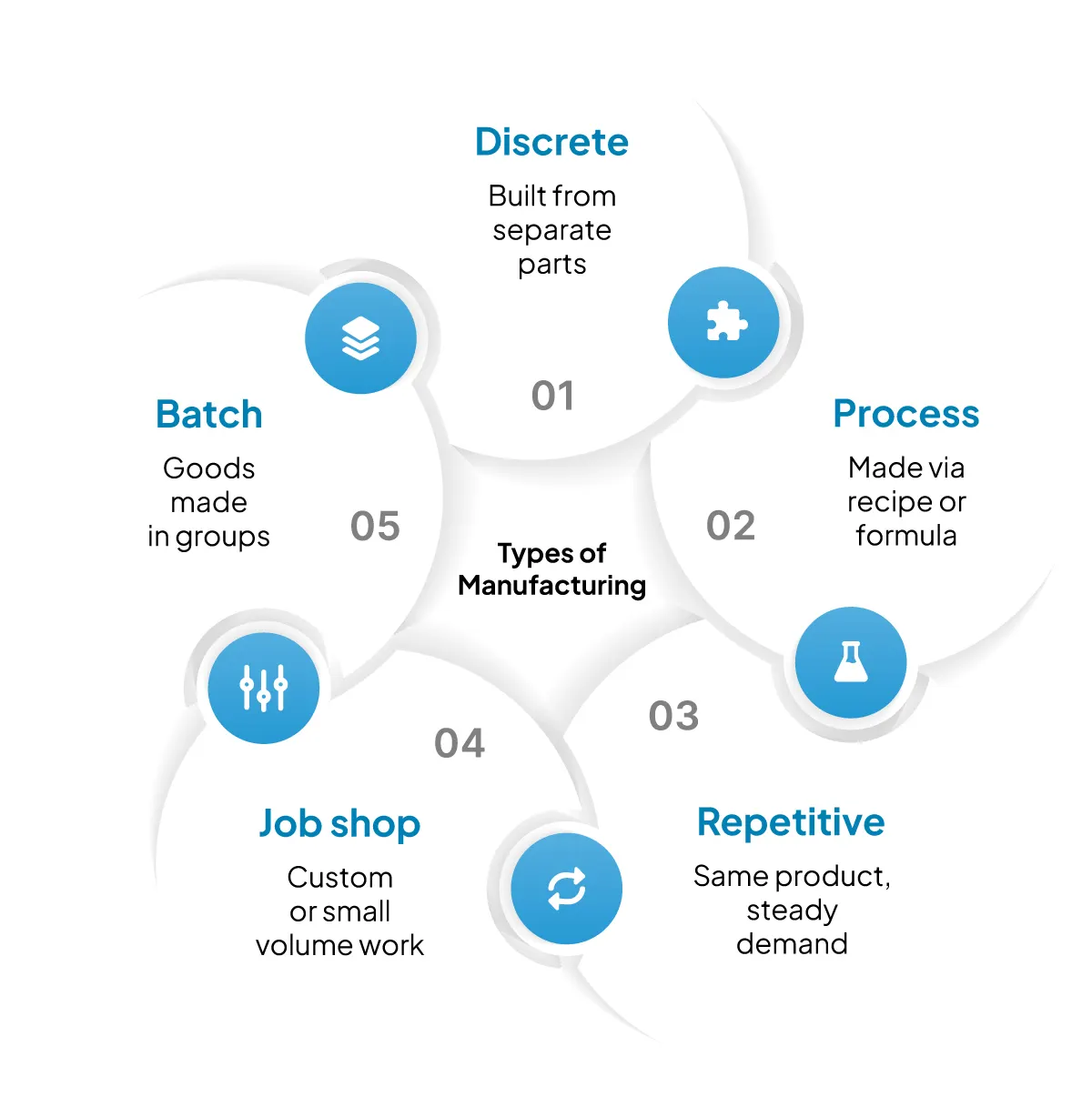
1. Discrete Manufacturing
Discrete manufacturing is used when products are made as separate items. These goods are usually built from different parts. A table may need wood, screws, polish, fittings, and packaging.
2. Process Manufacturing
Process manufacturing is used when goods are made through a recipe, formula, or mixture. Food, beverages, paint, cosmetics, chemicals, and pharmaceuticals are common examples.
The product is usually produced in bulk first. It is then packed into units that can be sold.
3. Repetitive Manufacturing
Repetitive manufacturing produces the same or similar products again and again. It works well when demand is steady and the production line can run for long periods.
This model suits standard products where the process does not change much between runs.
4. Job Shop Manufacturing
Job shop manufacturing handles custom or small-volume work. Each order may need different materials, steps, or labour time.
It works best when flexibility is more important than high-volume speed.
5. Batch Manufacturing
Batch manufacturing produces goods in groups. After one batch is complete, the business may switch to another product, flavour, size, or variation.
This works well for businesses that handle different SKUs using shared equipment.
Choosing the Right Manufacturing Type
The best manufacturing approach depends on how your products are made and how customers place orders.
| Business Need | Recommended Manufacturing Type |
|---|---|
|
Products built from individual components or parts |
Discrete Manufacturing |
|
Products created using recipes, formulas, or chemical processes |
Process Manufacturing |
|
High-volume production with consistent demand |
Repetitive Manufacturing |
|
Customised products made to specific customer requirements |
Job Shop Manufacturing |
|
Production carried out in planned groups or runs |
Batch Manufacturing |
Common Manufacturing Production Models Explained
A production model decides when goods are made. Some businesses produce before orders arrive, whereas others start after an order is confirmed.
1. Make-to-Stock (MTS)
Make-to-stock means goods are produced before customers place orders. The business uses demand forecasts to decide how much to make.
2. Make-to-Order (MTO)
Make-to-order means production starts after a customer places an order. This reduces finished stock because products are made against real demand.
3. Assemble-to-Order (ATO)
In assemble-to-order, the business keeps common parts ready. Once an order comes in, those parts are used to build the final product. This works for products with standard options and some customer choice.
4. Engineer-to-Order (ETO)
Engineer-to-order is used when the product needs design work before production. Sales confirm the requirement first. Engineering, buying, and production then work from the approved design.
Comparing MTS, MTO, ATO, and ETO
| Model | When Production Starts | Best For | Main Risk |
|---|---|---|---|
|
Make-to-Stock |
Before customer order |
Steady-demand products |
Overstocking |
|
Make-to-Order |
After customer order |
Custom products |
Longer delivery time |
|
Assemble-to-Order |
After order, using ready parts |
Configurable products |
Component shortages |
|
Engineer-to-Order |
After design approval |
Complex custom projects |
Cost and timeline changes |
Tip: Do not choose a model only by industry. Look at your demand pattern, customisation level, cash flow, and storage cost.
Key Components Every Manufacturing Business Must Manage
Manufacturing becomes easier to control when the main moving parts are tracked properly.
1. Inventory and Raw Materials
Production depends on having the right stock available. If a key material is missing, the job waits. If the business buys far more than it needs, cash gets tied up on the shelf.
Inventory records should answer simple questions: what is in stock, what has already been kept aside for production, and what needs to be ordered again.
2. Bill of Materials (BOM)
A bill of materials, or BOM, is the product’s ingredient list. It shows what is needed, and in what quantity, to make one item or batch.
For a 1 kg rice pack, this could include rice, the packet, the label, and carton space.
3. Work Orders
A work order tells the production team what to make, how much to make, which materials to use, and when the job should be completed.
It reduces confusion because production does not depend only on verbal instructions or scattered messages.
4. Production Scheduling
Production scheduling decides which job runs first, which machine is used, and which team handles each task.
Effective scheduling reduces idle time and helps managers adjust when staff are absent or urgent orders arrive.
5. Labor and Resource Planning
Manufacturing needs the right people and resources at the right time. This includes operators, supervisors, quality staff, maintenance teams, machines, tools, and utilities.
6. Quality Assurance
Quality assurance sets the standards that products must meet. It includes checks, approvals, documentation, and corrective action.
This is especially important for food, pharmaceuticals, chemicals, and any product where safety, expiry, or compliance is involved.
Tip: Keep BOMs updated when raw material costs or recipes change. An old BOM can make your product costing inaccurate.
The Biggest Challenges Facing Manufacturers Today
Manufacturers often deal with cost pressure, supply uncertainty, and limited visibility. Small issues can affect stock, cash flow, and customer delivery.
1. Inventory Shortages and Overstocking
Shortages stop production, while overstocking blocks cash and increases storage cost. Both problems often come from weak demand planning or delayed stock updates.
2. Rising Production Costs
Raw material prices, wages, electricity, transport, repairs, and packaging costs can change quickly. If these costs are not tracked, margins can shrink without warning.
Cost control needs updated purchase records, production costing, and regular review of wastage.
3. Supply Chain Disruptions
Supplier delays, import issues, transport problems, and port congestion can all affect production timelines.
A backup supplier list and better purchase planning can reduce the impact, but businesses still need clear visibility into pending materials.
4. Demand Forecasting Difficulties
Demand forecasting is harder when customer buying patterns change. If forecasts are too high, stock piles up; if forecasts are too low, production cannot meet orders.
5. Production Delays and Downtime
Machine breakdowns, staff shortages, missing materials, and power issues can delay production. In South Africa, load shedding has also pushed many businesses to plan around power availability and offline working needs.
6. Lack of Real-Time Business Visibility
Many manufacturers still depend on spreadsheets, notebooks, or disconnected tools. This creates delays in reporting and makes it more difficult to see true stock, cost, production progress, and pending orders.
Lean Manufacturing: Producing More With Less
Lean manufacturing focuses on reducing waste while improving flow, quality, and customer value. It helps businesses use fewer resources without weakening output.
What is Lean Manufacturing?
Lean manufacturing is a method of improving production by removing activities that do not add value. The goal is to reduce waste in materials, time, movement, waiting, defects, and overproduction.
For a South African SME, lean manufacturing can start with cleaner stock records, a better layout, fewer manual steps, and simple daily tracking.
Benefits of Lean Manufacturing
Lean manufacturing can help reduce wastage, improve quality, shorten lead times, and make production easier to manage.
It also helps teams identify problems earlier. If a process creates defects every week, lean thinking pushes the business to fix the cause, not only to reject the damaged goods.
Practical Lean Manufacturing Examples
A food manufacturer may reduce waste by tracking expiry dates and using older batches first. A production unit may reduce waiting by checking material availability before work orders are released.
Lean improvements work best when they are simple, visible, and repeated every day.
Interesting Fact: A 2025 Statistics South Africa release reported that South Africa’s manufacturing production grew by 1.8% in Q2 2025 after two quarters of decline, with automotive and petroleum-related divisions helping the recovery.
Source:StatSSA
Manufacturing KPIs Every Business Should Track
KPIs help manufacturers measure what is working and what needs attention. They also help owners make decisions based on facts instead of only daily pressure.
1. Production Efficiency
Production efficiency compares actual output with expected output. It shows how well labour, machines, and materials are being used.
2 Manufacturing Lead Time
Manufacturing lead time measures how long it takes to complete production from start to finish.
Shorter lead time helps you deliver faster and respond to customer demand. A longer lead time can expose issues in sourcing, scheduling, or production flow.
3. Throughput Rate
Throughput rate shows how many units are produced in a set period. It helps managers understand capacity and spot production slowdowns.
If output drops below the normal level, the cause should be checked quickly.
4. Capacity Utilisation
Capacity utilisation shows how much of your available production capacity is being used. Very low utilisation may mean weak demand or poor scheduling. Very high utilisation may mean your team has little room for urgent orders or maintenance.
5. Inventory Turnover
Inventory turnover shows how often stock is sold and replaced during a period.
A low turnover rate may mean slow-moving stock or overproduction. A very high rate may mean the business is at risk of stockouts.
6. Cost of Goods Sold (COGS)
COGS shows the direct cost of producing goods sold during a period. It includes raw materials, direct labour, and other production-related costs.
Tracking COGS helps you price products better and protect margins.
7. Defect Rate
The defect rate shows the percentage of products that fail quality checks.
A high defect rate increases rework, waste, customer complaints, and delivery delays.
Why South African Manufacturers are Moving Toward Digital Operations
Many South African manufacturers are improving their systems because manual work limits control. Digital operations help teams see stock, production, purchases, costing, and sales in one place.
1. Growing Competition
Customers can compare prices, delivery times, and product quality more easily. This puts pressure on manufacturers to control costs and deliver reliably.
A business that knows its real production cost can price more confidently than one working from rough estimates.
2. Rising Customer Expectations
Customers expect correct orders, faster delivery, clear communication, and consistent quality.
If your team cannot see production status or stock availability quickly, customer updates become harder. Digital records help sales and operations teams work from the same information.
3. Need for Operational Efficiency
Efficiency is important when margins are tight. Manual entries, duplicate work, stock mismatches, and delayed reports all take time away from production.
Digital operations reduce repeated entry and give managers a clearer view of what needs attention.
4. Industry 4.0 and Smart Manufacturing Trends
Industry 4.0 refers to connected machines, sensors, automation, cloud systems, analytics, and real-time data in manufacturing.
Many SMEs start with basic digital control: inventory, BOMs, work orders, purchase planning, batch tracking, and reporting.
How ERP Software Helps Manufacturers Scale Faster
As manufacturing grows, manual control becomes harder. A business may start with a few products and one production location, then add more suppliers, batches, orders, and stock points over time. That is usually when spreadsheets start falling behind.
ERP software keeps production records, stock updates, purchase details, BOMs, work orders, and accounts in one place. This gives your team a clearer view of what has been ordered, what is ready for production, and what still needs attention.
Once production starts growing beyond what your current system can handle, a connected ERP setup becomes a practical next step.
A platform like VasyERP can support inventory, production, purchases, accounting, and reporting in one workflow without making day-to-day work feel too complicated.
Frequently Asked Questions About Manufacturing
Manufacturing means making physical goods from raw materials or components. Production is a broader term that includes creating goods, services, digital products, or any process that generates value.
Inventory management ensures the right materials are available when production begins. It also helps reduce shortages, excess stock, batch errors, and unnecessary cash tied up in inventory.
Manufacturers commonly use ERP, inventory management, accounting, production planning, warehouse management, quality management, and reporting software. As businesses grow, they often replace spreadsheets with integrated systems.
ERP software connects inventory, purchasing, bill of materials (BOM), production, accounting, and reporting into one platform. This helps manufacturers track materials, control costs, reduce duplicate entries, and make faster business decisions.
Last Updated on July 9, 2026