Quick Summary:
VAT compliance requirements are complex for any supermarket operating in South Africa. Issuing a non-SARS complaint invoice, misclassifying a product, or filing VAT returns late can trigger audits and result in penalties. This guide covers everything a South African supermarket needs to know to stay compliant in 2026.
You will walk away learning the following:
- How VAT applies to supermarkets specifically.
- The VAT rate and threshold updates for 2026.
- Which products attract VAT, and which are zero-rated or exempt?
- The compliance requirements every supermarket must meet.
- Common mistakes and how to avoid them.
- How POS software simplifies VAT compliance.
VAT compliance requirements for a supermarket operating in South Africa are significantly different and more complex than, say, a manufacturing or service-based business.
The reason is simple: supermarkets sell hundreds of different products that fall under different VAT categories: exempt from VAT entirely, zero-rated, or the 15% bracket.
The problem is that the distinction between these categories is not always obvious. White bread being taxed at 15% while brown bread is zero-rated is a simple example. Get any of these wrong, and SARS will notice. This is the reality of how complex VAT can be for this type of business.
This VAT compliance guide will tell you everything you need to stay above board with SARS in 2026.
What is VAT and How Does it Apply to Supermarkets?
VAT, short for Value Added Tax, is a consumption tax that is added to the price of most goods and services sold in South Africa. It is collected at each stage of the supply chain, i.e., from the manufacturers all the way to the distributors.
Each party (registered businesses, also called vendors in this regard), regardless of its place in the supply chain, has to account for the VAT collected at its end. They then pay this VAT to SARS and can generally claim back VAT they paid on their own business inputs.
Goods and services in South Africa fall under three distinct VAT categories:
- Standard-rated goods and supplies: These categories of products attract a 15% VAT. When you sell these items, you add 15% to the price and pay that collected amount to SARS
- Zero-Rated goods and supplies: These are still taxable supplies but attract VAT at 0%. You do not charge VAT on them, but you can still claim input VAT on expenses related to selling them
- VAT-exempt goods and supplies: These fall outside the VAT system entirely. You cannot claim input VAT on expenses related to exempt supplies
For supermarkets operating in South Africa, it means that there is no room for error at your POS. If you charge VAT on zero-rated items, you essentially overcharge your customers. This creates compliance issues.
If you fail to charge VAT on items that fall under the 15% bracket, you’ll essentially have to pay that shortfall to SARS out of your own pocket.
Which Supermarket Products are Subject to VAT?
| VAT at 15% (Standard-Rated) | Zero-Rated Supplies |
|---|---|
| Soft drinks, energy drinks, and carbonated beverages | Brown bread (including brown rolls and brown buns) |
| Confectionery, sweets, and chocolates | Brown wheaten meal |
| Snacks like chips, biscuits, and crackers | Maize meal |
| Processed foods like canned goods (with some exceptions) | Samp |
| Cleaning products and household chemicals | Mealie rice |
| Personal care items like soap, shampoo, and toothpaste | Dried mealies and beans |
| Alcoholic beverages | Lentils |
| Pet food | Tinned pilchards |
| Paper products like toilet paper and tissues | Milk, milk powder, cultured milk |
| Batteries | Rice |
| Light bulbs | Fresh fruit and vegetables |
| Kitchenware | Vegetable oil |
| Appliances | Eggs |
SARS is increasingly using third-party data matching and electronic audit tools to identify VAT discrepancies between what vendors declare and what their purchase and sales data suggest they should have collected.
This makes it even more important for supermarkets to be extremely careful when it comes to their specific VAT compliance requirements.
The good news for supermarkets is the stable VAT at 15%. It means that they need to configure their inventory system once and rely on it consistently.
What requires continuous attention is product classification, which can change periodically, like the addition of edible offal, dairy liquid blend, and tinned vegetables in brine in May 2025.
When Does a Supermarket Need to Register for VAT?
Supermarkets in South Africa can register for VAT under one of the two scenarios.
Compulsory Registration
If your supermarket’s turnover exceeds (or is likely to exceed) R2.3 million in a consecutive 12-month period, you must register for VAT with SARS. The registration is to be made within 21 business days of when this threshold is about to be met or crossed.
Voluntary Registration
A supermarket can also choose to voluntarily register for VAT if its turnover exceeded R120 000 in the past period of 12 months.
Supermarkets that were registered under the old R1 million threshold, but that still don’t meet the new R2.3 million threshold, can consider deregistering from SARS, but the decision does come at a cost.
SARS treats deregistration as a deemed supply of all business assets at their open market value on the date of cancellation, and VAT is payable on that deemed supply.
Staying registered and continuing to claim input VAT on purchases may well be the better financial outcome in specific cases. Weigh this decision carefully with a qualified accountant in the loop before you proceed.
VAT Compliance Requirements Every Supermarket Must Meet
As a VAT-registered supermarket, you will need to meet the following VAT compliance requirements.
Issue VAT-Compliant Tax Invoices
Every invoice you issue post VAT registration must include:
- The words “Tax Invoice” written in a prominent place.
- Your supermarket’s registered name, address, and VAT registration number.
- The customer’s name and address (if the invoice exceeds R5,000).
- An individual serialised invoice number with the date of issue.
- A description of each item sold with:
- The quantity or volume of them.
- The price (excluding VAT).
- The VAT rate applied.
- The amount of VAT charged.
- The total amount of the entire invoice, including VAT.
For invoices under R5,000, you can issue an abridged tax invoice with fewer details.
Maintain Accurate Sales and Purchase Records
You must keep records of all the following documents.
- Daily sales summaries.
- Tax invoices issued.
- Tax invoices received.
- Credit and debit notes.
- Import and export documents.
- Bank statements.
SARS requires VAT records to be retained for five years from the date of the relevant transaction. These can also be stored digitally as long as they are readily accessible and in a readable format.
Adjust VAT During Returns
One aspect of VAT compliance that this VAT compliance guide would be incomplete without covering is the charge of VAT on the correct value when goods are returned. Every return in a supermarket environment should trigger a credit note that mirrors the original tax invoice.
A return processed as a simple refund without a credit note leaves your output VAT declaration higher than your net sales justify.
File VAT Returns on Time
All businesses are required to file VAT returns, usually by the last business day of the month following your tax period. As a supermarket, you will need to file your returns via the VAT201 form through SARS eFiling.
Common VAT Compliance Mistakes Supermarkets Should Avoid
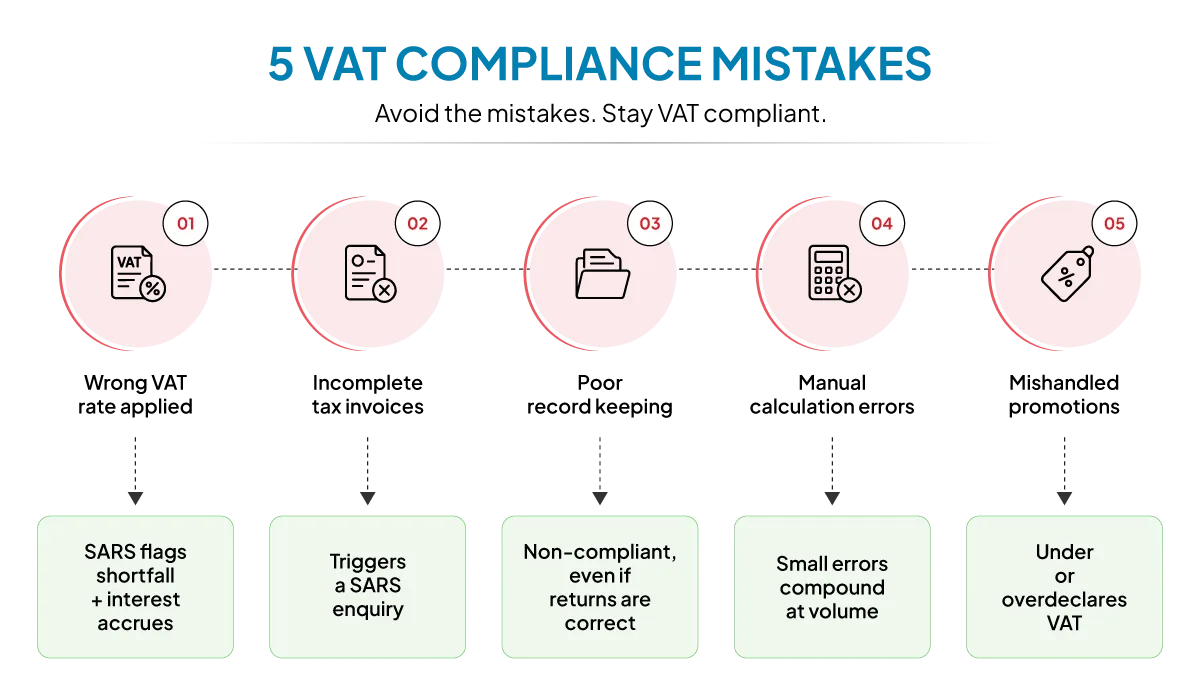
VAT compliance mistakes can lead to penalties that range from 5% to 200% of the tax amount due, depending on the severity of the infraction. Hence, it’s crucial to avoid these common compliance mistakes supermarkets tend to make.
Applying the Wrong VAT Rate to Products
Applying the incorrect VAT rate is one of the most common of the VAT compliance mistakes among supermarkets. While it is understandable, considering the sheer volume of SKUs they deal with, there are still consequences.
Applying 0% VAT to standard-rated products creates an output VAT shortfall. SARS will flag this, and interest accrues from the date of each transaction. Doing the opposite means you are overcharging customers and inflating your output VAT, which creates its own reconciliation problems.
Missing or Incomplete Tax Invoices
Missing mandatory information on tax invoices is another common issue in supermarkets. Incomplete invoices can raise a SARS enquiry, while missing invoices mean sales go unrecorded, which will create discrepancies down the line.
Poor Record Keeping
SARS’s five-year record retention requirement applies to every transaction a supermarket makes. Discarding supplier invoices after the financial year, or storing records in a format SARS cannot access, will be considered non-compliant even if your VAT returns are filed correctly.
Manual Calculation Errors
Calculating VAT manually on mixed baskets can and most likely will introduce rounding errors and misallocation between VAT categories. At high transaction volumes, even small per-transaction errors will accumulate into major material VAT discrepancies.
Mishandling VAT on Discounts and Multi-Buy Promotions
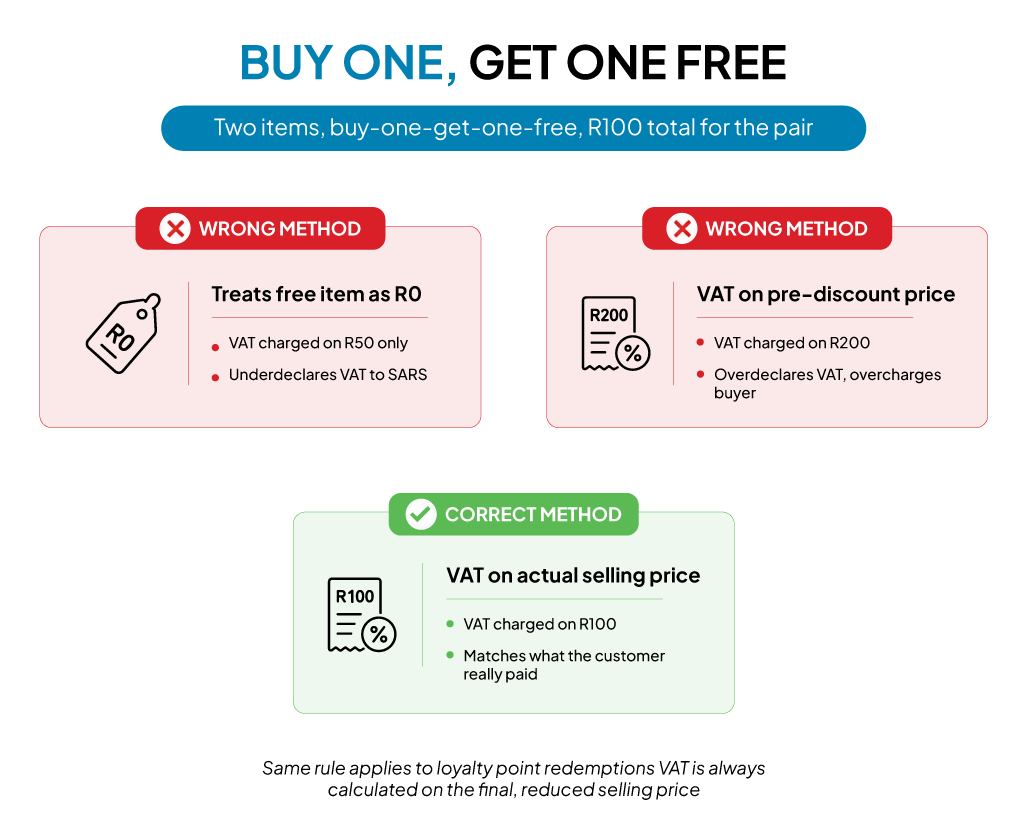
This is a mistake most generic VAT compliance guides miss. Promotions change the VAT calculation entirely.
A buy-one-get-one-free offer changes the per-unit price, and if the system treats the free item as a separate zero-value transaction, you may underdeclare VAT. If it applies VAT to the full price before the discount, you overdeclared.
Loyalty point redemptions also affect VAT. When a customer redeems points for a discount, the selling price reduces. VAT must be calculated on the reduced price.
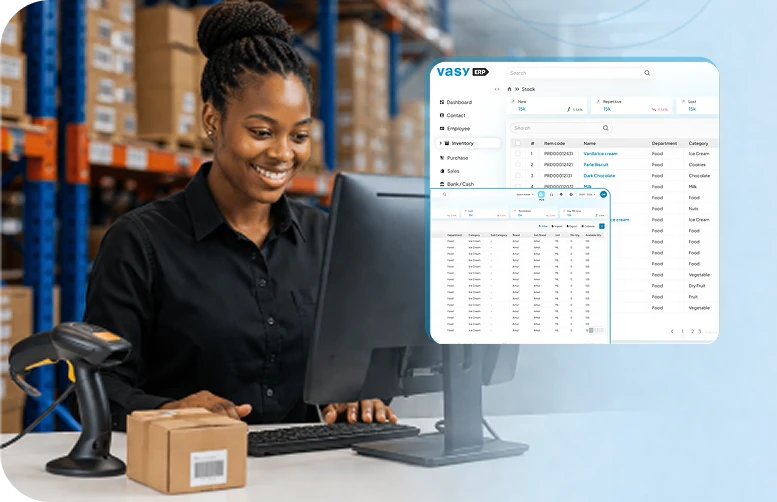
VasyERP configures product-level VAT rates and generates SARS-compliant tax invoices automatically at every checkout.
Request a DemoHow POS Software Helps Supermarkets Stay VAT Compliant
Most of the VAT compliance mistakes listed above can be mitigated right at the source using a POS system adapted for the South African retail space. Here is how:
Apply and Calculate VAT Correctly
If a POS is configured correctly, it will apply the applicable VAT and its calculations the moment the product is scanned. This eliminates any opportunity to introduce errors by entering and calculating items manually.
These systems can also be set up to calculate VAT on the actual selling price of each item after discounts, if any, have been applied.
Generate VAT-Compliant Invoices
Generating invoices as prescribed by SARS is one of the core VAT compliance requirements. A POS built from the ground up to be SARS-compliant will generate invoices with all the key information required from the system automatically.
Set Product-Level Tax Configurations
A POS will help you configure VAT classifications at the product level within the product master. The moment a change is made, the same will apply across every subsequent sale and in the invoices.
With a POS, this step becomes a one-time setup task rather than depending on the individual staff at the counter to make the update with each sale.
Create Accurate Sales Reports
A POS system connected with an integrated ERP with accounting software and reporting modules will be capable of creating reports to file an accurate VAT201 return.
The added benefit of such a system is that it will allow you to view specific information like total standard-rated sales, total zero-rated sales, output VAT collected, and input VAT for specific periods instantaneously.
Maintain Audit-Ready Records
An integrated POS system will be able to maintain audit-ready records of every transaction that happens at your counters or at the back end. If SARS requests supporting documentation for a specific period, the relevant transactions can be filtered and exported in real-time without having to reconcile all the required data manually.
VAT Compliance Checklist for South African Supermarkets
Follow this checklist to make sure that your supermarket is always VAT compliant.
Check if You Need to Register for VAT
- Monitor your turnover over consecutive 12-month periods. If it exceeds R2.3 million, register within 21 days.
- Consider voluntary registration if you exceed R120,000.
When Setting Up Your POS
- Maintain a product master with product classifications.
- Train staff on the differences.
- Set the correct rate for every product.
- Test the configuration before going live.
When Creating Invoices
- Make sure the system is set to include all required information on the invoice per SARS.
- Use an individual serialised invoice number.
For Maintaining Records
- Make sure every transaction and invoice is recorded.
- If storing digitally, make sure they are in a readable format.
- Retain records for a minimum of five years.
To File VAT Returns
- Reconcile the output VAT declared in the return against the POS sales reports before submitting.
- File the VAT201 return via SARS eFiling by the last business day of the month following the end of each tax period.
- Pay any VAT owed on time.
Review VAT Settings Periodically
- Review VAT classifications annually.
- Update your systems and test whenever SARS announces changes.
How VasyERP Helps South African Supermarkets Simplify VAT Compliance
VasyERP offers a POS natively integrated with a larger ERP system that is built by the group for supermarkets operating in South Africa. As a result, it helps you meet VAT compliance requirements at every stage of your supermarket’s operations, like so:
At the Product Setup Level
- The system allows you to configure VAT classifications per SKU in the item master. It also separates classifications per product variant.
- Bulk item upload and bulk update tools allow VAT classifications to be applied or corrected across large product catalogues in a single action.
- VAT label generation produces shelf and product labels with VAT-inclusive pricing drawn directly from the system.
At the Point of Sale
- Every product has a dedicated barcode, which, when scanned by the cashier, applies the correct VAT rate for each product automatically.
- For loose produce sold by weight, VasyERP’s weight scale integration feeds the weighed amount directly into the system, which again calculates the applicable VAT rate based on the product’s classification automatically.
- The system always generates the same SARS-compliant tax invoice regardless of the payment mode the customer chooses.
For Promotions and Loyalty Redemptions
- When coupon discounts and bill discounts are applied together in the same transaction, VAT is recalculated on the final post-discount selling price automatically.
- VasyERP recalculates VAT when loyalty point redemption impacts the selling price.
For Reporting and Audit Readiness
- VasyERP’s reporting module supports 150+ reports, including VAT-specific sales summaries that separate output VAT by category.
- Its bank reconciliation module matches cash collected at the till against VAT declared, surfacing any discrepancies before the return is filed.
- Activity logs and accounting audit trails record every transaction against a user, a timestamp, and a VAT rate.
- Records can be stored indefinitely, satisfying SARS’s five-year retention requirement.
For Supermarket Chains
- A single VAT classification set in the central inventory applies across every branch automatically.
- Stock transfers between branches generate automatic VAT documentation with VAT-specific controls.
- Central reporting consolidates VAT data across all locations into a single view for reconciliation and return preparation.
Final Thoughts
VAT compliance is a non-negotiable part of running a supermarket in South Africa. The rules are complex, and the penalties are severe. That said, compliance is achievable if you follow this VAT compliance guide and use the right system to support your business.
The steps are simple. All you need to do is classify products correctly, calculate VAT accordingly, generate the invoice in the prescribed format, and maintain all records continuously.
The best approach to do this, however, is automation. A modern POS system with VAT compliance features not only reduces errors and saves time but also gives you peace of mind knowing that your chances of a SARS audit have dropped significantly.
If VAT compliance is an area of operational concern for your supermarket, book a 30-minute demo with our team to see how VasyERP handles it in practice for your specific product range and branch structure.
FAQs Regarding VAT Compliance
No. South African VAT law distinguishes between standard-rated (15%), zero-rated (0%), and VAT-exempt products. Basic foods such as brown bread, maize meal, fresh vegetables, milk, eggs, and rice are zero-rated, while most processed foods, beverages, and non-food items are subject to VAT at 15%.
Zero-rated goods are taxable at 0%, meaning you do not charge VAT but can still claim input VAT on related business expenses. VAT-exempt goods are not subject to VAT, and businesses cannot claim input VAT on expenses related to exempt supplies.
A VAT tax invoice must include the supplier's name, address, and VAT number; an invoice number; the invoice date; a description of the goods or services; quantity; price excluding VAT; VAT rate; VAT amount; and the total amount including VAT. For invoices above R5,000, the customer's name and address must also be included.
VAT records must be retained for five years from the date of the relevant VAT return. This includes invoices, receipts, bank statements, and other supporting documents. Digital records are acceptable and recommended.
Yes. POS software automatically calculates VAT, generates compliant tax invoices, maintains accurate transaction records, and reduces manual calculation errors, helping businesses prepare more accurate VAT returns.
Last Updated on July 18, 2026