Quick Summary:
The blog explains how to start a clothing brand in the UAE. It covers why the UAE is a good market, the legal setup process, supplier and pricing tips, and digital growth strategies. The key message is to sort out licensing, inventory, VAT, and branding early to build a strong foundation before scaling.
Thinking about how to start a clothing brand in the UAE, but not sure what to do first? Many people begin with the product and branding. Soon, they realise the business setup needs just as much attention. Licensing, suppliers, pricing, VAT, and stock all need to be sorted out early.
The UAE remains a strong place for apparel businesses. Malls stay busy, online shopping keeps growing, and customers buy across many fashion categories. The guide below explains the key steps clearly.
Why the UAE Is Ideal for Starting a Clothing Brand
The UAE supports clothing businesses because:
1. The Population is Varied, and Demand Differs By Segment
Clothing demand in the UAE comes from a broad mix of residents and visitors. Style preferences and spending habits vary across groups. As a result, many clothing brands concentrate on clearly defined niches such as modest workwear, premium basics, or children’s apparel.
2. Malls Continue to Attract Regular Shoppers
Fashion retail in the UAE still gets strong support from malls. Many customers are more comfortable buying after they have seen the garment in person. Dubai Mall reported about 57 million visitors in the first half of 2024, and retail sales across categories were up by 8% to 15%.
3. Tourism Influences Peak Buying Periods
Tourism also affects retail activity during the year. Periods such as the Dubai Shopping Festival usually bring higher clothing sales. Events like Dubai Summer Surprises help keep shoppers active during the summer.
4. Online Fashion Sales Are Increasing
Digital demand is now a normal part of the market. The UAE’s internet penetration stood at 99% at the end of 2025, which supports online-first testing and social-led sales.
5. Certain Categories Maintain Stable Sales Year-Round
Categories tied to regular use, such as modest fashion, workwear basics, athleisure, and children’s clothing, are often easier to replenish consistently than trend-led occasionwear.
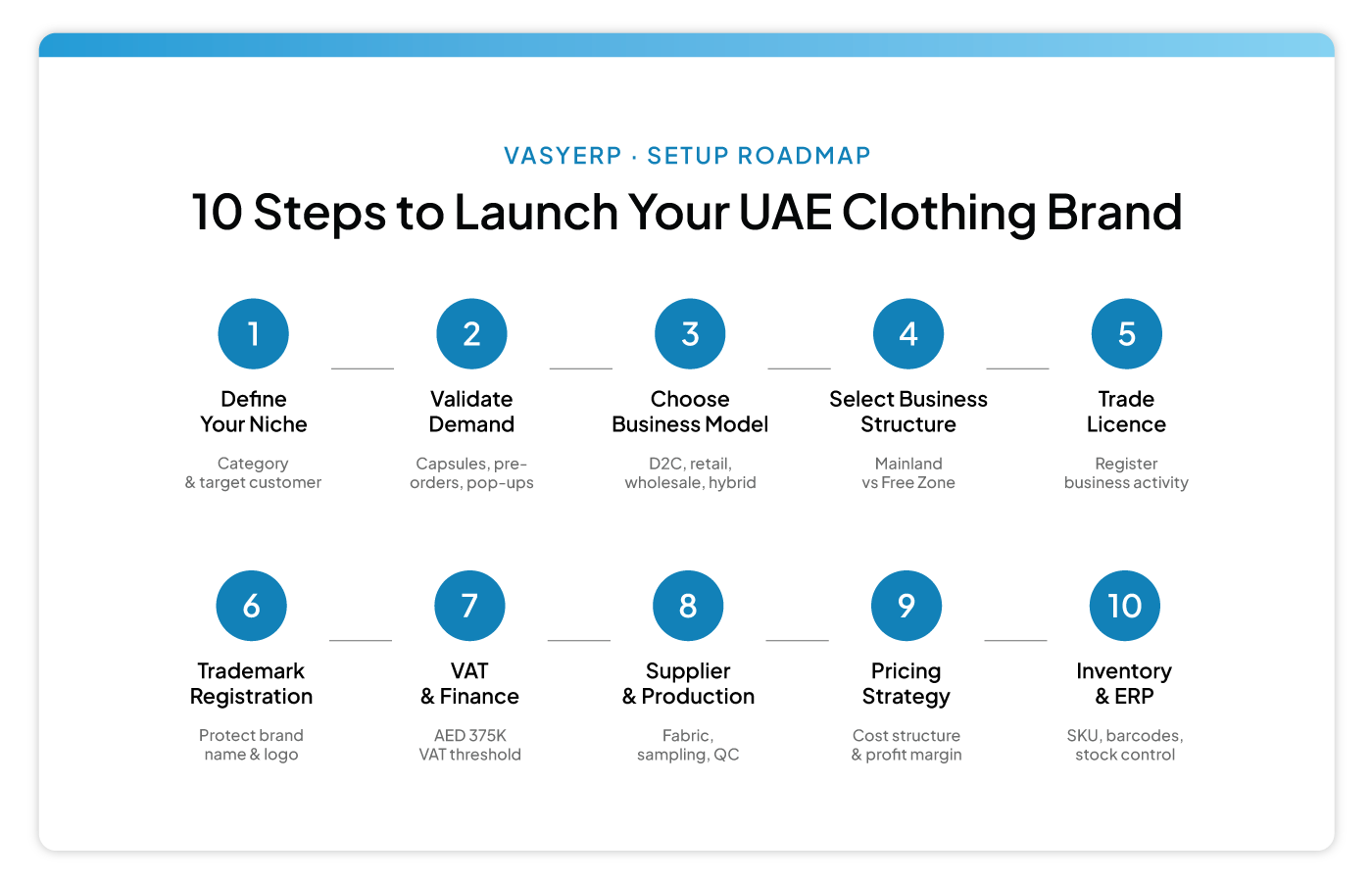
Step-by-Step Guide: How to Start a Clothing Company in the UAE
There are a number of practical steps to complete before a clothing company can begin operating. The following section explains how these stages come together.
1. Define Your Niche and Brand Positioning
Every clothing brand needs a clear identity. Before applying for a licence or placing orders, define:
- Your target customer
- Your price segment
- The category you are focusing on
- The specific design direction of your collection
2. Validate Demand Before Investing in Inventory
Inventory often represents the largest early expense. Testing demand before committing capital reduces financial risk. As part of how to launch a clothing line:
- Release small capsule collections
- Offer pre-orders for selected designs
- Test paid ads with limited stock
- Participate in pop-up retail events
Validation provides insights into preferred sizes, price sensitivity, and design appeal. It also protects working capital during early growth.
3. Choose the Right Business Model
Your selling structure affects licensing, staffing, and overhead. You may choose:
Direct-to-Consumer (D2C)
Selling through your own website and social platforms. This lowers rental costs but requires focused digital marketing.
Retail Store
Operating a physical outlet with in-store billing. This increases fixed costs but strengthens brand presence.
Wholesale
Supplying boutiques or corporate buyers. Margins differ from retail, but order volumes may be larger.
Hybrid Model
Combining online and offline channels.
4. Mainland vs Free Zone: Selecting the Right Structure
Jurisdiction is a core legal decision when planning how to open a clothing line in the UAE.
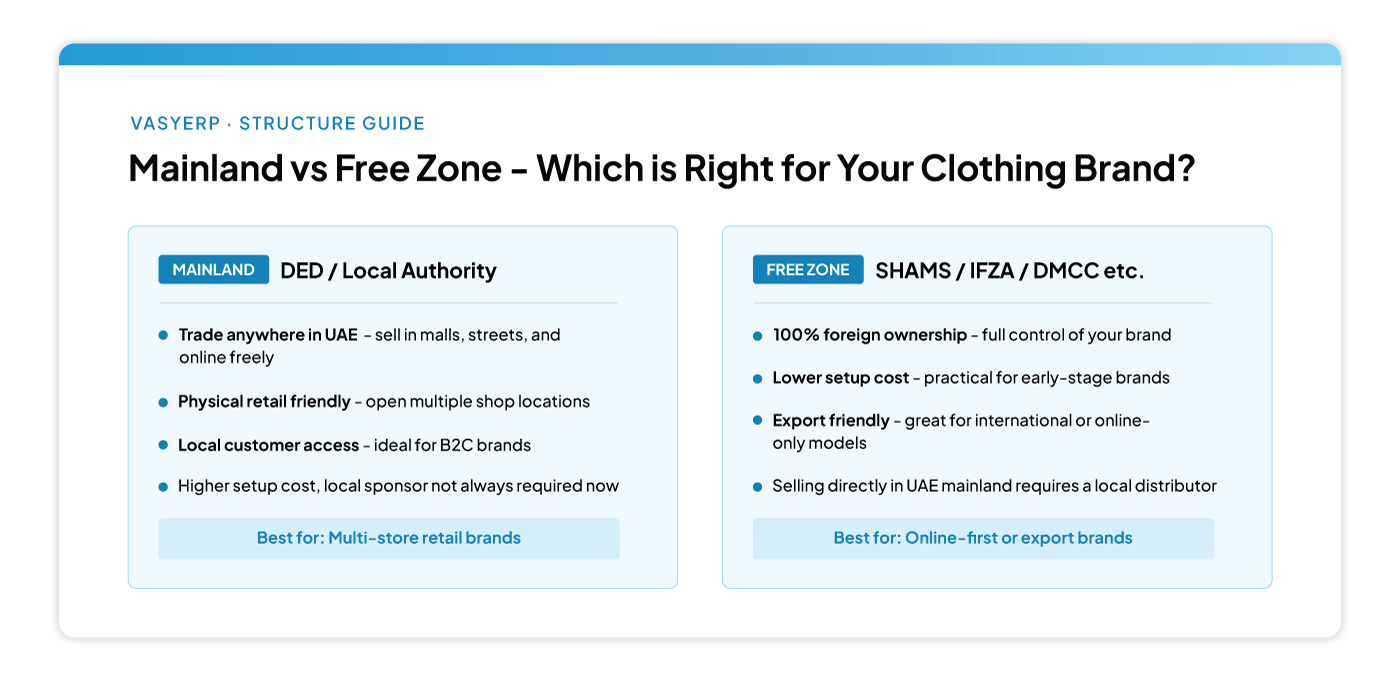
Mainland Setup
- Allows trade across the UAE
- Supports physical retail expansion
- Suitable for multi-location plans
Free Zone Setup
- Common for online-first brands
- Practical for export-focused businesses
- Structured licensing options
5. Trade Licence and Legal Setup
To legally start a branded clothing business, your commercial activity must match your operations. The general process includes:
- Reserving a trade name
- Obtaining initial approval
- Selecting the licensed activity that reflects garments trading or a related category
- Securing operational space, whether an office, storage unit, or shopfront
- Receiving the licence issuance
If importing inventory, complete customs registration early to avoid shipment delays.
6. Trademark Registration for Clothing Brands
Trade name reservation and trademark registration are not the same in the UAE. Trade names are handled through the business registration process, while trademarks are registered through the Ministry of Economy.
Official UAE guidance separates the two, and the Ministry’s online services include trademark application, publication fee payment, registration fee payment, and renewals. For a clothing brand, trademark registration matters because your brand name, logo, and other brand identifiers need legal protection once the business begins trading.
7. VAT Registration and Financial Planning
VAT registration is required after annual taxable supplies cross AED 375,000. Planning finances in advance makes pricing and reporting easier to manage:
- Calculate accurate retail pricing
- Monitor gross margins
- Keep financial documentation accurate
- Be ready in case of audits
8. Supplier Selection and Quality Control
When working with suppliers, define:
- Fabric specifications and GSM
- Stitching quality standards
- Size grading consistency
- Acceptable defect limits
- Packaging guidelines
Sampling should be thorough. Fit and finish determine long-term reputation. Overseas production can reduce cost per unit at scale, while local production offers flexibility and smaller minimum order quantities.
9. Pricing Strategy for Sustainable Growth
Pricing should reflect cost structure and market positioning. A structured framework includes:
- Landed product cost
- Shipping and customs duties
- Payment gateway or marketplace fees
- Marketing expenses
- Operational overhead
- Target gross margin
Underpricing to increase early sales can create long-term margin pressure. Build pricing discipline from the start. If you are importing fabrics or finished garments, customs should be factored into costing from the start. The GCC common customs union applies a 5% customs duty on goods produced outside the GCC, while goods produced within GCC countries are treated as national products and do not carry that customs tax.
For import processing in Dubai, customs documentation commonly includes the commercial invoice, packing list, certificate of origin, airway bill or bill of lading, and permits where applicable.
10. Inventory Management and SKU Structure
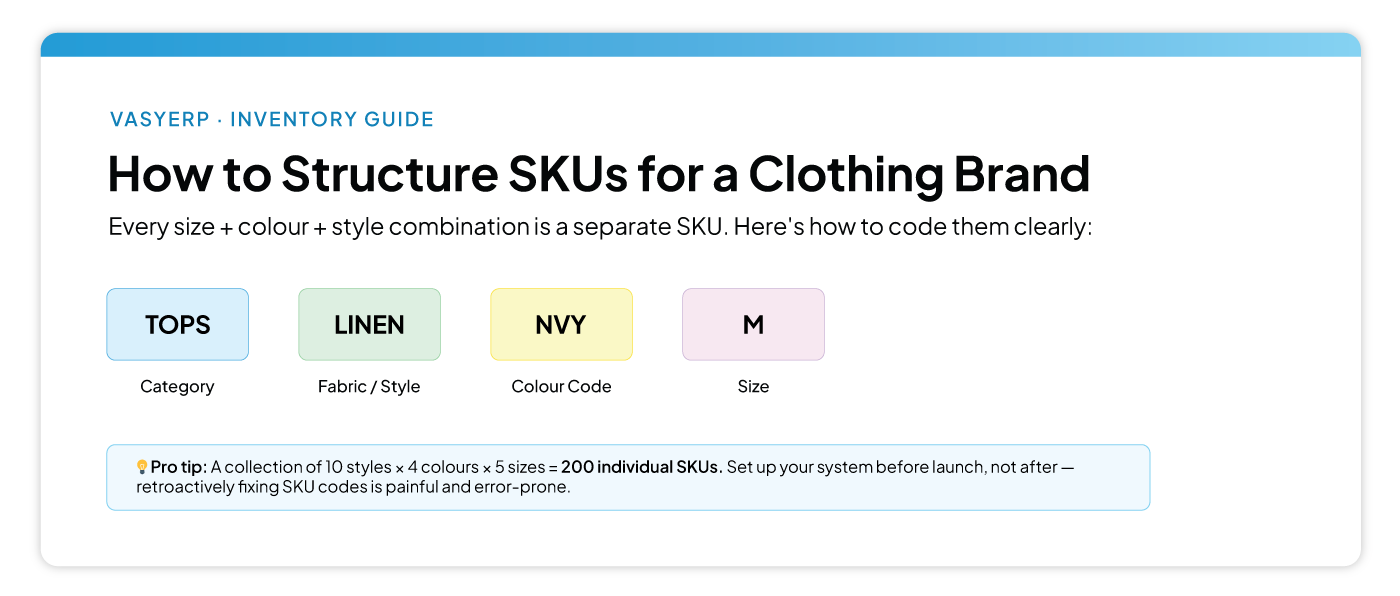
Apparel inventory requires detailed tracking because every size and colour combination is a separate SKU. To properly start clothing business operations, implement the following:
- Clear SKU coding systems
- Barcode labelling
- Goods receipt processes
- Real-time stock monitoring
- Structured return and exchange tracking
Digital Strategy and Growth Planning
Clothing purchases in the UAE are not limited to physical stores. Clothing brands in the UAE increasingly sell through digital platforms alongside physical stores.
Starting with an Online Store
Operating online lowers upfront costs and gives founders room to adjust inventory based on early sales. Key priorities include:
- Mobile-optimised website design
- Fast checkout flow
- Secure payment integration
- Detailed size guides
- Transparent return policies
- Consistent social media engagement
- High-quality photography and clear product descriptions improve conversion rates.
Instagram and TikTok Strategy for the UAE Market
Instagram and TikTok are both worth prioritising for a clothing brand in the UAE. DataReportal’s 2026 UAE report shows large reachable audiences on both platforms in late 2025, 8.05 million and 12.5 million, respectively, making them practical channels for brand discovery and product promotion.
Instagram works well for presenting the brand clearly. It suits lookbooks, new arrivals, styling videos, customer content, and creator collaborations. TikTok is better for reach and fast content testing, especially with try-ons, outfit transitions, behind-the-scenes clips, and trend-led videos. Platform guidance from Instagram and TikTok also reflects these differences in how content performs.
Scaling Beyond Launch
After establishing demand, growth becomes possible through:
- Opening additional retail outlets
- Expanding across GCC markets
- Launching seasonal or limited collections
- Developing wholesale partnerships
- Exploring franchise models
When Retail Software Starts to Matter
In the early stages, some founders manage inventory and billing manually. That usually works only for a small number of SKUs and a single sales channel. Once a clothing brand begins selling across a store, website, pop-up, or multiple locations, stock accuracy becomes harder to maintain.
This is where retail software becomes useful. For clothing businesses, the main value usually comes from:
- barcode-based stock tracking
- faster billing at the point of sale
- centralised inventory across locations
- return and exchange tracking
- clearer purchase and sales reporting
For brands looking at retail software in this stage, VasyERP is one example of a system built around POS, inventory, barcode workflows, multi-store management, and online-store integration.
Operational Planning: Staffing, Store Layout, and Daily Workflow
Operational planning affects margins and customer satisfaction. If launching a store, begin by setting up:
- Trained sales associates
- Standardised billing procedures
- Daily cash reconciliation
- Structured restocking routines
- Store layout should:
- Highlight new arrivals
- Organise sizes clearly
- Maintain clean trial areas
- Display pricing visibly
For online brands, operational focus shifts towards:
- Packaging standards
- Reliable courier partnerships
- Clear dispatch timelines
- Organised return processing
- Daily routines should include:
- Opening and closing stock checks
- Sales performance reviews
- Replenishment planning
- Looking closely at items that are not selling
How to Start a Clothing Business in the UAE: Final Takeaways
Setting up a clothing brand in the UAE involves working through registration, supplier arrangements, pricing, VAT requirements, and operational planning in a structured way. These foundations influence how the business performs once sales begin.
Anyone looking into how to start a clothing brand benefits from setting up a structure early. Clear inventory processes and straightforward financial tracking make growth easier to manage as sales increase.
FAQs
1. Can I enter the UAE clothing market without heavy capital?
A lot of new brands do not begin with a large inventory. They put out a small range first, use online orders or pop-ups to see what gets picked up, and then build from there. It is a simpler way to keep early spending under control and avoid sitting on too much stock.
2. What is the 3-3-3 rule for clothing?
The 3-3-3 rule comes from wardrobe organisation rather than business strategy. It usually refers to building outfits from a limited group of items, such as three tops, three bottoms, and three pairs of shoes. Even though it is a styling concept, the principle can still inspire small capsule-style collections.
3. Is a clothing business profitable in Dubai?
It depends largely on how the business is run. Pricing structure, rent commitments, stock planning, and marketing costs all shape profitability. Brands that avoid heavy overstocking and keep margins visible often manage the business more sustainably.
4. Should I register my trademark before scaling the brand?
Trademark protection should be reviewed early in the process. In the UAE, a reserved trade name does not automatically protect the brand itself. Trademarks are filed through the Ministry of Economy and apply to the name, logo, and other brand identifiers used in the business.
5. Is a mainland or free zone setup better for a clothing brand?
Mainland setup is usually more straightforward for brands that want broader local trading activity, while free zones can suit online-first or export-focused models. The UAE government’s business guidance separates mainland and free-zone pathways for this reason.
- 0
- 0
- 0