Quick Summary:
Struggling with inventory mismatches or fearing a VAT audit? In the UAE’s high-pressure retail market, a basic billing tool isn’t enough. This guide explores how modern, integrated POS systems ensure strict FTA compliance, eliminate stockouts, and provide the real-time connectivity needed to manage multi-store growth across the Emirates.
You will walk away knowing:
-
Regulatory Risk Mitigation: A breakdown of specific FTA penalties and how automated billing protects you from thousand-dirham fines.
-
Operational Intelligence: Insights into how modern systems sync central inventory with branch-level sales in real-time, even during peak seasons like DSF.
-
Customer Retention Strategies: How to leverage integrated CRM and loyalty data at the checkout to meet the high service expectations of UAE shoppers.
-
Digital Transformation Roadmap: Practical answers to common concerns regarding data migration, internet downtime, and transitioning without disrupting daily store hours.
-
Market-Specific Solutions: Understanding features designed for the region, from WhatsApp receipt integration to weight-scale support for grocery operators.
What do end-of-day stock discrepancies, VAT mismatches during monthly filings, and understocked inventory have in common? As a retailer, your first thoughts may go towards human errors or system glitches.
In most cases, the right answer is that your POS system is isolated from your retail operation as a whole. Most retail POS systems are simply billing tools; others add on a few extra tabs and claim to be more.
Modern retail POS software has moved well beyond billing into operational intelligence that was once available only to large chains with dedicated IT teams. This post will break down how these systems work and why you, as a retailer operating in the UAE, should consider upgrading to one.
How Modern POS Systems Vary In Terms Of Daily Operations In Comparison To Legacy POS Systems?
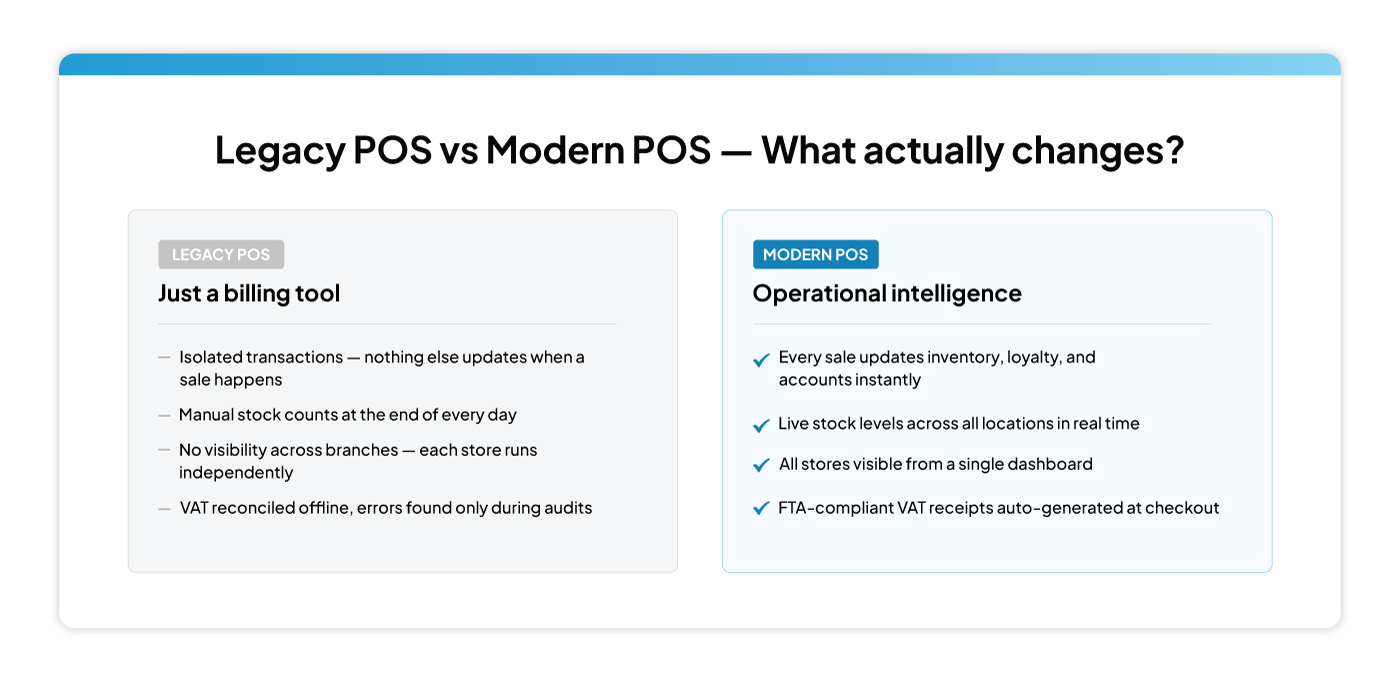
A modern POS system isn’t limited to processing transactions. They integrate each transaction with accounting and inventory management in real time. Since these systems are cloud-based, they can also sync data across all branches of larger operations and provide insights into your entire retail operation from a single centralised window.
Here is how their difference from legacy systems shows up in daily operations:
- A sale at one of your outlets reduces stock in your central inventory, triggers a low-stock alert if needed, and updates the customer’s loyalty balance before the receipt prints.
- A return at another store is processed in under a minute, and the stock is returned to available inventory without manual updates.
- A manager sitting at your HQ can see exactly which products are moving at your Dubai Mall outlet without leaving their desk.
If you are running more than one store or planning to, this level of connectivity should be the foundation on which your retail operation runs.
Why Consider A POS System If You Are Based In The UAE?
Now to the question of why they make sense specifically for you, the UAE-based retailer. The UAE sees, on average, a 23% increase in year-on-year retail sales. This is due to the region establishing its global image as a shopping destination.
Then you have the local spikes in the form of pre-Ramadan, Ramadan, and back-to-school sales, to name a few. These scenarios create specific operational pressures that do not exist at the same intensity elsewhere. Then there are the following issues to contend with:
Strict VAT Compliance
Since the Federal Tax Authority introduced VAT in 2018, every retail transaction is subject to compliance obligations. If you do not comply with the given obligations, the penalties are:
- Failure to issue a VAT-compliant invoice: AED 5,000 for each missing invoice
- Submitting incorrect VAT returns: AED 1,000 for the first offense; AED 2,000 for the next.
- Failure to maintain proper VAT records: AED 10,000 (up to AED 50,000 for repeat violations)
Considering retailers process hundreds of daily transactions, without a proper POS system, you will miss these violations until they are found during an audit.
The Nature Of UAE Shoppers
There is a change in consumer expectations and their behaviour. On the expectations front, nearly half expect personalised shopping when in-store and same-day deliveries.
A 2024 PwC report also found that 55% of UAE consumers regularly shop across both online and offline channels. Many customers check your website for stock before walking into your store.
If your online and physical inventory are not drawn from the same pool, customers arrive to find products that are not there. That does not just lose a sale. It loses the next ten. The “This product will be back in stock in a day or two” line (even if genuine) just doesn’t work anymore.
For retailers operating in, or considering expanding across, the UAE, relying on basic software will no longer cut the mustard today.
How Will A Modern POS System Change Your Retail Operation?
A modern POS system specifically designed for retail operations will go beyond basic billing and aid with business management. Here’s how:
1. Real-Time Inventory Tracking
Every sale, return, and stock transfer updates your inventory in real time. If you have a multi-branch operation, you can initiate a transfer from another location before the shelf goes empty. This level of control will eliminate stockouts and overstocking, no matter how many SKUs you handle.
2. VAT-Compliant Billing
The system will generate FTA-compliant VAT receipts and calculate VAT for each product category. A capability that can save you thousands lost in potential penalties.
3. Multi-Store Management from One Dashboard
You will be able to view sales, stock levels, and staff performance across all your locations from a single screen in real time. If one store loses internet connectivity, it will sync as soon as it reconnects to the network.
4. CRM And Loyalty Integration
A modern POS will also turn your checkout counter into a customer retention tool with purchase history, loyalty points, and eligible promotions visible to your staff at the checkout screen.
5. Reporting and Business Analytics
Perhaps the most important benefit would be access to instant reports and business analytics that will help you make smarter decisions to scale your operations faster.
How VasyERP Approaches POS for UAE Retail?
VasyERP‘s POS system is built around the operational realities of UAE retail rather than being a generic product adapted for the market.
- The infrastructure runs on Microsoft Azure, which handles transaction loads during high-traffic periods, such as the Dubai Shopping Festival (DSF), without disruption.
- Inventory operates through a central structure, providing location-level visibility across all branches from a single dashboard.
- VAT-compliant receipts are generated automatically and sent to customers via WhatsApp or SMS at the point of sale.
- For grocery and supermarket operators, weight scale integration, barcode scanning, and expiry date tracking are built into the core system.
- An inbuilt CRM gives you access to all customer information at the checkout page. You can also launch bulk WhatsApp promotions based on individual customer behaviour.
Your Billing Counter Is The Last Place You Want To Lose
Every part of your retail operation, your buying decisions, your staff, your store’s layout, and your marketing exists to get a customer to the checkout counter. A POS system that cannot keep up with your business needs does not just slow things down; it quietly undoes everything that came before it.
As a retailer in the UAE, you should not continue with such operational lag, keeping in mind your customers, the strict compliance regulations, and, more importantly, your bottom line.
The good news is that switching to a modern POS system is far less disruptive than you think. If you want to see how a POS system built specifically for UAE-based retail operations operates in practice, book a live demo with VasyERP. It’s a mere 30-minute conversation that costs you nothing and shows you everything.
FAQs
1. Will switching to a new POS system disrupt my daily store operations?
A well-planned POS migration does not require shutting down your store. Onboarding can be phased, and with proper setup and staff training, the switch can be made without disrupting your daily operations.
2. What happens to my existing sales data and customer records when I switch systems?
Any reputable POS provider will migrate your existing data before you go live. You should ask any vendor you evaluate to walk you through their data migration process. Focus specifically on how they will handle data from your current system’s format, and whether there is a parallel running period where both systems operate before full cutover.
3. Is a cloud-based POS system right for a small retail business in the UAE?
A cloud-based system is perfect for a small retail business. The transition to one is relatively quick, you don’t have to invest in any server hardware and its maintenance. If you plan to scale, the same system grows with your operations.
4. What happens to my POS system if the internet goes down during a busy period?
If a system is equipped with an offline mode, as VasyERP is, it will continue to function as normal. Once connectivity is restored, all the data syncs automatically.
5. How do I know if my current POS system needs to be replaced?
If your current system is:
- Struggling to keep up during rush hour.
- Causing stock mismatches.
- Requires manual intervention of any kind.
- Does not do much to improve your customers’ experience
You most likely need to upgrade your POS system.

- 0
- 0
- 0