Quick Summary:
Trying to manage store sales, online orders, and customer information across separate systems? This guide explains what omnichannel retail means, why retail businesses pay attention to it, and what helps make the customer journey feel connected across channels.
You will walk away learning:
- Signs that separate systems are starting to slow down sales and service
- What this means inside a retail business
- How to connect stock, customer records, and selling channels in a way that stays easy to manage
Customers do not always buy through one channel from start to finish. This is one reason Middle Eastern retailers are paying more attention to omnichannel retail. A customer may first see a product on Instagram, look it up on the website, send a question on one of their channels, and then buy it in-store.
This shopping behaviour creates pressure for retailers in the UAE. When stock, pricing, orders, and customer records are handled in separate systems, the experience becomes less convenient for customers and more difficult for businesses to manage.
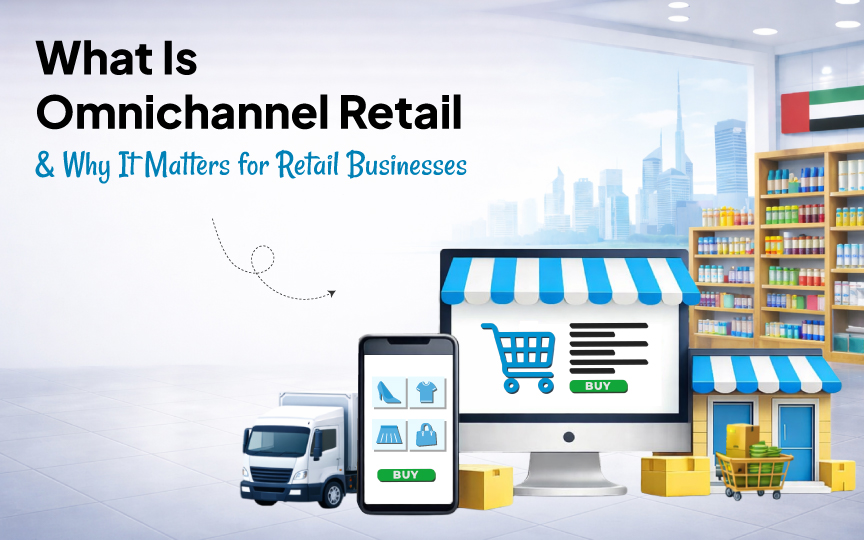
What Is Omnichannel Retail
Omnichannel retail is a retail model where all customer touchpoints are connected. These touchpoints can include:
- Physical stores
- E-commerce websites
- Mobile apps
- Online marketplaces
- Social media
- Messaging channels
- Customer support
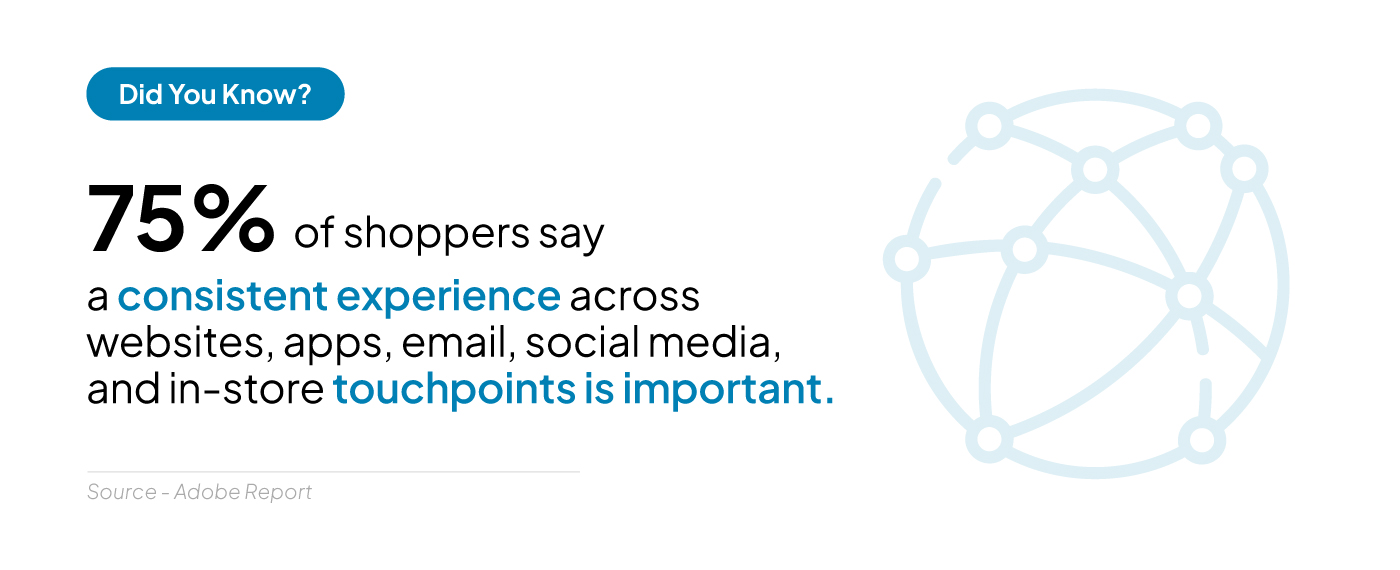
A shopper in the UAE should see the same stock details across online and in-store channels. They should not lose access to the same offer just because they changed channels. They should also not have to explain the same issue again when asking for help.
Take a simple example. Someone finds a product on the website, checks if a nearby branch has it, visits the store to see it properly, and then asks for home delivery because the right size is out of stock there. If the business is set up well, that whole process works without friction.
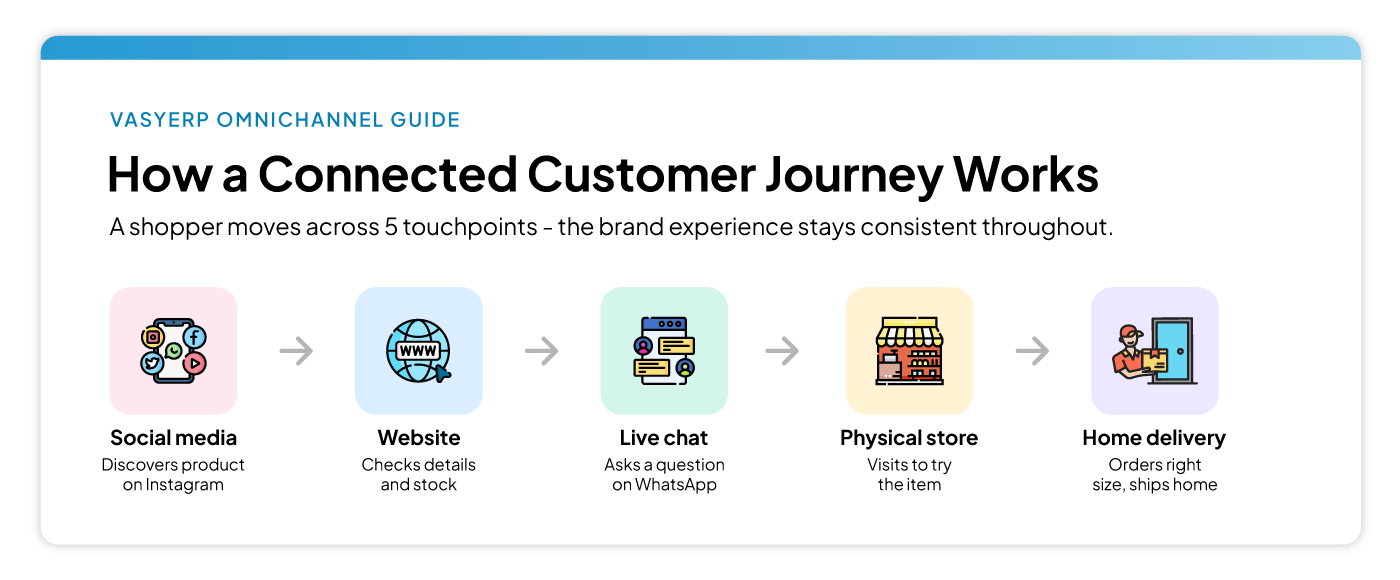
That is what omnichannel retail means: the store, website, inventory, and customer service are tied into the same setup rather than run separately. Many retailers refer to this as unified commerce, where sales, stock, customer data, and fulfilment are managed in a single, connected setup, rather than across separate tools.
For retailers in the UAE trying to build that kind of setup, the real requirement is keeping sales, stock, and customer information connected. This is also the kind of retail model VasyERP is built to support, with online and offline sales linked through shared inventory, POS, and customer data.
Omnichannel vs Multichannel Retail
Many retailers already sell through multiple channels. That does not automatically make them omnichannel.
In a multichannel setup, a business may have a store, website, and marketplace presence, but each channel often runs on its own. Inventory may be tracked separately. Promotions may differ. Customer records may not carry across channels.
A simple comparison looks like this:
- Multichannel retail is selling through several channels
- Omnichannel retail is making those channels work together for the customer
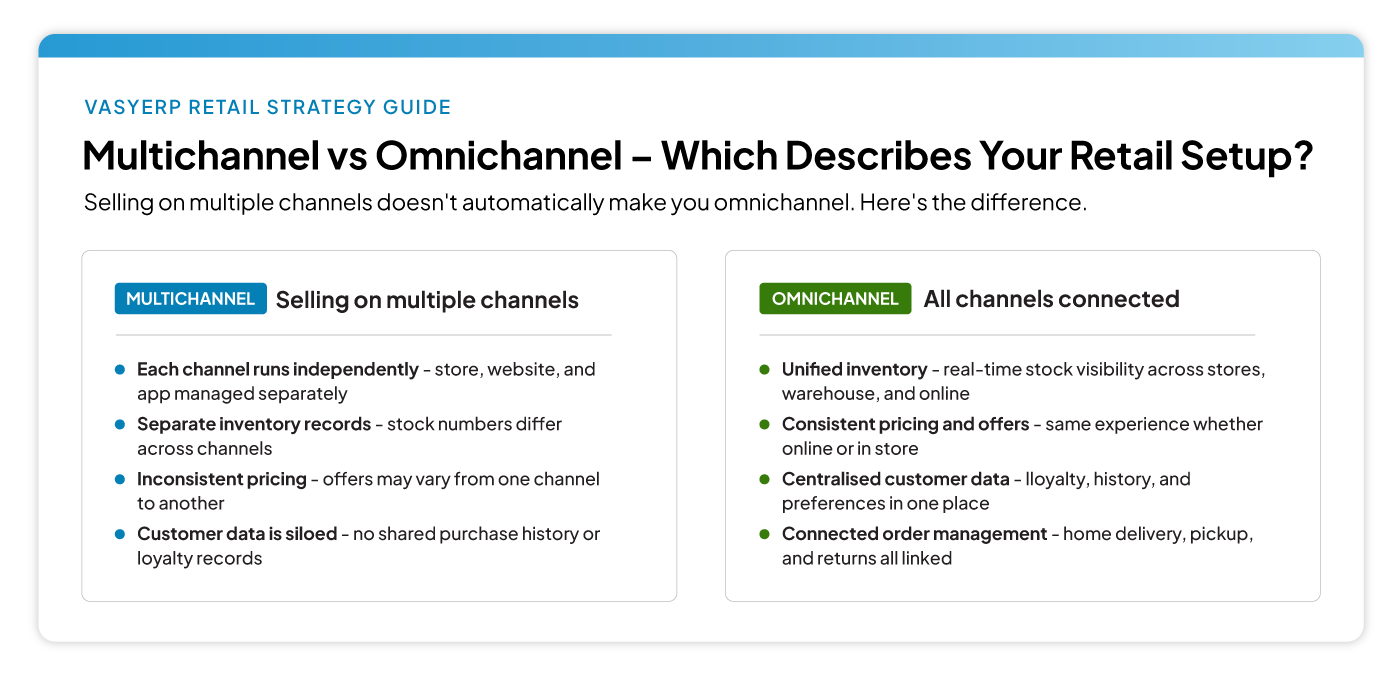
One common example is pricing. A customer may see one price online and another when they get to the store. They may need to repeat order details to support staff. Returns and exchanges can also become harder to manage.
In an omnichannel setup, the customer experiences a unified brand. The channel may change, but the journey stays connected.
Why Omnichannel Retail Matters for Retail Businesses in the UAE
Retail customers in the UAE do not think about channels. They think about convenience. They expect the brand to work properly whether they shop in-store, on a phone, or on a website. Omnichannel retail helps businesses support the way people already shop.
Stores are still doing a lot of the work, but digital channels are firmly part of the picture too. PwC found that shopping habits have stayed fairly stable since 2022, with about 42% preferring to shop in-store, 34% using smartphones, and 23% using PCs. That tells retailers one thing clearly: customers are still spread across different buying channels.
The UAE shows both sides of modern retail clearly. Dubai Mall had 57 million visitors in the first half of 2024. The UAE’s e-commerce market was AED 27.5 billion in 2023 and is projected to reach more than AED 48.8 billion by 2028.
The UAE is also highly connected online. In early 2025, internet penetration was 99%, and social media user identities were equal to 100% of the population. A purchase may start on Instagram, continue with a question on WhatsApp, and end in the store.
Omnichannel retail helps businesses:
- Lower the chances of losing a sale because stock and fulfilment are out of sync
- Make the overall shopping experience easier to deal with
- Help turn one-time buyers into repeat customers
- Create a better base for growth across stores and online channels
Benefits of Omnichannel Retail
The benefits of omnichannel retail show up in customer experience and in daily operations. When channels are connected, retailers have better visibility, and customers face fewer problems while shopping.
1) Better Customer Experience
A smooth retail experience depends on things working familiarly across channels. Customers should be able to shop, collect orders, make returns, or contact support without having to work everything out again each time.
2) Stronger Inventory Visibility
A shared stock system gives retailers a clearer picture of what is available across stores, warehouses, and online channels. This helps cut down on stock problems and fulfilment issues.
3) More Chances to Capture Sales
If a product is unavailable in one location, another channel can still save the sale. A store can place an order for home delivery. A website can guide the customer to a nearby branch.
4) Better Loyalty and Retention
A connected system makes it easier to manage purchase history, loyalty programmes, and personalised offers. Customers are more likely to return when the shopping experience feels simple.
5) Smoother Operations
Retail teams spend less time dealing with duplicate records, stock mismatches, and manual follow-ups. This reduces avoidable errors and helps teams work faster.
6) More Useful Business Insight
When store and online data sit in one place, retailers get a clearer view of product demand, customer behaviour, and channel performance.
Key Elements of a Successful Omnichannel Retail Strategy
A good omnichannel retail strategy depends on the systems and processes behind the customer journey. The most useful foundations usually include the following.
1) Unified Inventory
Stock visibility needs to be accurate across stores, warehouses, and online channels. If it is not, customers can end up looking at unavailable products or miss stock that exists in another location.
2) Centralised Customer Data
Customer information should not be scattered. When purchase history, loyalty records, communication preferences, and support interactions sit in one place, staff can respond with better context.
3) Consistent Pricing and Promotions
Retailers need clearer control over pricing, discounts, and offers across channels. Customers should not feel confused by major differences unless those differences are intentional.
4) Connected Order Management
Orders should move smoothly between channels. This includes:
- Home delivery
- Click and collect
- Buy online, pick up in store (BOPIS)
- Inter-branch fulfilment
- Returns
- Exchanges
- Integrated Customer Support
Problems take longer to fix when store teams and support staff are working with different information. They need access to the same order and customer details, so they can deal with issues without repeated follow-up. The wider setup matters too. POS, e-commerce, CRM, inventory, and fulfilment need to be connected in a way that does not create extra manual work.
VasyERP supports that by bringing POS, inventory, CRM, and e-commerce operations together in one setup. That makes omnichannel retail simpler to manage in practice.
5) Cross-Channel Reporting
Retailers need one clear view instead of piecing things together from different places. Sales, stock movement, customer patterns, and operational results make more sense when they can be read together. That makes it easier to spot issues early and respond properly.
Omnichannel Retail Examples
It helps to picture a few simple retail situations.
A fashion retailer in the UAE may let a customer look through products online, check stock at a nearby branch, reserve a size, visit the store to try it on, and then place an order later using the same loyalty account.
Similarly, a grocery business may take orders through an app, offer in-store pickup, and apply the same rewards and offers a customer would get at the till.
An electronics retailer may let someone look at products online, speak to the business on chat, visit a store to inspect the item, and then have the order shipped from a warehouse.
These examples all show a similar pattern:
- The customer moves between channels with less friction
- The retailer keeps inventory and order details connected
- The brand experience stays consistent across the journey
That is what makes omnichannel retail practical for everyday retail operations in the UAE.
How Retailers in the UAE Can Implement an Omnichannel Retail Strategy
Retailers in the UAE do not have to change everything in one go. It usually makes more sense to look at where the current setup is breaking down first, then sort those problems step by step.
Common issues often include:
- Stock not matching between stores and online channels
- Prices or offers vary from one channel to another
- Manual order handling
- Separate customer or loyalty records
- Limited visibility between branches, warehouses, and e-commerce operations
Once these gaps are clear, retailers can decide which systems need attention first.
1) Start With Inventory
Most omnichannel problems become harder to solve when stock data is unreliable. Accurate, centralised inventory gives retailers a stronger base for fulfilment and customer service.
2) Connect Sales and Fulfilment
Retailers should decide how orders will be routed, how returns will be managed, and how options such as ‘buy online, pick up in store’ or ‘buy in store, deliver to home’ will work in practice.
3) Bring Customer Data Together
Loyalty, purchase history, and communication records should support one connected experience. If this information sits in separate tools, the service becomes slower and less consistent.
4) Train Teams Alongside the Technology
Store teams, warehouse teams, and support teams all need to know how the process works. Even a good system causes issues when different teams handle it differently.
Final Thoughts on Omnichannel Retail
Omnichannel retail helps customers in the UAE get what they want the most: flexibility. They want to browse, buy, pay, collect, and return products in the way that suits them, without running into disconnected systems at each step.
Retailers feel the difference when channels are not connected. Stock gets harder to track, service slows down, and the customer journey becomes more awkward than it needs to be.
The opposite is also true. When inventory, customer information, fulfilment, and support are aligned, the business is easier to manage and better equipped to handle growth.

- 0
- 0
- 0