Quick Summary:
Tired of losing customers to shipping delays or out-of-stock items? This guide explains what an Order Management System (OMS) actually is, how it syncs your sales channels, and how to choose a solution that ensures you never miss an order again.
You'll walk away knowing:
- Whether your current order process is holding your business back
- How an OMS connects your sales, inventory, and shipping (in plain English)
- The key differences between a standalone OMS and a full ERP system
What is an Order Management System (OMS)?
Simply put, an order management system is a software solution that helps businesses track, manage, and in some cases, automate certain stages of an order’s lifecycle. They are particularly suited for businesses that operate multiple sales channels simultaneously and are struggling to manage them. They help solve specific problems that may sound familiar to you as a business owner, such as:- Orders falling through the cracks.
- Orders accepted against stocks that don’t exist.
- Invoices raised with mismatched information.
- Being unable to track where an order is when a customer asks for an update.
How Does an Order Management Solution Work?
An order management system works as a central hub that connects to every point of an order’s journey. Here is how it plays out in practice.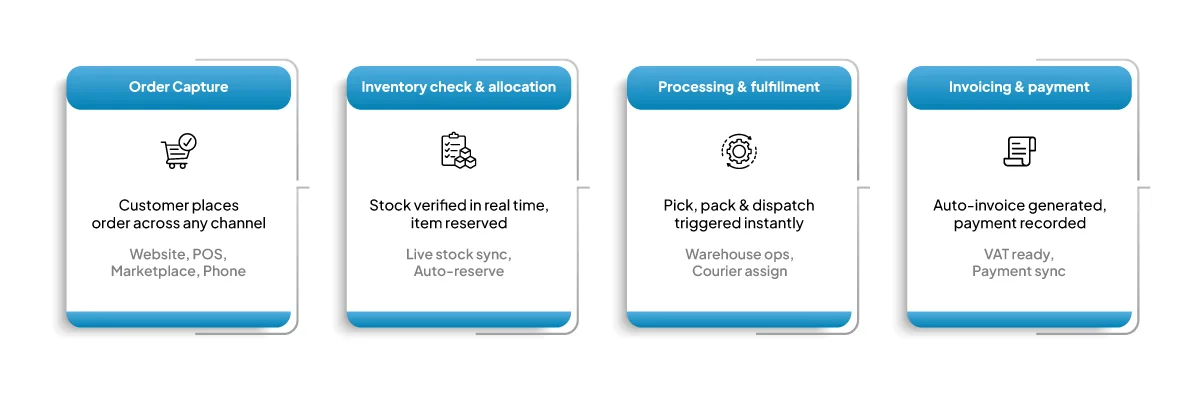
1. Order Capture Across Sales Channels
The moment an order comes in, be it from:- Your Retail POS system.
- Your e-commerce website.
- Any other marketing platforms or
- Through sales channels
2. Inventory Availability or Allocation
Once the order enters the workflow, the OMS then verifies the following:- Is the item in stock?
- Which of the warehouses holds it? (in case of multiple)
Pro Tip If an item is out of stock, the system won't allow orders to be placed against it. If set up, some OMS can also initiate restocking workflows or send out notifications when stocks run low.
3. Order Processing & Fulfilment
The moment a stock is allocated to a shipment, the system then initiates steps to process and fulfill the order. These include:- Generating the picklists.
- Assigning the same to the warehouse staff
- Once packed, schedule the shipment.
4. Invoicing, Payments, and Documentation
Once a product is ready for dispatch, the system triggers the final step in the workflow, like documentation, where the system automatically generates the following:- The sales orders
- Invoices
- Delivery instructions, if any.
What Are the Key Features of a Modern Order Management System in South Africa?
Order management solutions in South Africa come with several features specifically designed to streamline the order fulfillment process. The list includes: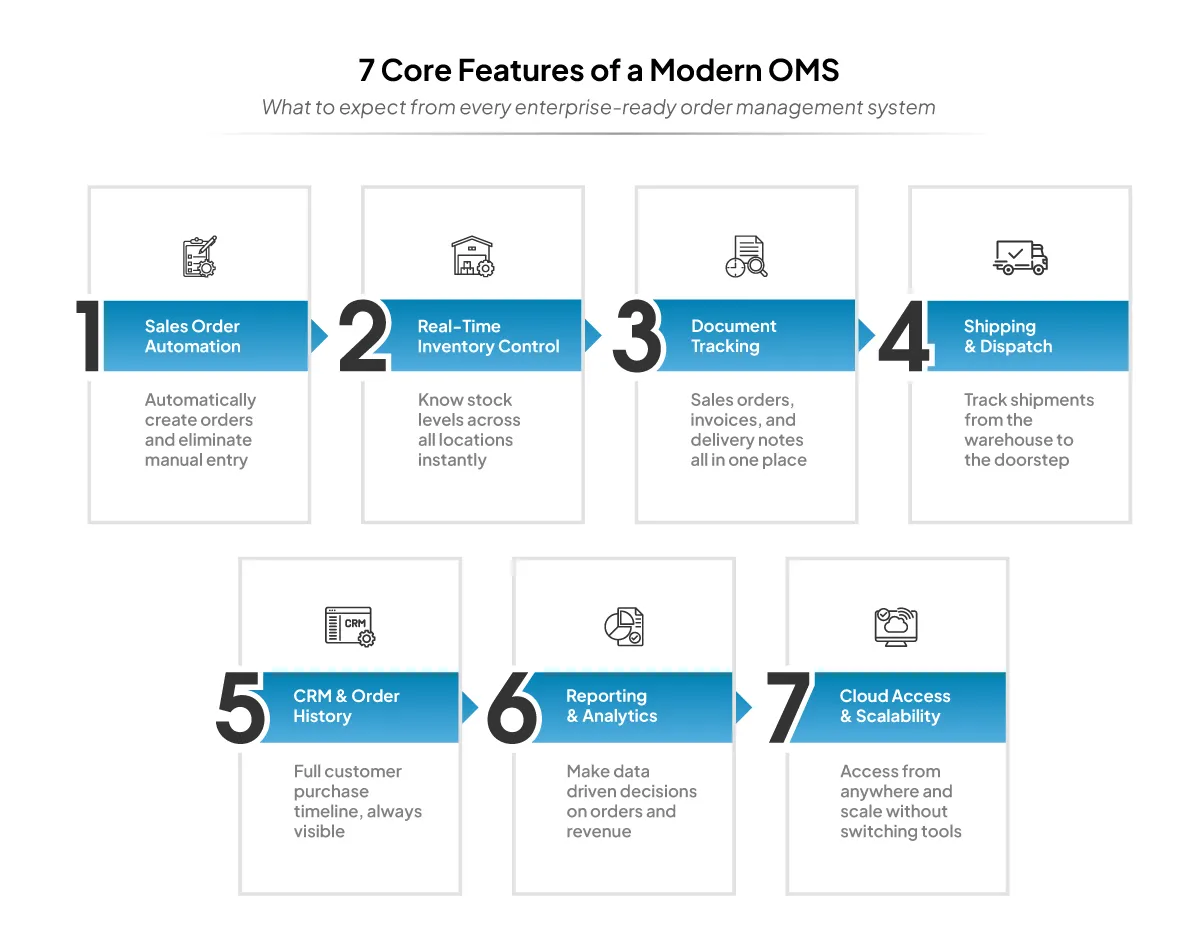
1. Sales Order Automation
Sales Order Automation is one of the primary reasons growing businesses in South Africa decide to go for an OMS. This feature automates the intake of orders across multiple channels, thereby eliminating the delays and errors that naturally creep in with manual data entry.2. Real-Time Inventory Control
Real-time inventory management is a core feature of an Order Management system. It updates stock levels every time an order is bought in-store, or when it is placed, and stock is allocated toward it, or when an order is returned, regardless of the sales channel.3. Document Tracking
An order management solution creates and manages all essential documentation (sales orders, invoices, and delivery notes) essential to order fulfillment. All the data are for the same and are updated in real time and pulled from the same source. As a result, the documents are accurate and help teams quickly locate order records if and when needed.4. Shipping and Dispatch Management
Shipping and dispatch management is another key sub-module of an order management system that handles order dispatches, carrier assignments, and shipment tracking. All relevant information is updated in real time so that your internal teams and customers know where things stand.5. CRM and Customer Order History
This feature of an OMS lets South African sales teams access order history, payment status, and delivery records from a single system. The same comes in extremely handy on the customer service side of operations and helps speed up resolutions.6. Reporting and Order Analytics
An OMS also provides reporting tools that can show reports on key parameters of the process. All of which can aid in identifying areas of improvement in the workflows and improving operational SOPs accordingly.7. Cloud-based Access and Scalability
Modern South African OMSs are also cloud-based, which means your teams in the office, at the warehouse, at the store, or when out on delivery can access the same system. Cloud-based systems are also scalable, which means you can add new operations or locations to your business without having to rebuild the system.Order Management Systems vs ERPs: What’s the Difference?
An Order Management System is designed to do exactly what it says: manage orders. Nothing more, nothing less. An ERP, on the other hand, is a solution with a much wider scope in the context of business operations.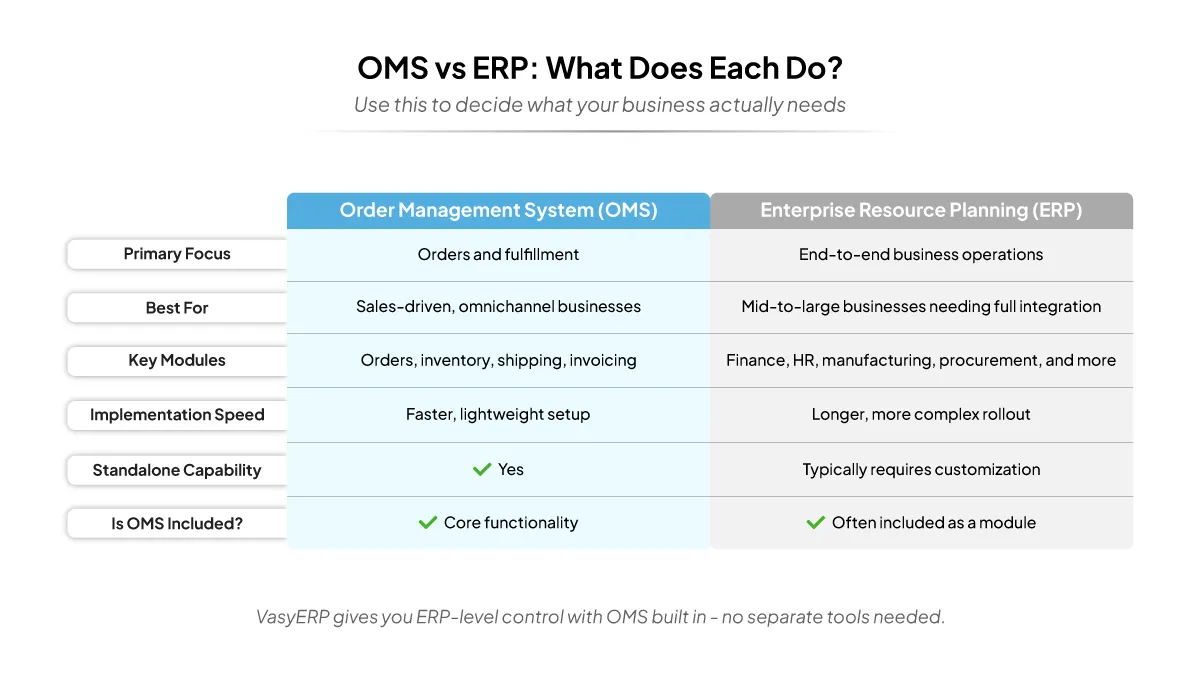 It includes an Order Management System module, but along with it also has built-in modules for finance, accounting, procurement, and manufacturing. In short, an order management system operates as part of a larger ERP platform.
As to the question of which one you should opt for? The answer comes down to your primary pain point. If it’s only your order management pipeline that is holding your growth back, you are good with an OMS.
But, if it’s every aspect of your business operation that is suffering due to the issues that arise from disconnected systems, then an ERP is what you need.
It includes an Order Management System module, but along with it also has built-in modules for finance, accounting, procurement, and manufacturing. In short, an order management system operates as part of a larger ERP platform.
As to the question of which one you should opt for? The answer comes down to your primary pain point. If it’s only your order management pipeline that is holding your growth back, you are good with an OMS.
But, if it’s every aspect of your business operation that is suffering due to the issues that arise from disconnected systems, then an ERP is what you need.
Industry Use Cases That Can and Do Benefit From an Order Management System?
Different industries rely on Order Management Systems in different ways.1. Retail Businesses
Retail businesses in South Africa, especially those that operate either via in-store and online channels or those with multiple outlets, require an OMS. Having one ensures that all channels operate from the same inventory pool and have a smoother order fulfillment process.2. E-Commerce and Omni-Channel Sellers
E-commerce businesses often sell across several platforms to maximise reach and hence revenue. Their main pain point without an OMS is a synchronised inventory. With an OMS, the system allocates and updates the inventory so that orders go out effectively regardless of the platform.3. Wholesale and Distribution
Wholesale and distribution companies in South Africa deal in volumes that are cumbersome to track manually. With an OMS in place, these businesses can track orders, allocate inventory, and coordinate dispatches from the nearest warehouses with ease.4. Manufacturing Businesses
Unlike the above examples, South African manufacturers have to coordinate orders with their production cycles as they need to take into account the procurement of raw materials and lead times. An order management system connects the sales order to production scheduling, so your team is not promising delivery dates they cannot keep.Quick Fact 6The global market size of the OMS sector was USD 2.3 billion in 2025 and is expected to grow at a CAGR of 12.1% from 2025 through to 2034.
Source:Custom Market Insights
How to Choose the Right Order Management Solution for Your Business in South Africa?
The decision on which order management solution for your business is best for your business should depend on the answers to the following questions:1. Is the OMS designed for my industry and the size of my business?
A generic Order Management System or one built specifically for e-commerce may not have the features or workflows that a manufacturing unit may rely on. For example, if you are a retail business, you will most likely need POS integration. A manufacturing business, on the other hand, does not need one but instead would need an OMS that can handle production and delivery logistics. Go with a solution that can handle orders the way your industry and business require it.2. Is the system designed for localised operation?
In South Africa, businesses have to pay VAT as per the South African Revenue Service (SARS). A generic OMS may not be calibrated to calculate VAT and generate invoices compliant with SARS’s requirements: a simple detail that can lead to hefty fines down the line. Check if the system has built-in workflows to account for this.3. Is the Solution User-friendly?
An order management solution with a steep learning curve will not help streamline your order fulfillment woes. Look for a system that your teams can adopt quickly without the need for extensive training. Ask for a live demonstration using your own order scenarios to assess how intuitive the system actually is for the people who will use it.4. Does the Order Management Solution Integrate Well With Your Existing Systems?
The system you consider should be able to integrate with your existing tools easily. If the proposed integration plan leans heavily on workarounds or third-party connectors, you are most likely adding complexity to the process.5. Is the System Scalable?
The system you are considering should be able to scale with your business without the need for a major overhaul. Gain clarity on how the vendor handles new locations, additional users, and new channel integrations, and at what cost.6. Does the Cost Justify the System’s Long-term Value?
Just because a system costs less upfront doesn’t mean it’s the right option. The main question you should ask here is whether the system in question (even if it costs more) can pay for itself with the efficiency it brings to your business.How VasyERP Simplifies Order Management in South Africa
Effective order management doesn’t just mean processing orders faster. It’s about eliminating the efficiency gaps across your entire process, which, when left unaddressed, can cost your business customers and impact profit margins.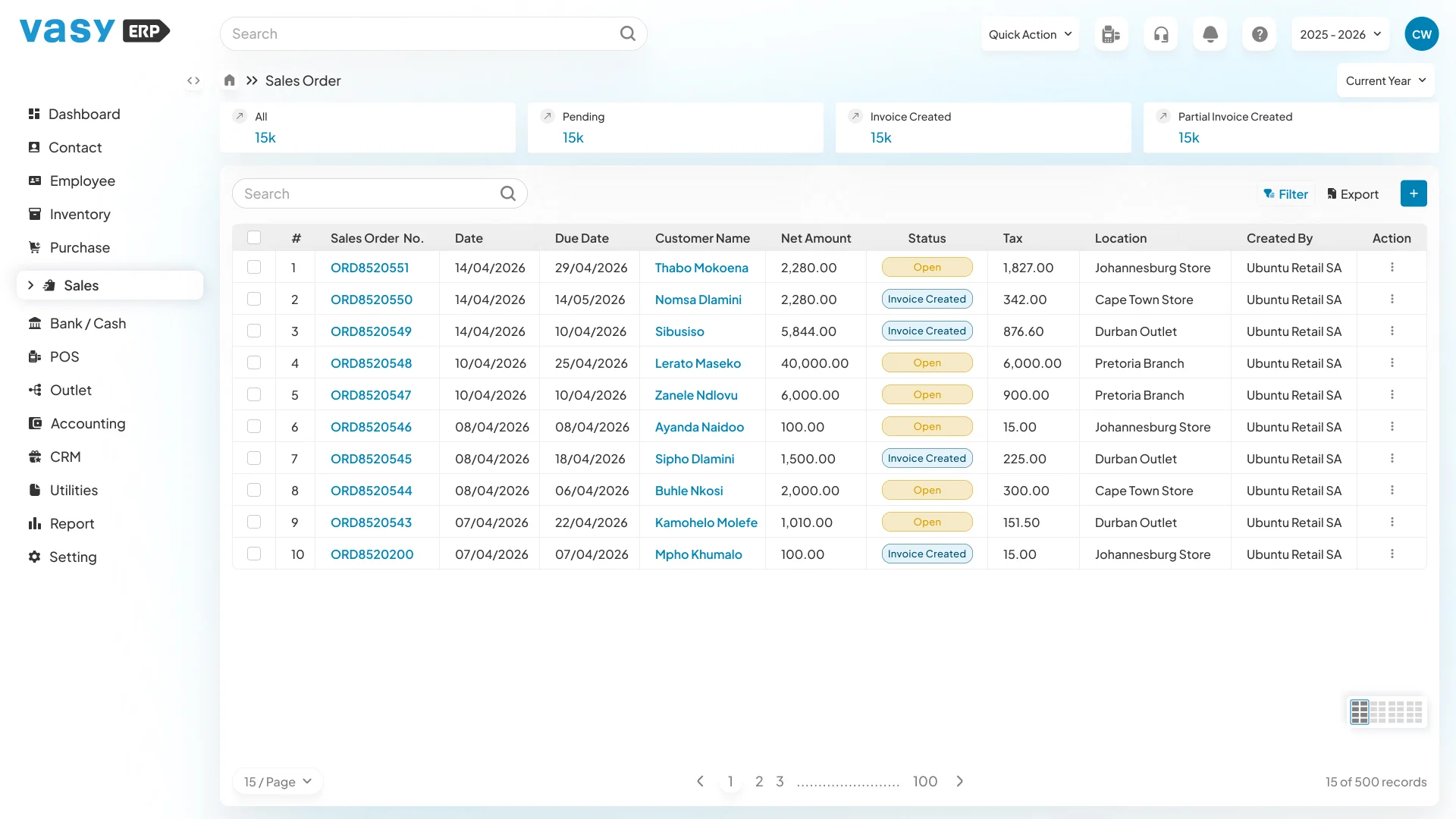 VasyERP addresses this by connecting order management directly to inventory, finance, CRM, and POS within a single platform. Every order that comes in, no matter the channel, goes into the same fulfilment workflow.
As VasyERP’s order management module sits inside the same platform as inventory, finance, CRM, and POS, it leaves no gaps, and all your teams work off of the same live data.
Book a short 30-minute demo with us to see how VasyERP can improve your order management operation
VasyERP addresses this by connecting order management directly to inventory, finance, CRM, and POS within a single platform. Every order that comes in, no matter the channel, goes into the same fulfilment workflow.
As VasyERP’s order management module sits inside the same platform as inventory, finance, CRM, and POS, it leaves no gaps, and all your teams work off of the same live data.
Book a short 30-minute demo with us to see how VasyERP can improve your order management operation
Frequently Asked Questions
It may be enough on an individual level, but it does not ensure that everything will be synced up in real-time. For instance, if you have a multi-channel store, an OMS will be helpful in order not to make any mistakes such as overselling something.
It is recommended to consider introducing an OMS once you experience any challenges related to an increase in order number, sell on several channels, and face delays, stock mismatches, or dissatisfied customers due to manual tracking.
In most cases, no. However, if you choose a quality solution such as VasyERP, it would integrate with those systems or even combine them all together (for example, an ERP platform).
It may take some effort in case of switching from manual methods to automated solutions, but nowadays it is rather easy with cloud-based OMS systems such as VasyERP.
OMS solutions operating in the cloud need internet connectivity. Some hybrid POS systems, such as VasyERP, can work offline to capture orders that are synced when the internet service resumes.
Last Updated on May 12, 2026