Quick Summary:
Not sure why your cash position feels tight even when sales look healthy on paper? This guide explains what a cash flow statement is, why it often gives a clearer picture than profit alone, and how to read it in a simple, practical way.
You'll walk away knowing:
- The signs that your business has outgrown basic cash tracking and disconnected spreadsheets
- What a cash flow statement shows in day-to-day business terms.
- How to read cash movement across operations, investments, and financing without getting lost in accounting terms
- The benefits they offer to your business.
A business can appear profitable in its accounts and still struggle with cash. Customer payments may not have come in yet, stock may be using up funds, or fixed obligations may be due soon. A cash flow statement makes that difference easier to understand by showing the actual movement of cash during the period.
It is a practical report for daily business decisions. It helps owners track how cash moves through the business, spot areas where pressure may be rising, and see how well operations are covering regular costs and future requirements.
This helps with planning for working capital and gives the business a better chance to respond before cash becomes a problem.
What is a Cash Flow Statement?
A cash flow statement is a financial statement that captures cash and cash equivalent movements over a set period. It shows the sources of cash, the uses of cash, and the change in the closing cash balance.
A cash flow statement is the report that tracks actual cash movement, not just sales recorded or expenses booked. This is important because revenue can be recorded before money is received, and expenses can appear before they are paid this is how debits and credits work under accrual accounting.
What is the Purpose of a Cash Flow Statement in South African Businesses?
A cash flow statement in South Africa is used to show if a business is bringing in enough cash to manage daily operations, invest in assets, and meet financing obligations.
It gives business owners, accountants, lenders, and investors a more direct picture of the business’s cash position. Used regularly, a cash flow statement can help track:
- Ability to cover payments
- Pressure on working capital
- Readiness for expansion
- Reliance on outside funding
A profit figure can still sit alongside cash pressure. A profit figure does not always make routine payments easier. If supplier dues or wages are starting to feel harder to manage, the cash flow statement usually makes the reason easier to spot.
What Does a Cash Flow Statement Reveal About Your Business?
A Cash flow statement shows the main source of cash. In some cases, that is a regular business activity. In others, it may be loans, money added by the owner, or cash raised through asset sales.
This difference is important. A healthy bank balance does not always mean the business itself is generating strong cash flow. It can also point to pressure areas such as:
- Slow customer collections
- Growing stock purchases
- Heavy capital spending
- Regular debt repayments
This gives a better sense of cash movement across the business, especially when profit numbers do not explain the actual position very well.
What Should a Cash Flow Statement Include?
A standard cash flow statement should include:
- Opening cash balance
- Cash inflows and outflows grouped by activity
- Net cash movement during the period
- Closing cash balance
The standard cash flow statement format places cash flows under operating, investing, and financing activities. This helps make cash movement easier to read. It should also match the closing cash position in the books.
When the statement is prepared properly, it becomes easier to see if cash improved because of stronger operations, lower investment, or added financing.
The 3 Core Sections of a Cash Flow Statement
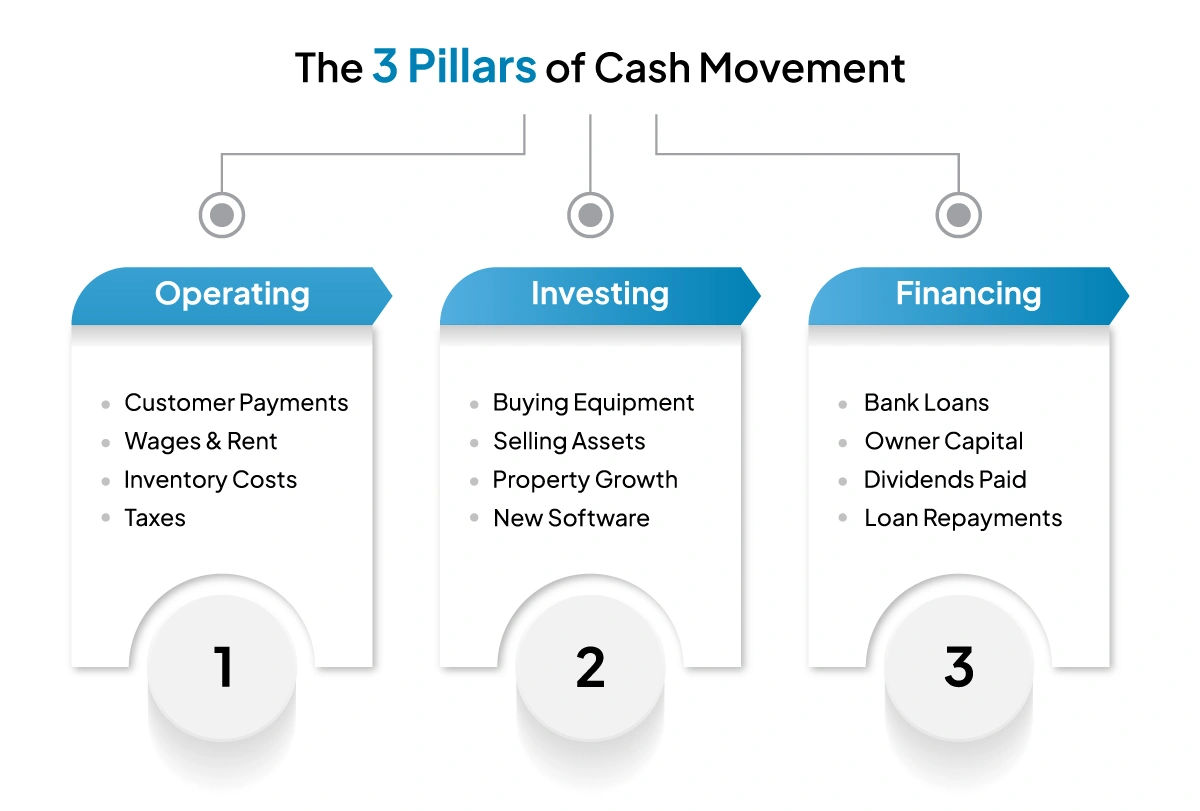
Every cash flow statement has three main sections: operating, investing, and financing activities. This layout helps South African businesses separate routine business cash movement from long-term spending and funding activity.
1. Operating Activities: Cash From Day-to-day Business
Operating activities cover the cash that comes in and goes out through the business’s usual day-to-day work. This includes money received from customers, typically confirmed through an invoice and receipt, and money spent on suppliers, wages, rent, utility bills, taxes, and other routine costs.
It is usually one of the first sections people look at because it shows if the core business is generating cash.
2. Investing Activities: Cash Used for Growth
This section usually covers long-term spending and asset-related transactions. Purchases such as machinery, equipment, software, or a new outlet would normally appear here as cash outflows.
Selling equipment or receiving money from an investment sale would appear as inflows. Negative cash flow in this section is not always a problem. It may simply mean the business is investing in growth.
3. Financing Activities: Cash From or to Owners and Lenders
Financing activities show how the business raises money and pays it back. Cash received from loans, owner contributions, or share issues appears as an inflow.
Loan repayments, dividends, and owner withdrawals are shown here as outflows. This section helps indicate whether the business is funding its needs internally or depending more on outside sources.
Interesting Fact Four in five small firms face customer-payment-related issues, which can make cash flow harder to track clearly.
Source:Fed small Business
What Are Cash and Cash Equivalents?
Cash generally covers cash in hand, and money kept in demand deposits. Cash equivalents are short-term liquid investments, generally with an original maturity of up to three months, that can be converted into a known amount of cash quickly and with low risk.
That is relevant because the cash flow statement records changes in both cash and cash equivalents, not just the cash figure on its own.
Direct vs Indirect Cash Flow Method
The direct vs indirect method of cash flow comparison is about how cash from operating activities is presented. Both methods are accepted. The investing and financing sections stay the same either way.
| Basis | Direct Method | Indirect Method |
|---|---|---|
| Starting point | Actual cash receipts and cash payments | Net profit, adjusted for non-cash items and working capital changes |
| Operating section view | Shows cash collected from customers and cash paid for expenses | Reconciles accounting profit to operating cash flow |
| Ease of preparation | Usually needs more detailed cash-level records | Often easier when using accrual-based accounting records |
| Best for | Clear visibility into day-to-day cash movement | Standard reporting and easier reconciliation with financial statements |
| Result | Net cash from operating activities | Net cash from operating activities |
The direct method shows actual cash coming in and going out, while the indirect method starts with profit and adjusts it to show cash from operations.
How to Read a Cash Flow Statement Like a Business Owner
It is easier to read a cash flow statement when you follow the movement of cash through the business rather than looking only at the closing total. Start with the cash coming from operations.
Then review the cash used for investments and see whether financing activity is helping the business grow or helping it manage a shortage. It also helps to look at how the three sections connect with each other. For example:
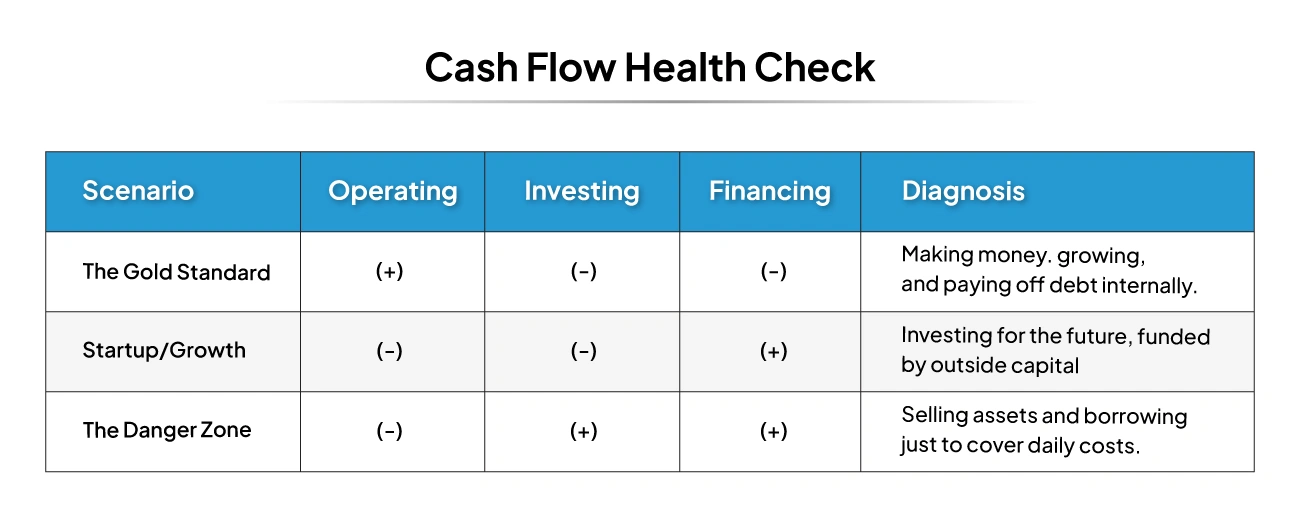
- Strong operating cash flow often points to better collections and tighter control over spending
- Large investment outflows may be a positive sign if they support future growth
- Repeated financing inflows without strong operating cash flow may suggest pressure in the business
1. Positive Cash Flow
A business has positive cash flow when its cash inflows are higher than its cash outflows for the period. If most of that comes from normal operations, it usually means bills are easier to manage, and growth is easier to support.
2. Negative Cash Flow
Negative cash flow means cash outflows were higher than cash inflows during the period. This is not always a warning sign. It may happen because of planned expansion, equipment purchases, or debt repayment.
It becomes more concerning when operating cash stays negative for a long time or when outside funding is needed just to manage regular expenses.
Quick Fact According to the 2025 Small Business Credit Survey, 56% of firms found operating expenses hard to manage, and 51% said cash flow was uneven.
Source:Fed small Business
Cash Flow Statement vs Income Statement vs Balance Sheet
These financial statements are linked, though each one looks at a different part of the business. The income statement shows profit over a period of time. The balance sheet shows the business’s position on a given date in terms of assets and liabilities.
The cash flow statement shows cash inflows and outflows during the period and explains the change in closing cash.
| Statement | Main Focus | Time View | Key Question It Answers |
|---|---|---|---|
| Cash Flow Statement | Actual cash inflows and outflows | Period-based | Where did cash come from and where did it go? |
| Income Statement | Revenue, expenses, and profit | Period-based | Was the business profitable? |
| Balance Sheet | Assets, liabilities, and equity | Point in time | What is the financial position right now? |
A profitable income statement does not always mean cash is readily available. When money is stuck in receivables or inventory, the cash flow statement helps show the real position for daily financial decisions.
Example: A Simple Cash Flow Statement Explained
Here is a simple cash flow statement example to show how the format works.
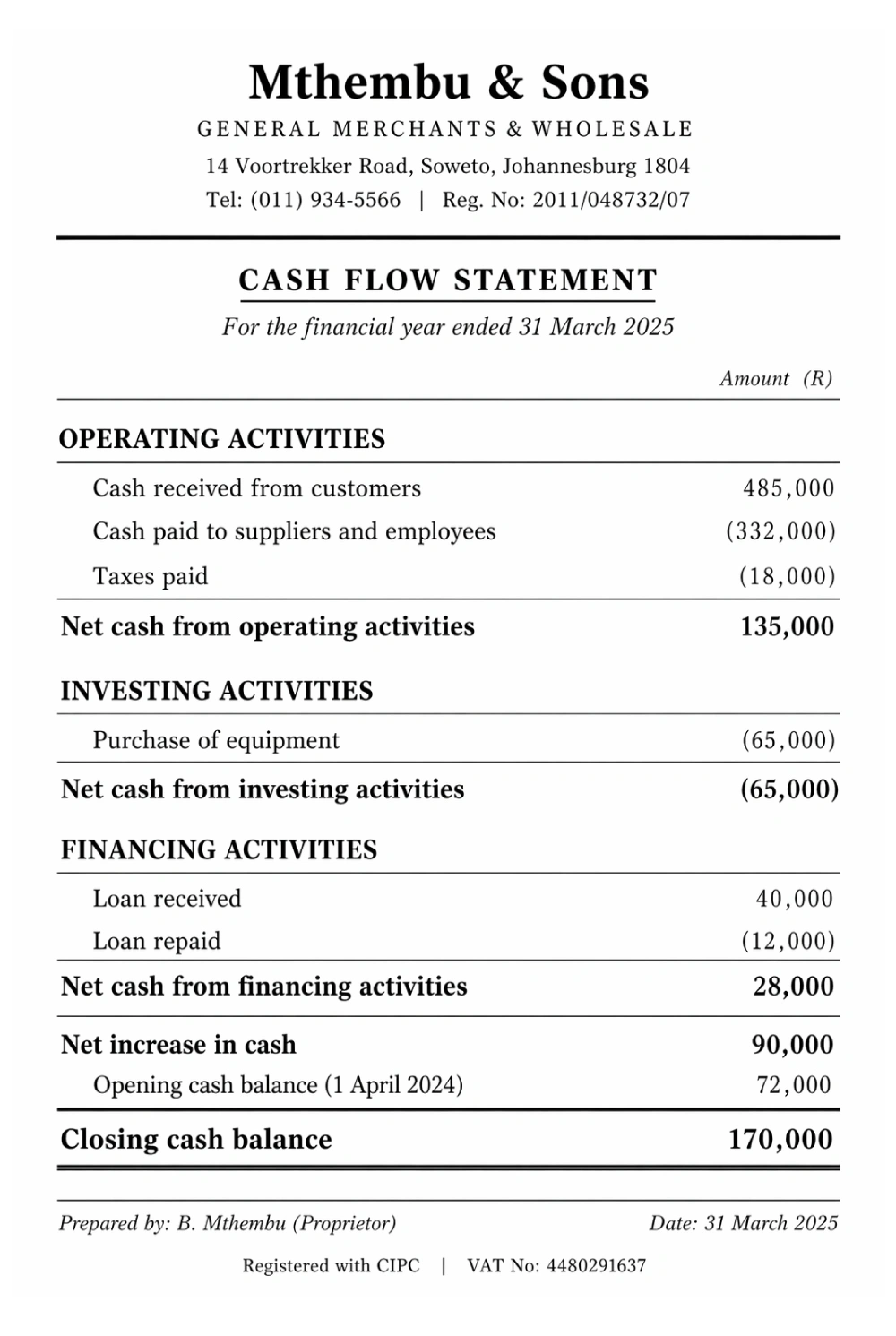
This example shows a few important things:
- The business generated healthy cash from operations
- Some cash was used to buy equipment
- Financing also helped support the overall cash position
The closing cash balance improved, but the clearest positive sign is that the operating section stayed strong. This shows the business was not dependent only on borrowing to keep running.
For many South African businesses, a cash flow statement example like this makes the report easier to understand because it shows the difference between cash generated from normal operations and cash that comes from outside support.
Download Free Cashflow Guide for your Business
How VasyERP Simplifies Cash Flow Tracking for South African Businesses
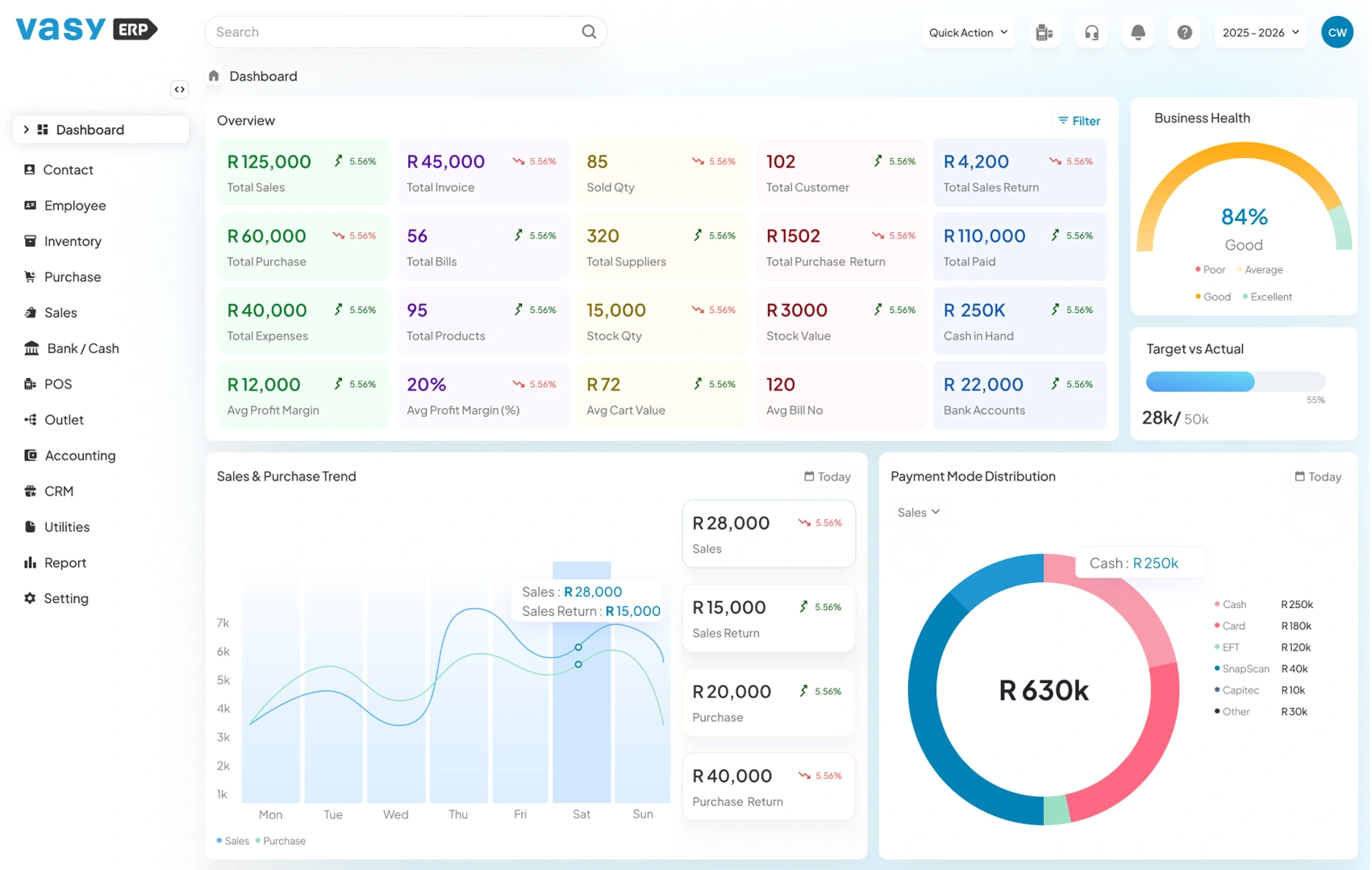 Cash flow tracking becomes easier when financial records are not spread across different tools. VasyERP brings together accounting, inventory-linked records, payment tracking, and reporting so South African businesses can follow cash movement more clearly. This helps businesses handle:
- Receivables and payables in one place
- Inventory-linked financial movement
- Payment tracking across daily operations
- Real-time reporting for better financial visibility
- Cash book and accounting records with less manual work
Problems from the cashflow statement often come from a mix of issues, such as delayed collections, supplier payment pressure, stock movement, tax obligations, and poor visibility across systems or branches. When billing, accounting, and reporting stay connected, it becomes easier to:
- Find issues earlier
- Reduce manual follow-up
- Improve day-to-day financial control
- Make better business decisions
Most business owners want a steady view of cash movement, so they can spot what is affecting it and step in early when something starts to go wrong. A connected system like VasyERP helps make that process clearer and easier to manage.
FAQs Regarding Cashflow
Profit is recorded when sales are made, not when cash is received. If customers delay payments or too much money is tied up in inventory, your business can show profit but still face cash shortages.
For most small and mid-sized businesses, reviewing it monthly is the minimum. If cash flow is tight or the business is growing quickly, weekly tracking gives better control.
A healthy business typically generates positive cash flow from operating activities. This means your core operations are bringing in enough cash to cover expenses without relying heavily on loans.
Yes. Negative cash flow from investing activities can indicate growth, such as buying equipment or expanding operations. The concern arises when operating cash flow remains negative over time.
Consistently negative cash flow from operations is a major warning sign. It suggests the core business is not generating enough cash to sustain itself.
Cash flow tracks movement of money over time, while working capital is the difference between current assets and liabilities at a specific point. Both are connected but serve different purposes.
Some practical ways include:
- Speeding up customer collections
- Reducing unnecessary inventory purchases
- Negotiating better payment terms with suppliers
- Controlling discretionary expenses
Last Updated on May 7, 2026