Quick Summary:
Are you new to business? You've likely heard "invoices" and "receipts" or something around 'invoice vs receipt' being tossed around when colleagues in the accounting department discuss transactions. But confusing them can spark buyer-seller mix-ups, audit headaches, or worse, payments for phantom services.
You'll walk away knowing:
- What is an invoice?
- What is a receipt?
- What are the key differences when it comes to invoices vs receipts
- Which document is issued when and by whom?
A supplier fulfills the purchase order and sends an invoice for goods or services rendered. Your finance team makes the payment and asks for a receipt to close the file. Instead, the supplier accidentally sends another invoice marked “Paid.”
Now, this will show up in your books as two separate bills, but in reality, one is supposed to be a proof of payment. Do you see the problem here? This simple mix-up between invoice vs receipt can lead to payment disputes, massive headaches during tax audits, or, in the worst-case scenario, lead to paying twice for the same service.
This is where knowing the difference between an invoice and a receipt actually matters, the debit and credit that goes behind each and that is what this post will help you do.
What is an Invoice?
An invoice is a document that a provider of goods or services sends to the buyer after they have delivered the requested goods per the purchase order or after rendering a service. In very simple terms, it tells the buyer:
- What services were rendered: A list of the services that were provided
- What products were sold: A list of the products that were sold
- How much is owed for the same: A break-up of the amount owed
- When is the payment due: Last date for payment
They are most commonly used in B2B credit-based transactions. Once issued, it indicates the pending financial obligation of the buyer. Invoices are also critical financial records for sellers as they help them keep track of their revenue, outstanding payments, and their tax liabilities.
Common Types of Invoices You Will Come Across in South African Businesses
Now, businesses use several types of invoices, each of which serves a different purpose. The following are the most commonly used. 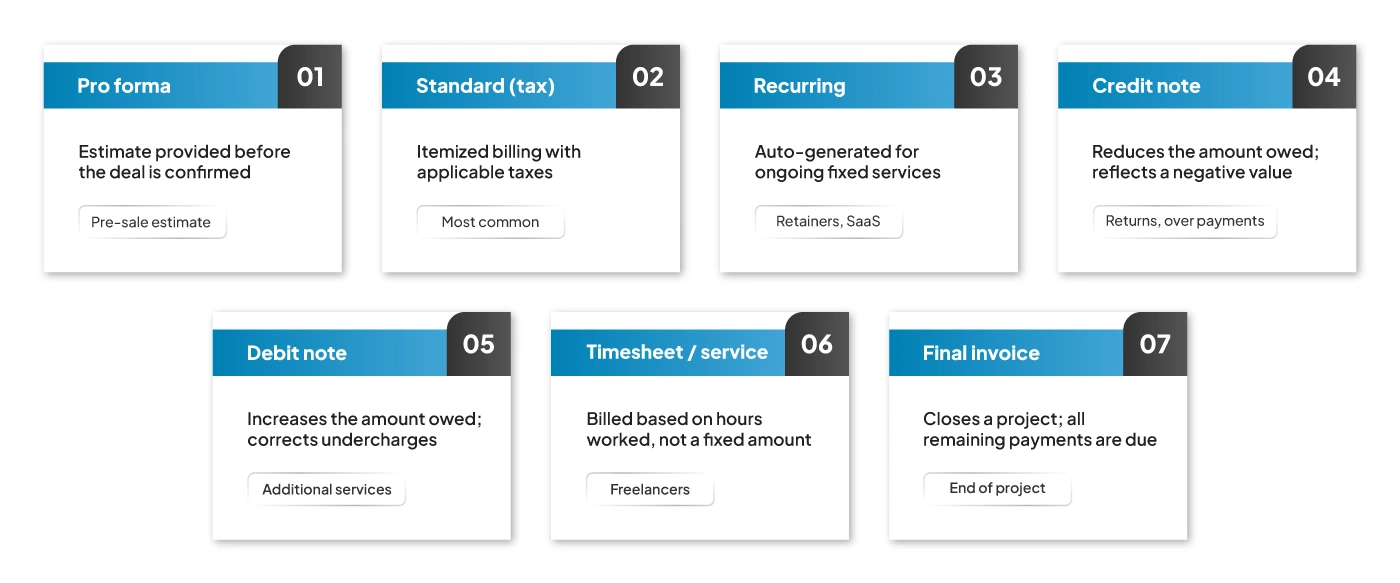
1. Pro Forma Invoice
A pro forma invoice is one that a seller or service provider issues before the transaction is formally agreed on. It is meant to be an estimate to help the buyer understand the cost of the goods or services they are considering.
It’s important to note here that pro forma invoices do not create a legal obligation between the two parties. They are primarily used in large or international transactions to help the buyer estimate taxes, duties, or shipping costs beforehand.
2. Standard (Tax) Invoice
These are the most common invoices used in day-to-day business transactions. They contain an itemised list of the goods and services provided along with the applicable taxes.
3. Recurring Invoice
A recurring invoice is generated automatically for ongoing services, usually of a fixed value. Think regular payments to accountants or consultants, or a retainer, SaaS subscriptions, or maintenance contracts.
4. Credit Note
A credit note is a document issued when the seller needs to reduce the amount owed by the buyer. This usually occurs when the buyer returns goods to the seller or the buyer overpaid due to an accounting error.
A credit note always carries a negative value and must reference the original invoice it is correcting.
5. Debit Note
A debit note does the opposite of a credit note. It is used when the amount owed by the buyer needs to increase. For example, if extra services were provided beyond the original scope or if the original invoice understated the correct amount.
6. Timesheet / Service Invoice
A timesheet or service invoice is issued when the buyer is being charged based on hours worked rather than a fixed value. These invoices usually come into play when consultants or freelancers who charge for their services by the hour are involved.
7. Final Invoice
A final invoice, as the name alludes to, is one that is sent at the end of a project or contract. It summarises all remaining payments due before the transaction is formally closed.
Quick Fact In South Africa, invoices must also comply with VAT requirements set by the South African Revenue Service (SARS), especially for VAT-registered businesses.
How to Create an Invoice the Right Way?
Creating an invoice is by no means a complicated process. That said, you do need to be mindful of the details when creating one so as to avoid disputes or accounting problems later on. Here is how to go about it.
Step 1: Clearly Label the Document as an Invoice
When creating an invoice, always label the document clearly as one. If you use templates to do so, this should already be written in bold or emphasised across the top of the document.
Step 2: Add Your Business’s Details
The invoice should clearly list your business’s details, such as the registered name and address of the business, contact information, and most importantly, your tax registration details.
Step 3: Mention the Client’s Information
Just as you did with your business’s details, do the same for the client’s or buyer’s details. There should be no confusion as to who the invoice is addressed to.
Step 4: Give the Invoice a Unique ID Number and a Date
Every invoice should have a unique ID number so that it’s easier to keep track of. It’s best to assign a sequential number, so each document can be tracked and referenced in correspondence, payment records, and during audits.
Each invoice should also mention the date on which it was issued, along with when the payment for the said invoice is due.
Step 5: Item Wise Products or Services
Clearly list each product or service provided with the quantity, unit price, and line total. The more specific this section is, the fewer disputes arise later.
Step 6: Calculate Taxes and Total Amount Payable
Finally, calculate the full amount the customer needs to pay. Take into account applicable taxes, list out the discount applied, if any, and clearly mention the final payable amount.
Remember Always issue an invoice before requesting payment in credit transactions.
What is a Receipt?
A receipt is a document that is issued after the seller has received payment against the original invoice sent to the buyer. Here is the critical distinction between an invoice and a receipt.
The former was a request for payment, the latter is a confirmation that the payment has been received. A receipt is just as important as an invoice because it confirms that the payment has been received against an open invoice.
This means the transaction can be marked complete in both the seller’s and buyer’s books.
Common Types of Receipts You Will Come Across in South African Businesses
Just as is the case for invoices, receipts, in South Africa too, are of different types and are issued based on where and how the payment was made.
1. Cash Receipts
Cash receipts are handed out against payments made with cash. For businesses that largely deal with physical goods currently, this is one of the most common types of receipts they issue and this directly affects the cashflow statement.
2. Sales Receipts
Sales receipts are most common in retail environments and are usually issued after a POS transaction. It serves as both the record of the transaction for the business and proof of purchase for the customer.
3. Delivery Receipts
Delivery Receipts are used to confirm that goods have been physically delivered to the buyer. Unlike the previous two receipts, these are issued by the buyer rather than the seller and only confirm delivery. They are not related to payments.
4. Payment Receipt
A payment receipt is issued when a buyer makes a payment against an outstanding invoice, whether in full or in part. These receipts specifically mention the invoice number that the payment was made against.
5. E-receipt
An e-receipt is nothing but an electronic version of a receipt. Any of the aforementioned receipts can be issued electronically and are now becoming the new normal, with most operations going digital.
6. Donation Receipt
A donation receipt is issued by a charity or non-profit organisation to acknowledge a financial contribution. These are typically used by donors to claim tax deductions.
Did You Know? There is a significant difference between the legal definition and the general cash receipt's meaning used in daily retail; while retail treats any proof of purchase as a receipt, legal accounting only recognises the actual inflow of liquid funds.
How to Write a Receipt Correctly:
The steps to write a receipt correctly are just about the same as those used when writing an invoice.
Step 1: Label the Document as a Receipt
Just like in the case of an invoice, this document too should clearly indicate that it is a receipt.
Step 2: Add the Seller’s Business Details
The next step is to make sure that all the details of the seller issuing the receipt are added to the receipt.
Step 3: Mention the Client or Customer’s Information
Include the name of the client or customer who made the payment.
Step 4: Record Transaction and Payment Details
This is the most important part of the receipt. Clearly mention the amount received (in South African Rand, for local transactions), the date on which the payment was made, and the invoice number against which the payment was received.
Step 5: Add Notes (Taxes, Refund Policy, Mode of Payment)
If required, add additional details, like how the taxes were calculated, the business’s refund or return policy, and how the payment was made. Do keep in mind, however, the importance of accuracy.
Difference Between an Invoice and a Receipt
This side-by-side comparison should help address any doubts you still may have when it comes to understanding the difference between an invoice and a receipt.
| Invoice | Receipt | |
|---|---|---|
| Who issues it and when? | The seller issues the invoice after the delivery of goods and services. | The seller issues the receipt after the payment is received for the invoice. |
| What is the main purpose? | To request payment for the goods delivered or services rendered. | To confirm that payment has been received after the invoice has been issued. |
| Does it create a payment obligation? | Yes, issuing an invoice does create a payment obligation. | No, a receipt is simply a confirmation that payment has been received. |
| Is it proof of payment? | No, an invoice is not proof of payment. | Yes. A receipt confirms payment. |
Example: What a Real Invoice and Receipt Looks Like
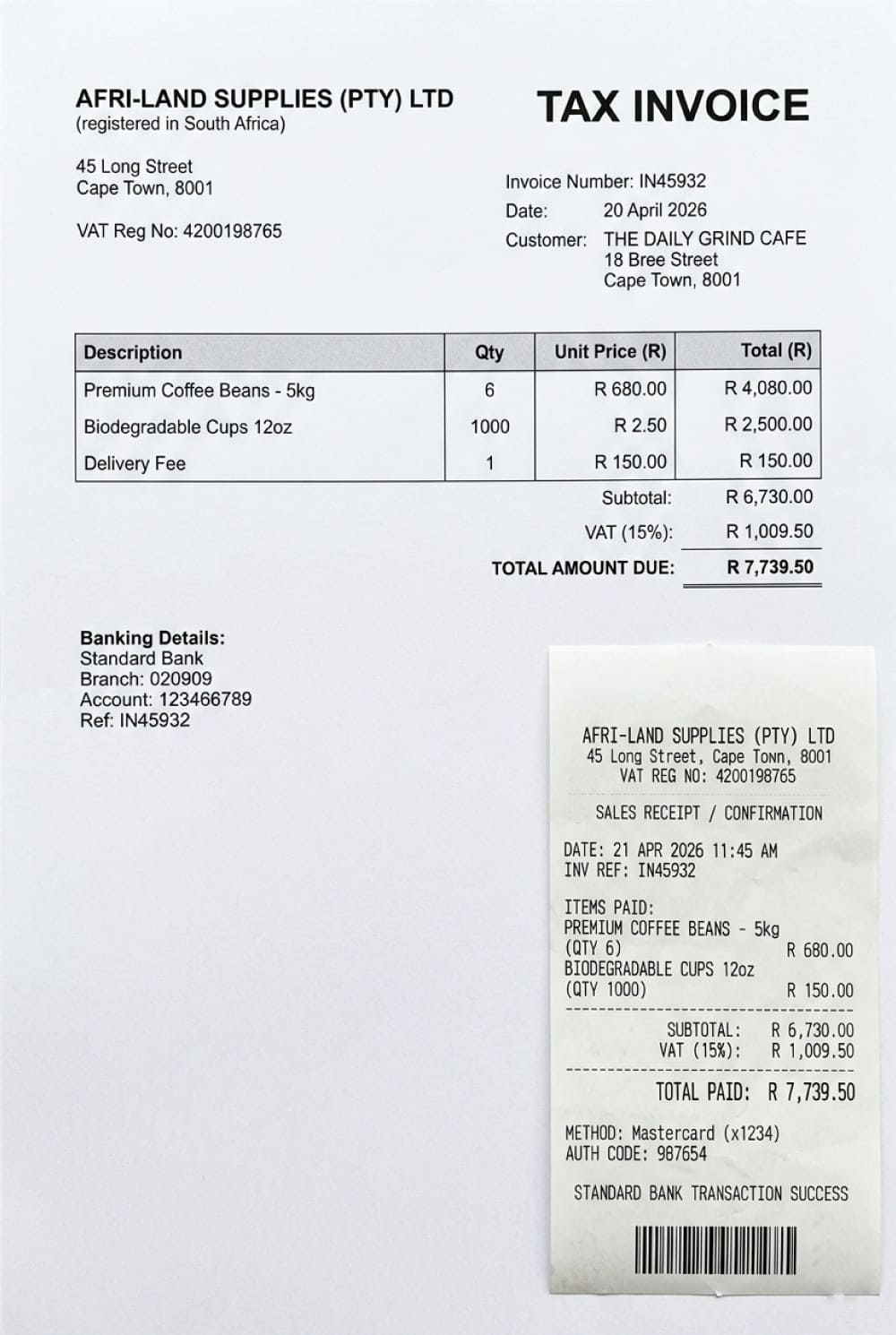
When Should You Issue an Invoice vs a Receipt?
Not all scenarios require you to issue an invoice and a receipt. Let’s look at a few.
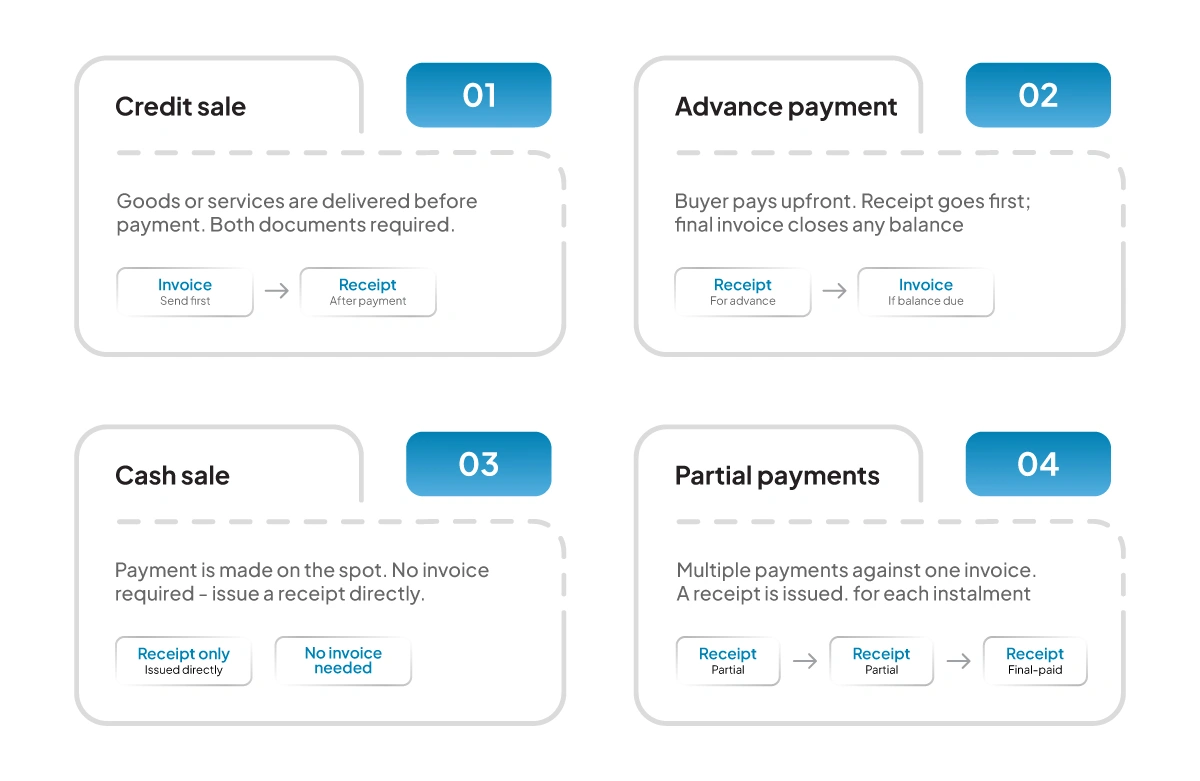
1. Credit Sales
A credit sale is a scenario in which you require an invoice and a receipt because the services or goods are delivered before any payment has been made. Here, an invoice is issued first, and a receipt follows after the payment has been made.
2. Advance Payments
In this scenario, you issue a receipt first to confirm the advance has been received, and then the goods and/or services are delivered. Once the work is complete, if additional payments have to be made, they are communicated by issuing a final invoice.
3. Cash Sales
In the case of a cash sale or a sale through a POS system, a receipt can be issued directly as the payment is made on the spot. An invoice is not required here.
4. Partial and Full Payments
In a scenario where partial payments are involved, the buyer first issues a receipt for the partial payment made, with the outstanding balance clearly mentioned. A final receipt is issued again once the payment has been cleared in full.
5. Manual vs Digital Invoices and Receipts: What Works Better Today?
Manually creating invoices and receipts works decently as a system when transaction volumes are small. For businesses whose transaction volumes are high, a digital system is always the better option. With them you can:
- Generate invoices instantly
- Track payment statuses in real time.
- Send digital receipts automatically, and
- Store transaction histories securely for as long as required legally.
Invoice and Receipt Management Becomes Challenging. How to Effectively Manage Both?
It is easy enough to manage invoices and receipts manually when your daily order volume is just a few orders. However, with more orders comes chaos.
The client pays for the order, yet the receipt does not get issued. The invoice is closed somewhere in the back office, while in some other location, it still remains open. Your client is trying to find the receipt issued three months ago but finds it impossible.
All of this happens quite often in organisations which do not pay due attention to invoice and receipt management. With systems like VasyERP, this issue is no longer relevant, as invoices are generated and issued straight from the sales module, while a receipt is generated automatically as soon as the payment is received, without any need for double data entry.
If the client pays for several invoices with one payment, the receipt is issued once only. If the client made any advances, the credit note or partial payment is credited against the original invoice.
If you want to see how it works in practice, book a 30-minute demo and we will walk you through it.
FAQs for Invoice and Receipts
An invoice is a request for payment issued after goods or services are delivered, while a receipt is a confirmation that payment has been received. An invoice creates a payment obligation; a receipt closes it.
No. An invoice only shows that payment is owed — it does not confirm that any money has changed hands. Only a receipt serves as official proof that payment was received.
Not always. For cash or POS sales, a receipt alone is sufficient since payment happens instantly. Both documents are needed for credit sales, where goods or services are delivered before payment is made.
A paid invoice and a receipt are not the same document. You should request a formal receipt referencing the original invoice number. Accepting a paid invoice as a receipt can result in duplicate entries in your books or complications during a tax audit.
A credit note is issued when a seller needs to reduce the amount owed on an existing invoice — for example, due to returned goods or an overcharge. A receipt, on the other hand, confirms that a payment was made. The two serve very different accounting purposes and should never be used interchangeably.
Last Updated on May 20, 2026