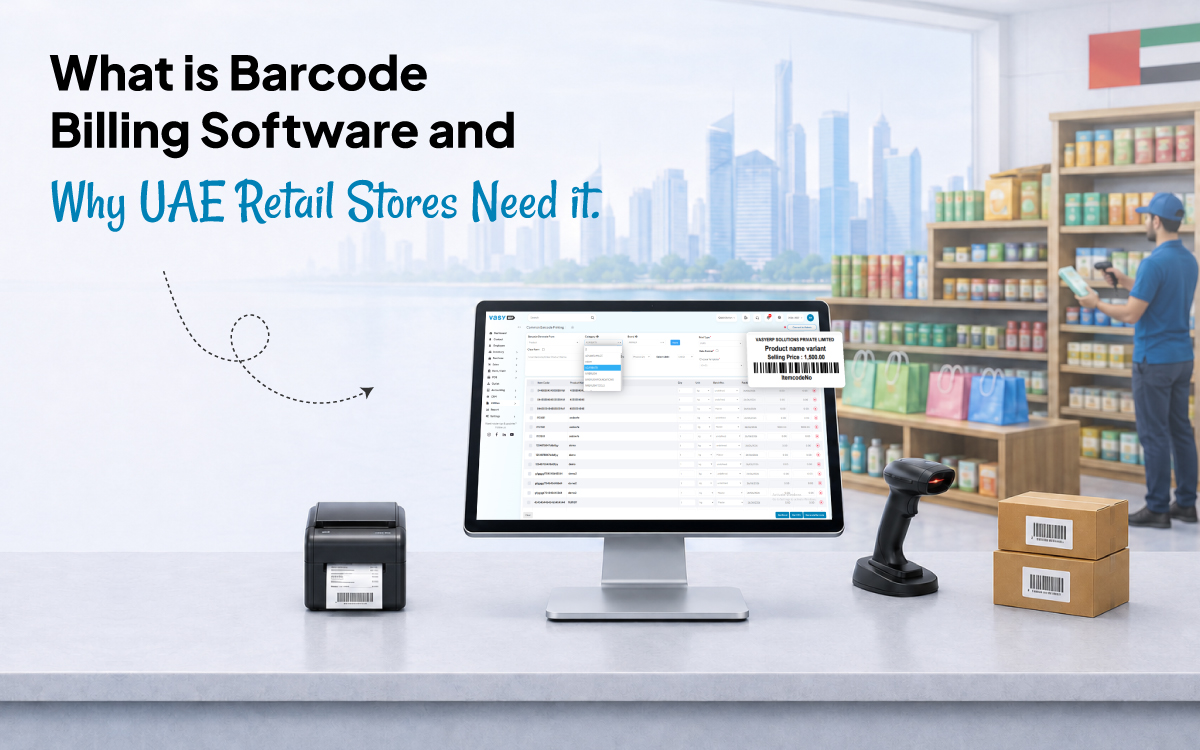
Manual billing, as a process, is slow and error-prone. Every entry typed in by hand has the potential to impact the accuracy of your inventory, your accounts, or both. Barcode billing software eliminates both issues. This guide explains what barcode billing software is, how it works, and why UAE retailers are adopting it.
You’ll walk away knowing:
- What barcode billing software is and how it works.
- Why the UAE retail environment specifically demands it.
- The key benefits they offer.
- How to choose the right barcode software for your store.
Running a retail store in the UAE is no small feat. It’s a highly competitive space with customers whose expectations for better yet quicker service are always on the rise. In this scenario, relying on manual billing, which is a painstakingly slow process, will not earn you brownie points in terms of service.
Then, on the business front are the financial and logistical issues this manual billing can cause. One wrong digit means a wrong price, a wrong inventory count, and a receipt that will not hold up under an FTA audit.
This is why retailers in the UAE are moving away from manual processes to automated barcode billing software. This post will explain why.
What is Barcode Billing Software?
Barcode software is a point-of-sale system that uses barcode scanning to automate the checkout and invoicing process. With this system, each product in your inventory carries a unique barcode, which is typically a UPC or EAN code.
This code is mapped to a product record in the system database that contains the item’s name, price, and the applicable VAT rate. When a cashier scans the barcode, all of that information is pulled instantly and billed with accurate VAT calculations.
However, there is one primary difference that separates the good billing software from the rest, like a basic product scanning software. The latter acts as an integration layer that can automatically update your inventory levels and create relevant entries into your books and customer profiles.
How Does Barcode Billing Software Work in Retail Stores?
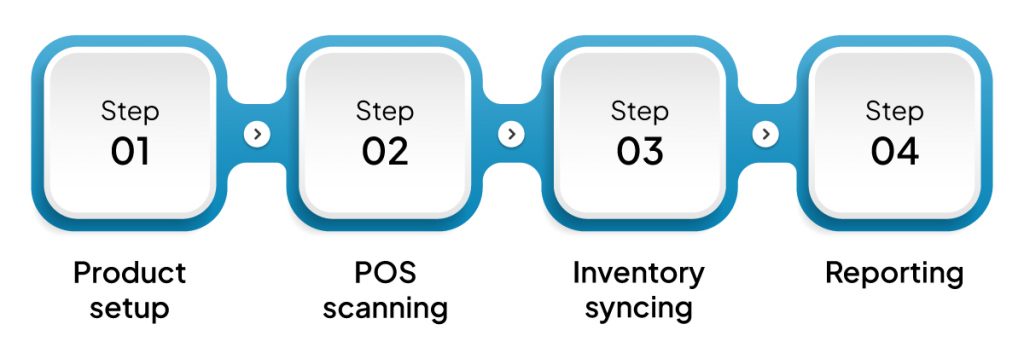
Billing software in retail stores follows a simple four-step process:
Step 1: Product Setup
Every SKU in your catalogue is assigned a barcode, which is either printed by the manufacturer (GS1-compliant codes) or generated and printed in-house. The barcode maps to a product record in your billing software’s database.
Step 2: Point-Of-Sale Scanning
At the checkout counter, the cashier scans each item. The software retrieves the product record, adds the item to the bill, and calculates VAT in line with FTA requirements.
Step 3: Inventory Syncing
Every sale decrements the stock count automatically. Some barcode software support low stock alerts when a product hits a preset threshold.
Step 4: Reporting And Reconciliation
At the end of the day, every transaction is recorded against a product, a cashier, and a timestamp. Sales reports, VAT summaries, and inventory movement logs are generated automatically.
Why UAE Retail Stores Need Barcode Billing Software?
The need for billing software in Dubai or the UAE as a whole can be easily justified if you look at it from the POV of your customers and your business itself.
From the POV of Customers
UAE’s customers expect a smooth customer experience, and a slow checkout process doesn’t go hand-in-hand with this expectation. Nearly 30% of customers in the UAE say they would switch brands if the in-store experience doesn’t meet these demands, regardless of how beautiful or upscale the store is.
From the POV of Your Business
Faster billing means you serve more customers per hour with a better experience. A smooth experience means you not only gain this one sale but also convert what could be a one-time sale into a regular customer.
In the UAE, it’s mandatory to generate a tax-compliant invoice with the correct VAT rate applied to each product. With barcode billing software, the calculations are always spot on and FTA-compliant. This saves you the stress of dealing with inaccurate records during audits or when filing VAT returns.
Finally, if you run a business with multiple retail outlets, you need real-time, accurate stock levels across all locations. Barcode asset tracking within an integrated billing system makes this possible without having to rely on manual stock counts between branches.
Did you know:
There is a slow and steady shift from linear barcodes to 2D codes, with 82% of retailers supporting this transition.
Key Benefits of Barcode Billing Software
The benefits of adopting billing software for small businesses or even large ones go beyond the simple speed and accuracy talking points. They fundamentally change the underlying economics of a retail operation like so:
1. Pricing integrity
With billing software, the price on the shelf always matches that at the till every time. For stores that sell thousands of SKUs, this single factor alone can prevent a significant volume of billing errors daily.
2. Shrinkage detection
With every sale being scanned and logged, any discrepancies between recorded stock movements and physical inventory become quickly apparent.
3. Faster staff onboarding
With barcode billing software, your newly hired staff becomes productive a lot sooner now that they do not need to memorise product codes or prices. In short, your training overhead drops significantly compared to manual or semi-manual systems.
Common Challenges Without Barcode Billing Software
Operating a retail or small business without barcode billing software is a lot like driving a car at night with dim headlights; you might still move forward, but you’re bound to hit a few costly potholes.
When a business relies on manual entry or legacy cash registers, it places the entire weight of operational accuracy on human memory and repetitive typing. This reliance inevitably introduces friction into daily operations, draining both profit margins and customer patience.
The Realities of Manual Checkout Operations
- Frequent Pricing Discrepancies: Without a centralised system syncing the till to the shelf, price mismatches are practically guaranteed. Whether it’s an outdated shelf tag or a cashier mistyping a price, these errors lead to awkward checkout disputes, lost customer trust, and accidental revenue leakage from undercharging.
- Invisible Inventory Shrinkage: When sales aren’t instantly logged against inventory data, tracking stock becomes a massive guessing game. Theft, damages, and administrative errors slip through the cracks unnoticed, leaving business owners blind to shrinkage until a painful, manual end-of-month stock count reveals the damage.
- Stonewalled Staff Onboarding: Training new employees becomes a sluggish, frustrating process. Instead of learning customer service, new hires are forced to memorise product codes, flip through bulky price binders, or constantly wave down managers for help. This drastically increases training overhead and slows down transaction times during peak hours.
Barcode Billing Software vs Manual Billing: Which Is Better for UAE Retailers?
Still in doubt whether a billing software is worth the upgrade from your existing manual process? Here is a quick comparison to help you decide.
| Barcode Billing Software | Manual Billing | |
| Checkout speed | Can easily scan and complete the checkout process in under a minute. | Generally takes longer, and the time increases with the number of products. |
| Accuracy | 100% | Varies |
| VAT Compliance | Auto-calculated | Reliant on manual calculations |
| Training involved | Hours | Significantly longer |
| Audit trail | Complete, exportable, time-stamped | Incomplete or paper-based |
Essential Features To Look For In Barcode Billing Software
Not all barcode software will include the same capabilities, but the following are a must-have, especially for retail.
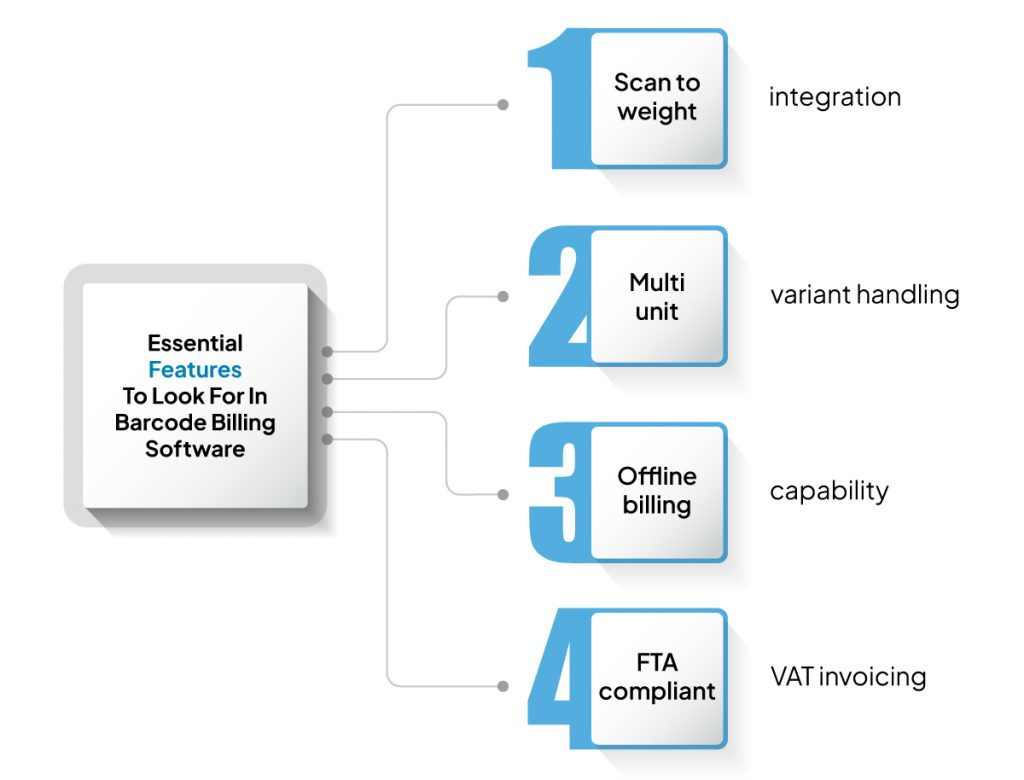
1. Scan-to-Weight Integration
For supermarkets and grocery stores that sell loose produce by weight, integration between the barcode billing system and electronic weigh scales is a must-have. This feature will calculate the price automatically based on the per-kilo rate of the item in question.
2. Multi-Unit and Variant Handling
Retail stores also sell the same product in multiple pack sizes. The billing software should handle all variants under a single product master, without requiring separate entries for each.
3. Offline Billing Capability
Connectivity while rare in the UAE does happen. The billing software must be able to continue processing transactions offline with all data syncing automatically when the connection is restored.
4. FTA-Compliant VAT Invoicing
The billing software must generate tax invoices that meet UAE FTA requirements out of the box. This should include correct VAT rates by product category, the supplier’s TRN, and the sequential invoice numbering the FTA requires.
Did you know: Penalties for not maintaining and submitting tax documents per FTA guidelines can attract fines up to AED 5000.
How To Choose The Right Barcode Billing Software?
To choose the right software for your specific retail business, you should evaluate the following against the following checklist:
- Can it handle the scale of your current business and your projected future growth?
- Check if it’s a generic system or one built for the UAE; i.e., does it support VAT compliance, the local language, and payment gateways?
- Does it work offline during connectivity drops?
- Does the vendor have local support in the UAE?
- Can the system keep up with the demands of your busiest hours?
Why UAE Retailers Choose VasyERP’s Barcode Billing Software?
VasyERP is a cloud-based retail management platform built specifically for the UAE’s retail industry. It combines, along with the billing software, inventory, accounting, and CRM in one system. Here is what you get with it and why retailers are choosing it.
- Fast barcode scanning: VasyERP supports high-speed barcode scanning for quick checkout.
- Real-time inventory: Every scan updates stock levels in real time.
- UAE VAT compliance: The system handles UAE VAT automatically.
- Offline functionality: VasyERP’s POS works without internet. The data syncs when connectivity returns.
- Multi-store management: It provides a centralised dashboard to control multiple locations or outlets.
- Barcode generation: You can generate and print barcodes for any product.
- All-in-one Integrated platform: VasyERP integrates billing, inventory, accounting, and customer management in one system.
- Cloud-based access: Being a cloud-based system allows store management from anywhere.
Conclusion
Manual billing slowly but surely chips away at your profits, be it in the form of customers or due to inaccuracies they cause internally. A Barcode billing software reverses most of these losses at the source. For retailers, especially those in UAE, which happens to be one of the world’s highest-expectation retail markets, a switch to one should be a clear-cut decision.
If you want to see how VasyERP‘s barcode billing software handles your specific retail setup, book a 30-minute demo with our team now. We will walk you through how the software handles your specific workflows.
FAQs :
Barcode billing software uses barcode scanners to identify products at checkout based on their unique barcode. When scanned, the software retrieves product details, price, tax rate, and stock level instantly without having the cashier type anything.
Billing software helps retail stores speed up their checkouts, eliminate errors and discrepancies that arise due to manual inputs, and, in cases of integrated systems, ensure that your inventory reflects your actual sales.
Ideally, yes. It’s best to consider a barcode billing software that can continue to work offline to prevent any outages from hampering your customers’ in-store experience.
Anyone operating a high-traffic retail store in the UAE should look for features like quick barcode generation and fast scanning, real-time inventory updates, UAE VAT compliance, and offline functionality along with detailed reporting capabilities.
Barcode scanning processes items in under a second, making checkout up to ten times faster than manual data entry. It shrinks minutes of waiting into seconds, keeping lines moving smoothly while completely eliminating human typing errors.
Yes, it updates your stock levels in real-time the exact moment an item is scanned at checkout. This eliminates manual tracking, provides instant visibility into what’s on your shelves, and automatically alerts you when it’s time to reorder.
- 1
- 0
- 0