Quick Summary:
There is no shortage of feature-rich options when you are on the lookout for an ERP solution in the UAE. The shortage, in fact, is in the lack of clarity on how to decide which of the ERP software features actually matter when picking one. This post does just that.
You’ll walk away knowing:
- Why ERPs are essential, especially for a growing business.
- Getting one with the right features is just as important, if not more, than one that is priced right.
- How those features impact your day-to-day operations.
- How to evaluate and pick the right system for you.
The decision to consider an ERP is not one that is made at random. The thought process to do so begins when businesses realise that their existing systems have started stifling growth.
However, what should be a relatively easy decision soon becomes overwhelming when you start comparing the extensive ERP software features list. At this point, the entire decision-making process shifts from “Does the business really need one?” to “How do we decide which one we should go with?” Let’s answer this.
What Makes ERP Software Essential for UAE Businesses?
The UAE has a unique set of scenarios that make it essential for a business to use an ERP, but only if the ERP’s software features are the right ones from the start.
To Meet Customer Expectations
First and foremost are customer expectations. The UAE is home to a vast array of nationalities. You have the Emirati nationals, the expats, and tourists, all of whom have varying digital behaviors. That said, they do have one thing in common: all of them expect a high degree of personalisation in their shopping experiences.
Without an ERP in place, it will be next to impossible to keep track of their digital preferences and cater to them individually.
According to Dubai’s e-commerce market, valued at AED 32.3 billion in 2024, it is expected to reach AED 50.6 billion over the next five years, with nearly 67% of this figure attributed to mobile shopping.
To Stay Compliant
Running a business in the UAE comes with a specific set of operational and regulatory demands when it comes to VAT. And violations result in heavy penalties that range from AED 5000 to 50000 depending on the offence.
An ERP system, especially one designed with these regulations in mind, will help your business stay compliant without the need for manual intervention and reconciliation.
To Streamline Your Entire Business Operations
An ERP’s core functionality is to help streamline your entire business’s operations from inventory management, sales, accounting, and customer outreach, and everything in between.
According to Panorama Group’s 2026 ERP report, 87% businesses that implement an ERP saw a significant increase in productivity and efficiency organization-wide.
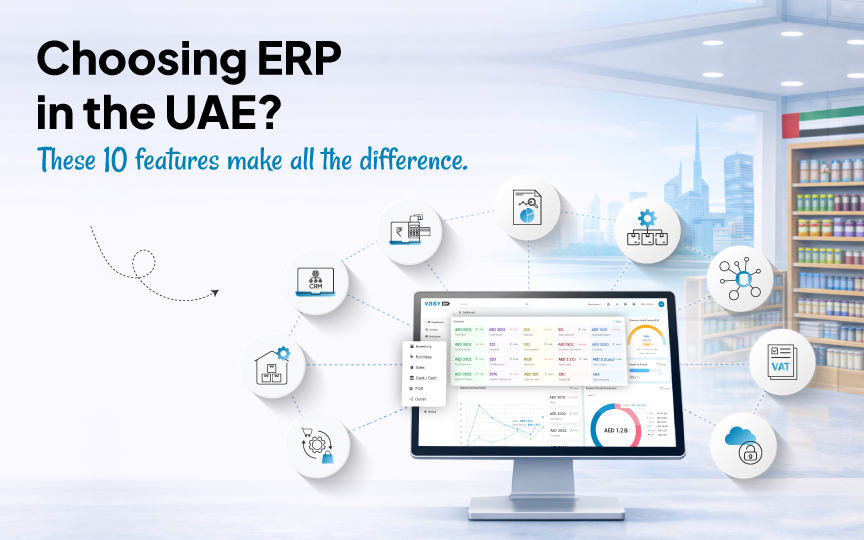
Top 10 ERP Software Features Every UAE Business Should Look For?
Not all ERP systems are the same. Some ERP software features simply move problems around, while others actually fix them. The following are the ones to look out for.
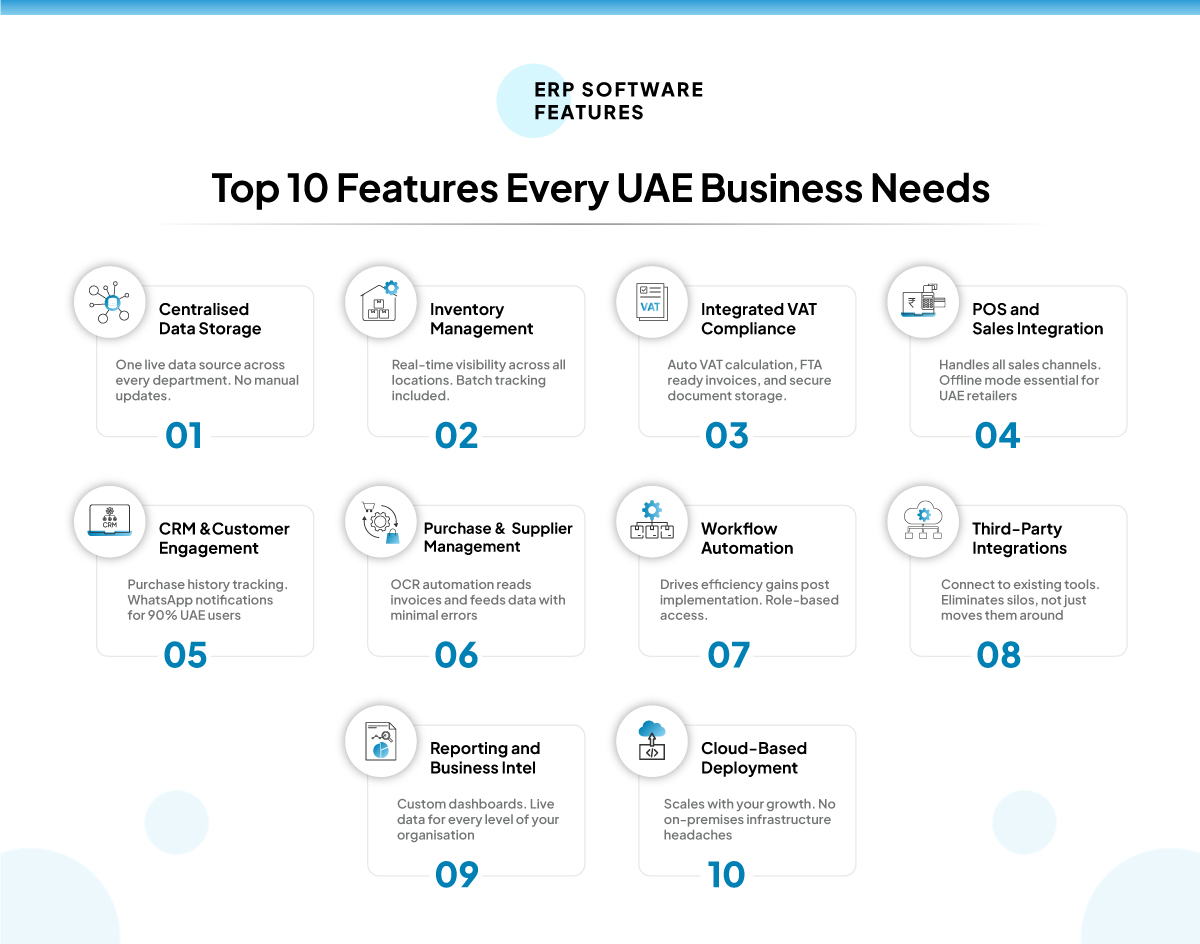
1. Centralised Data Storage
This is the foundational ERP functionality that should be at the top of your list when considering an ERP system. The moment your operational data is centralised, every change is reflected across every department in real time. That way, everyone is working with the same live data.
2. Inventory Management With Independent Location Visibility
If you run a multi-store operation, this is one of the most critical ERP software features to have on your checklist. A centralised inventory will give you real-time insights into your stock levels across your network, either individually or as a whole. These insights help avoid stockouts and prevent cash flow blockage from overstocking.
3. Integrated Accounting And VAT Compliance
If you are VAT-registered in the UAE, check the ERP’s feature list and verify if VAT compliance is baked into the accounting module. The system should be capable of calculating VAT at the product level, generating VAT-compliant invoices, and storing the documents securely for as long as the regulations dictate.
4. POS and Sales Integration
The ERP’s system functionality should also include a POS and Sales Management. It should be able to handle sales no matter where they enter the system from, i.e., POS systems, online, or B2B channels. Look out for an offline functionality that can keep the system running during network outages and syncs automatically once the system is back online.
5. CRM and Customer Engagement
A CRM module is an ERP software feature that has the maximum impact on your operations. It will help you to keep track of the customer profiles behind these sales and their purchase history to help personalise their experiences in the future. In the UAE market, the ability to send notifications via popular apps like WhatsApp is a significant add-on to look out for to meet local digital behaviors.

6. Purchase And Supplier Management
Procurement is a key part of any business, and the ERP functionality should include this. It should be capable of managing purchase orders, tracking suppliers, and monitoring payment cycles. The ERP key feature to look for here is OCR-based purchase automation capability that can scan a supplier invoice, read its information, and feed it into the system with minimal errors.
7. Workflow Automation and Role-Based Access
Extensive workflow automation is an ERP system functionality that will drive most of your efficiency gains. For instance, if a stock dips below a set threshold, the system should automatically raise a purchase order and notify the relevant manager for approval. Role-based access will ensure that only the relevant manager can approve the request.
8. Integration with Third-Party Platforms
An ERP system that cannot connect to your existing tools will only create new data silos. Look for an ERP with a rich feature list of native integrations that support your current ecosystem. Such a system will ensure your e-commerce, logistics, and payment gateways work seamlessly rather than in isolation.
9. Reporting and Business Intelligence
Look for a solution that can generate a wide array of reports across all modules. Look for the ability to customise them or the ability to filter data based on each store, warehouse, or pending payments, and so on. The solution should have reporting capabilities that give everyone, from the bottom of the corporate ladder to the very top, accurate information on demand.
10. Cloud-Based Deployment and Scalability
Your ERP should grow with your business. Look for a cloud-based system that eliminates the headache and the resources required for maintaining on-premises infrastructure. Look for a system that can handle expansions without requiring a complete overhaul.
How to Evaluate These Features When Choosing ERP Software?
You can approach evaluating if a specific ERP is right for you by seeking answers to the following questions:
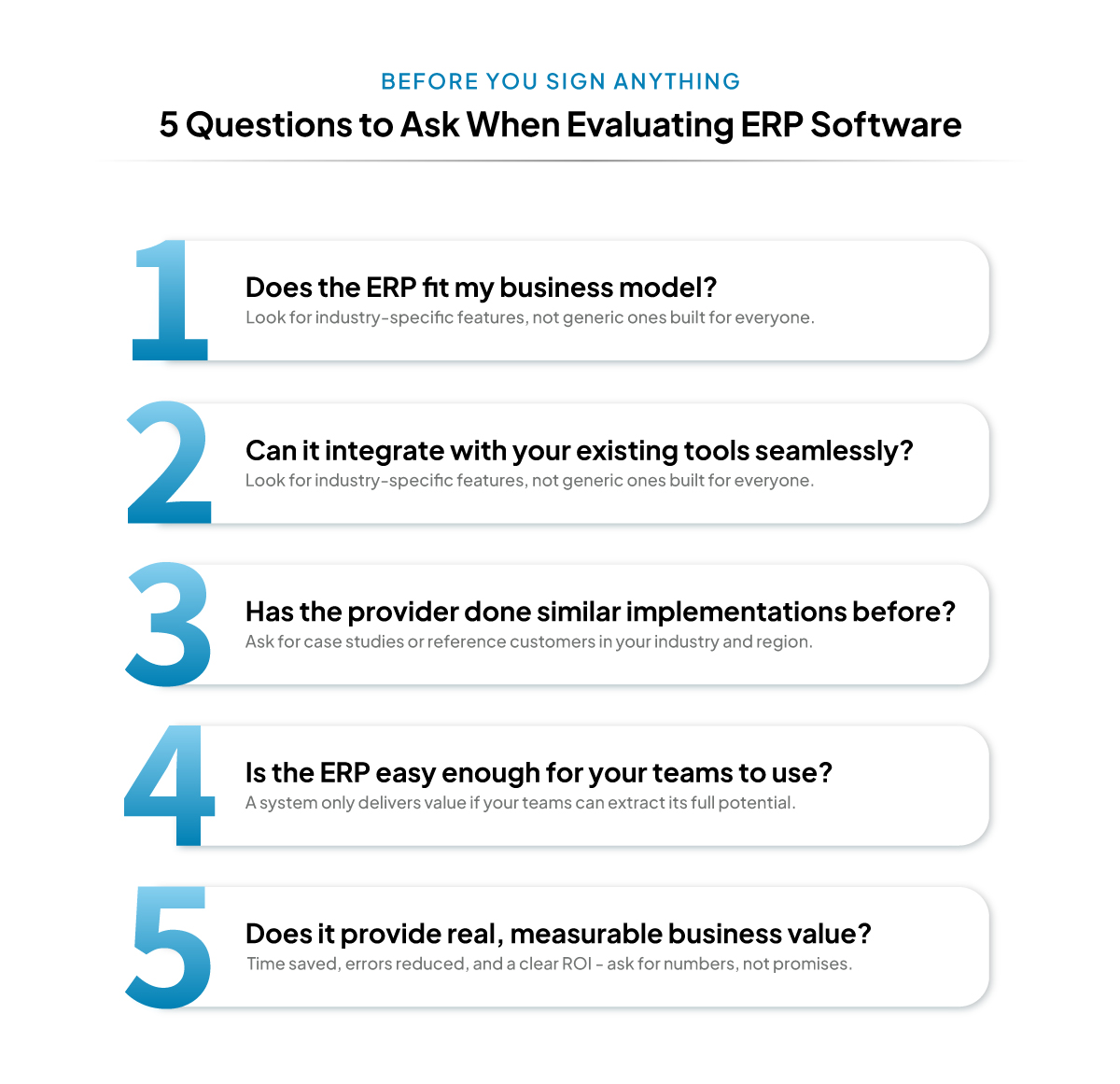
1. Does the ERP fit my business model?
A lot of ERPs feature lists are built to be generic. Choose one whose feature list and functionality match what your business and industry need. Ask the vendor to walk you through a real workflow specific to your business during the demo (e.g., a retail sale or a wholesale order). Observe if the system supports them easily.
2. Can It Integrate With Your Existing Tools Seamlessly?
The ERP in question should easily connect with the remainder of the tools that still exist post its implementation. Ask for a list of native integrations and check if the system supports UAE payment gateways, popular local e-commerce platforms, and accounting software that you already use.
3. Has the solution provider performed prior implementations for similar businesses?
Each industry and type of business has its unique set of implementation challenges. Ask for case studies of successful implementations for local businesses similar to yours. Any provider with local experience will understand FTA compliance and regional logistics better than one that doesn’t.
4. Is the ERP easy to use?
A complicated system with a steep learning curve will lead to low and slow adoption. Keep in mind that an ERP is useful only if your teams can extract its full potential. During the demo, ask one or two of your employees (who will actually use the software) to observe. Their understanding in one demo will give you a realistic baseline on how easily they will be able to adopt it.
5. Does It Provide Real Business Value?
At the end of the day, the entire exercise should help you save time, resources, and have a reasonable ROI. If the system doesn’t, it’s not the right fit. Ask the provider directly: What measurable outcomes have similar businesses seen within the first six months of going live?
Download ERP Feature Comparison Checklist
Why VasyERP Is the Right ERP Choice for UAE Businesses?
By now, you should have seen a pattern emerge in the evaluation criteria, i.e., the solution should fit your workflows, integrate seamlessly, and deliver measurable improvements from day one. VasyERP does just that and is designed exactly around how retail, distribution, and manufacturing businesses actually operate.
It covers all 10 ERP features discussed in this post and connects your sales, inventory, purchases, and accounting into one platform. This directly eliminates all the delays and inconsistencies that most businesses running without an ERP or the right one struggle with.
For inventory-heavy operations, features like batch tracking and multi-location management ensure that stock movement is always accurate. On the sales front, the system generates VAT-compliant invoices by default right at the POS.
And with real-time dashboards, you no longer need to wait for reports to understand how your business is performing. Everything you need to know is available the moment it happens.
Summing It Up
Choosing an ERP is about setting up a structure that can handle the pace of the UAE market. The right ERP software features shouldn’t just exist on a list; they should work together to simplify your daily operations. Getting this right isn’t about picking the most expensive option, but finding the one that fits your exact needs.
The best way to see if a system fits is to watch it handle your specific tasks in a live setting. A demo moves past the sales deck and shows you how the software actually behaves. Book a 30-minute demo with VasyERP to see what it can do for your business.
- 0
- 0
- 0