
Quick Summary:
Petty cash plays a critical role in most South African businesses' day-to-day operations. That said, while it may not be a large amount in the larger scheme of your business's cash flow statement, when not managed properly, these transactions can lead to fraud and cause major accounting mismatches in the long run. This guide will explain everything you need to know to avoid these scenarios.
You'll walk away knowing the following:
- What petty cash is and why businesses need and depend on it.
- The various systems businesses use to manage petty cash.
- How to record and manage these transactions properly.
- How to use technology to digitise and further simplify its management.
Any business, regardless of the industry or its size, needs funds to keep its day-to-day operations running smoothly. Now, for expenses as simple as taking out a client for a small meal or buying a last-minute birthday cake, it’s impractical to go through a formal approval process every single time. That is where petty cash comes in.
Although the amount per transaction here may be small, it adds up over time. If not documented properly, it can create accounting headaches and make it difficult to understand where company money is going.
In South Africa, where a lot of businesses already operate on paper-thin margins, keeping track of these transactions is rather important. That is why this guide walks you through how to manage these transactions better, avoid common pitfalls while doing so, and go one step further by digitising the process.
What is Petty Cash?
Petty cash is a small amount of physical money kept aside for those minor or unexpected transactions that do not warrant a cheque or going through a formal approval process. These include transactions like milk, sugar, or coffee for the office pantry, a parking fee for a delivery vehicle, or a last-minute birthday cake for a colleague.
Most businesses set up a petty cash fund with a fixed amount, such as R1,000 or R2,000. One person, called the custodian, manages the cash and keeps all receipts.
Why is Petty Cash Important for Businesses?
The need for petty cash in running a business is a valid question to ask in an era where digital payments are common. In reality, there are several valid reasons why sticking to using cash for petty transactions is essential even today.
- It saves time: Having this fund allows the custodian to disburse the cash immediately for small expenses without having to go through bureaucracy.
- It is safer in certain contexts: Company cards or accounts can be cloned or hacked and misused. Petty cash, being a small amount, limits the losses.
- It works all the time: This fund is not dependent on digital devices that run on electricity or internet connectivity. Payments can be made anytime.
Beyond convenience, a properly managed petty cash system creates a documented audit trail for every small expense.
Did you Know: According to the SARS Tax Guide for Small Businesses, all business expenses, including petty cash expenditures, must be supported by valid documentation to be deductible.
Source:SARS
Types of Petty Cash Systems
There are four petty cash management systems businesses use today
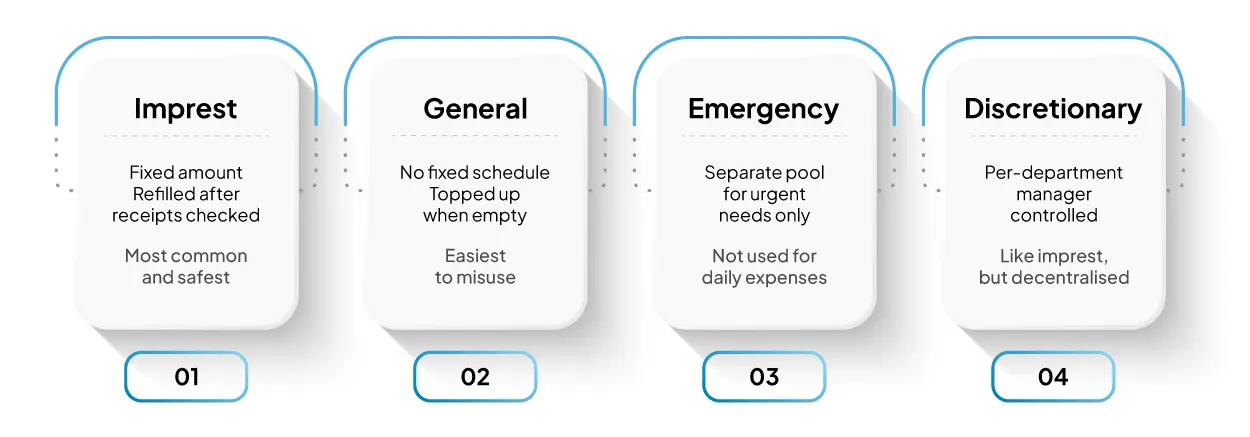
1. Imprest Petty Cash System
The imprest petty cash system is one of the most common management systems in use among South African businesses today. It sets aside a fixed amount, say R2000, and a set period of time, post which the accounts need to be reconciled.
For example, if R 800 has been spent, the account receives R 800 back, but only after providing receipts to account for the money spent.
2. General Petty Cash System
A general petty cash management system is the simplest when it comes to managing these funds. The custodian keeps a cash box and takes money out as needed. When it runs out, they ask for more. There is no fixed replenishment schedule here.
The downside to this method is that without a fixed balance and regular reconciliation, the system is prone to misuse.This is why very few businesses use this system today.
3. Emergency Petty Cash System
Here, there is a separate amount of petty cash set aside that is to be used only for emergencies. This fund is not used for general day-to-day expenses.
It’s tracked separately and replenished only after it’s used up, with full documentation to support all the expenses.
4. Discretionary Petty Cash
Under this method of petty cash management, managers are given limited authority to make small business expenses at their discretion. It operates similarly to an imprest fund but is allocated per department rather than being a central fund.
Examples of Petty Cash Usage
Typical examples of petty cash expenses in South African business can include but are not limited to the following:
- Office stationery purchased urgently from a shop around the corner.
- Parking fees, tolls, or the unexpected traffic fine paid for by your drivers.
- Refreshments bought on the fly during client meetings.
- Cleaning supplies bought between scheduled supplier deliveries.
How the Petty Cash System Works
A well-managed petty cash system works when it follows the five steps below:
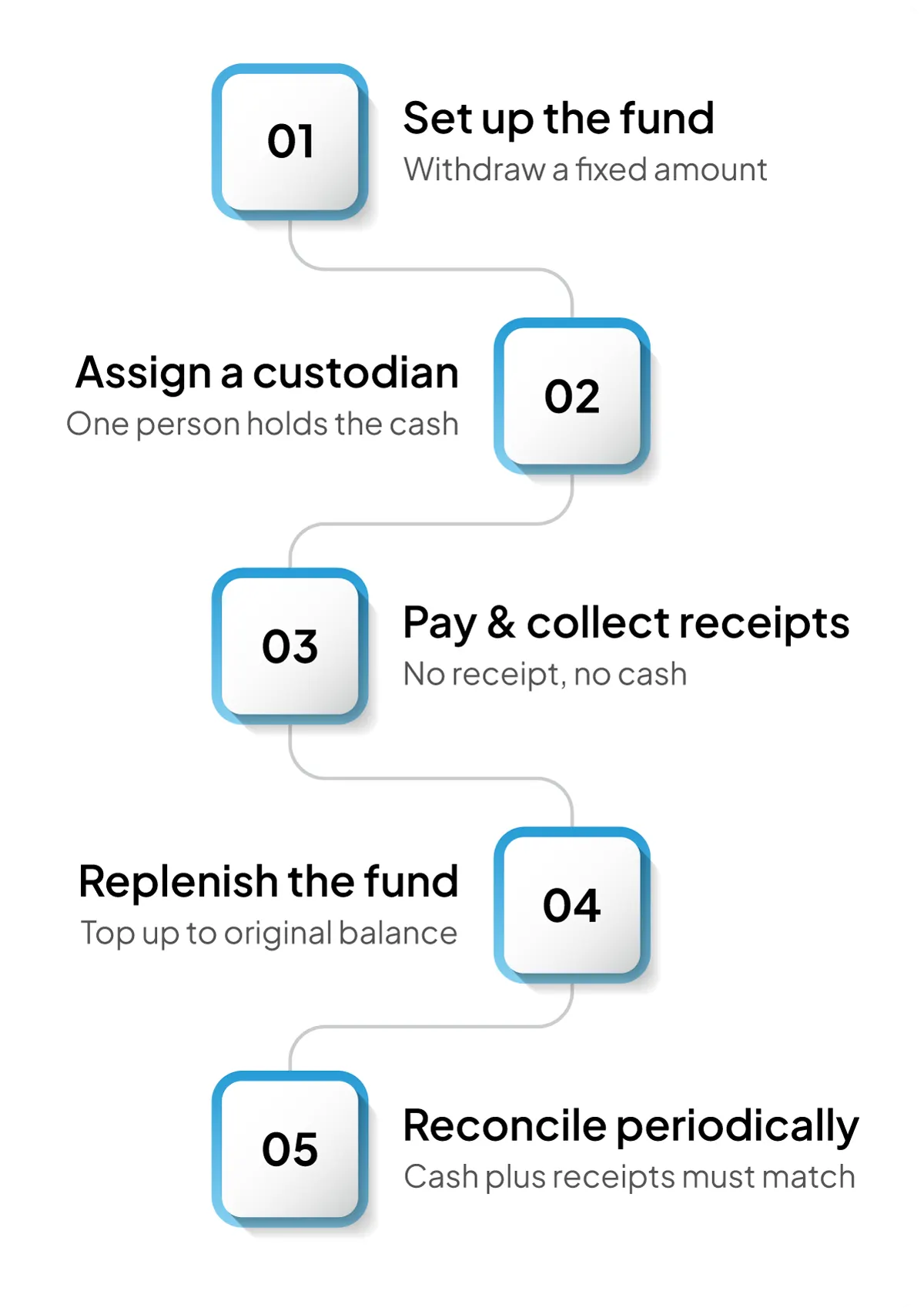
Step 1: Set Petty Cash Fund
Decide on the amount to set aside for the petty cash fund. This should ideally be a figure that can cover two or three weeks’ worth of minor expenses. Then withdraw this amount from the bank and record the transaction as an asset in your books.
Step 2: Assign a Petty Cash Custodian
Assign one person as the custodian of the fund. Clarify that it’s the custodian’s responsibility to lock the box, give out cash, collect receipts, and request replenishment as needed.
Never assign multiple custodians to one account. Shared custody could lead to finger-pointing if money disappears.
Step 3: Make Payments and Collect Receipts
If petty cash is required, the custodian will give out the cash and request a signed form or receipt from the employee. They’ll also log the amount in a petty cash record, which should detail the date, the amount taken, the purpose, and the name of the employee involved. Enforce a strict no-receipt, no-cash policy for the petty cash fund.
Step 4: Replenish the Petty Cash Fund
When the petty cash fund starts running low, the custodian gathers all receipts, adds up the total spent, and then places a request for that total. When the new cash arrives, they put it in the box, and the total returns to the original fixed balance.
Set either a set time period (a week or two) or a set percentage (when 20-30% of the original fund has been utilised) to replenish the fund so that it doesn’t run out.
Step 5: Have a Periodic Reconciliation Process.
Set a timeline, either weekly, every fortnight, or monthly, to reconcile the petty cash fund. Here, the custodian should have cash on hand plus receipts that equal the original fund amount.
The sum should match the fixed fund amount. If it does not, you have a discrepancy that needs investigation. Businesses with high transaction volumes should reconcile petty cash weekly rather than waiting until the end of the month.
How to Record Petty Cash Transactions?
Proper petty cash accounting ensures that every expense is reflected accurately in your financial records. In South Africa, the standard is to maintain a petty cash journal. This is a subsidiary book that captures every payment made from the fund under expense columns.
At the end of the reconciliation period, this book’s column totals are posted to the relevant expense accounts in the general ledger.
Example of Recording a Petty Cash Expense
Let’s say business A sets up a petty cash fund worth R2,000, and over two weeks, the staff spends R650: R300 on office coffee, R200 on a birthday cake, and R150 on postage.
All of these expenses are recorded in the petty cash journal under their respective analysed columns. At period end, the column totals are posted to the general ledger as follows:
- Debit: Office Coffee Expense – R300
- Debit: Birthday Cake – R200
- Debit: Postage Expense – R150
Example of Petty Cash Replenishment Entry
Per the current example, the custodian should have R 1350 in petty cash and receipts worth R 650. When added up,thesetotal R 2000, meaning the reconciliation is confirmed.
The entry in the general ledger is then recorded as follows:
- Debit (Various expense accounts) – R650
- Credit: Bank Account – R650
Is Petty Cash an Asset? (and Where It Appears in Financial Statements)
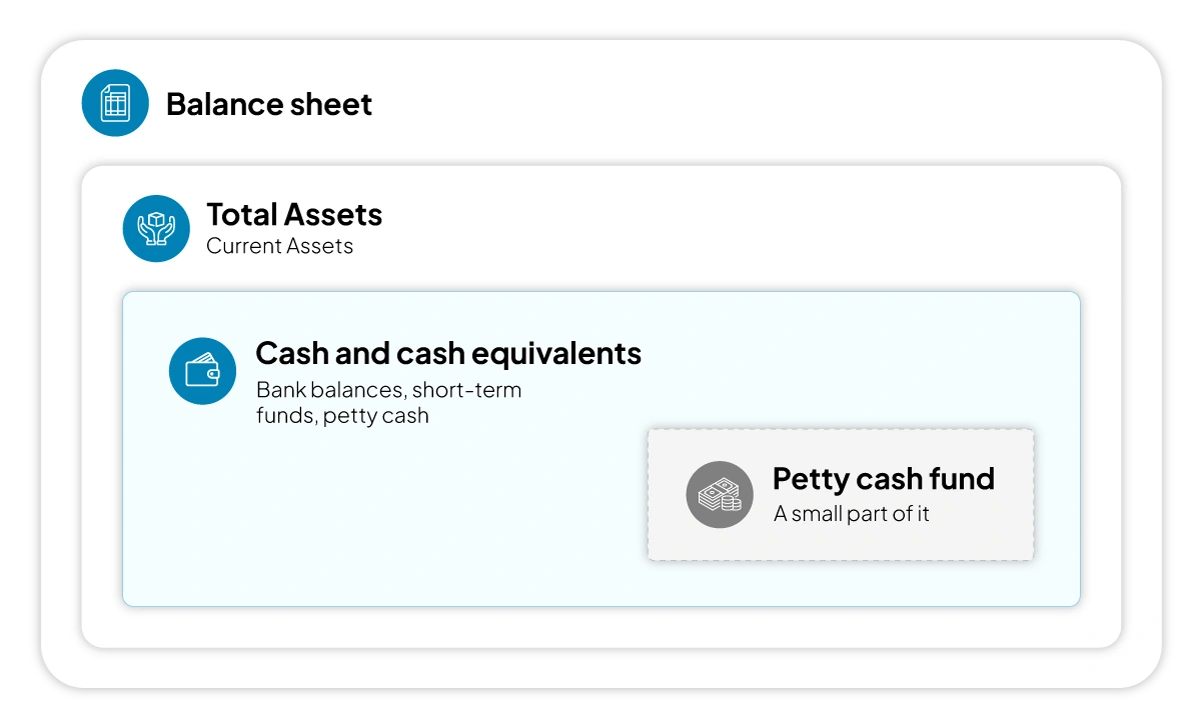
In simple terms, yes, petty cash is treated as an asset and shows up on your balance sheet in the Cash and Cash Equivalents section. Even though petty cash amounts are generally modest, they are still part of the company’s total cash resources.
Now, because it is an asset, any unexplained shortage in the petty cash fund must be accounted for either as an expense or investigated as a potential internal control failure. Unexplained cash shortfalls may invite further enquiries from SARS during audits.
Challenges in Managing Petty Cash
Although managing a petty cash fund seems pretty straightforward, there are a few challenges that businesses in South Africa face on a regular basis, such as:
- Missing or incomplete receipts: These are the most common issues when dealing with petty cash. Without a receipt attached to every voucher, the expense cannot be substantiated, which, as explained above, creates further problems for the business.
- Unauthorised or inflated claims: If team members realise that the petty cash fund is not reconciled frequently, it opens doors for employees to exploit the fund via either inflating expenses or unauthorised spending.
- Reconciliation gaps that compound over time: When reconciliation is ignored, what could be small, easily traceable discrepancies become more significant with no clear way to trace their origin.
Best Practices for Effective Petty Cash Management
Follow these best practices to maintain accountability for your petty cash account:
- Set a written petty cash policy so that there is no confusion as to its functioning.
- Limit access to the custodian only.
- Mandate a numbered voucher and receipt for every payment, regardless of amount.
- Reconcile weekly to flag any discrepancies.
- Conduct occasional surprise audits.
- Keep petty cash records for a minimum of five years in line with SARS documentation requirements.
How Technology Simplifies Petty Cash Management
Technology removes nearly every problem of managing petty cash manually. When using dedicated petty cash management software or an integrated ERP system, you as a business can set up a system where employees can request cash digitally, which by default creates an audit trail.
The same system can also use this data to categorise petty cash transactions and generate reconciliation reports in real time. For businesses operating across several branches, these digital systems also make it easier to maintain standardised processes for petty cash requests across the board.
How Does VasyERP Help Businesses Manage Petty Cash Efficiently?
VasyERP includes an integrated expense management module that tracks every cash transaction in real time. Your team requests petty cash through the system; approvals happen through here as well, and so does the uploading of the receipts. This creates a complete and tamper-proof audit trail for every petty cash transaction.
What makes VasyERP different is how it connects petty cash to your broader accounting. When you approve a petty cash expense, the system automatically creates the journal entry, updates the general ledger, and reduces the cash account balance: all of this without needing manual intervention.
For multi-location businesses, VasyERP tracks petty cash separately for each store or warehouse. It can also show you a consolidated view of all cash expenses across your entire operation.
The icing on the cake is that all of this comes with integration with purchasing, inventory, POS, and full accounting so that your business and its financial operations run from one platform.
FAQs Regarding Petty Cash
The imprest system of managing petty cash involves replenishing the fund periodically after reconciliation. The fund always returns to its original amount, but only after receipts are submitted and verified, making it one of the safest petty cash management methods used today.
The ideal petty cash limit depends on your business size and spending patterns. Most South African SMEs start with a fund between R1,000 and R5,000 and adjust it based on actual usage and reconciliation results.
At a minimum, petty cash should be reconciled monthly. However, businesses with higher transaction volumes or multiple locations often benefit from weekly reconciliation.
Yes. Many businesses now use prepaid cards, expense management applications, or ERP modules that reduce or completely eliminate the need for physical cash handling.
Last Updated on June 22, 2026