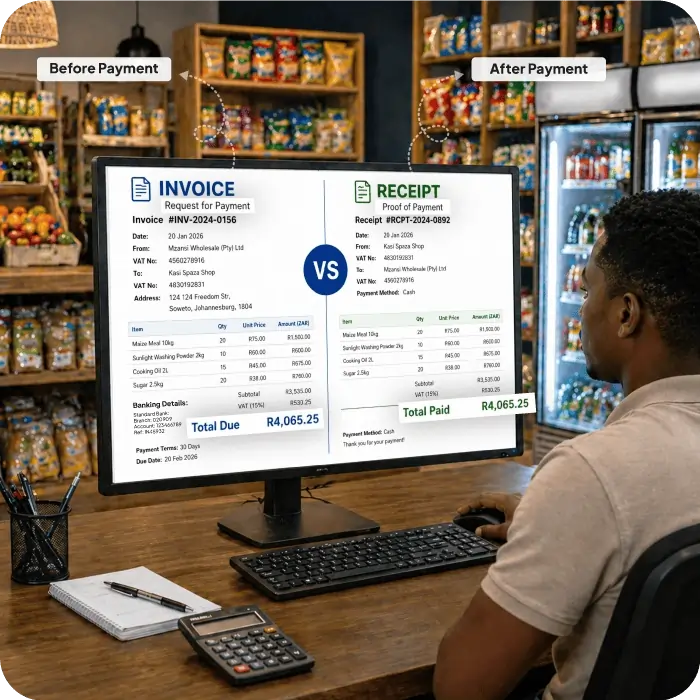
Quick Summary:
Still find debit vs credits confusing? This guide explains what they mean, how they work across the five main account types, and why they are essential to accurate bookkeeping in South Africa. It also shows how modern accounting and ERP software can handle these entries more efficiently for growing businesses.
You'll walk away knowing:
- How debits and credits work in accounting.
- How they affect assets, liabilities, equity, revenue, and expenses.
- How real business transactions are recorded.
- Why ERP-based accounting makes day-to-day financial management easier.
Debits and credits are among the first accounting terms most people come across, and they are often misunderstood, especially when you consider the debate around debit vs credit. Many assume they mean the same thing. In accounting, that is not the case.
They are part of the recording system used to track transactions correctly and keep the books balanced. For many business owners, the first step is understanding the difference between debit and credit and how each side affects the books.
That is also why debit and credit bookkeeping is such a core part of everyday business accounting.
What are Debits and Credits?
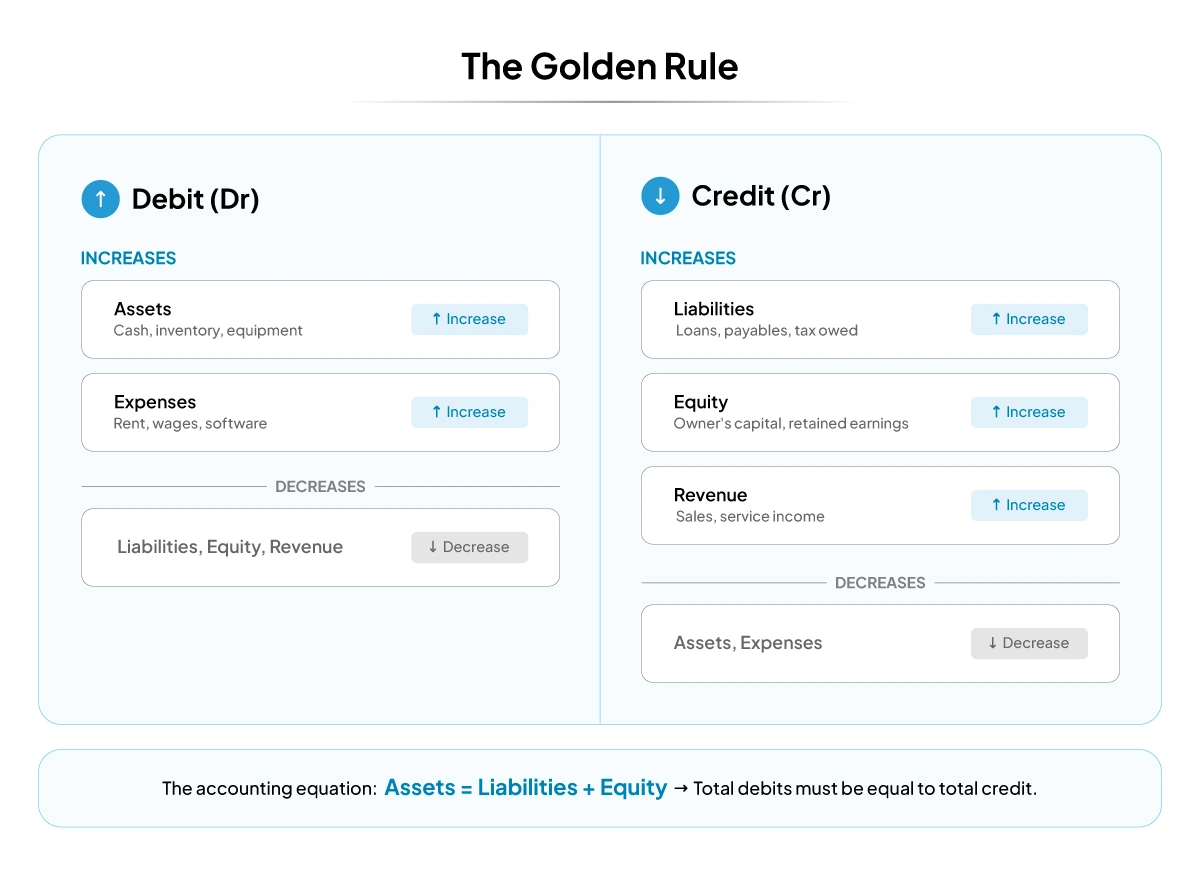
Each accounting entry is recorded through a debit and a corresponding credit. Under double-entry bookkeeping, each transaction affects at least two accounts, and total debits must always match total credits. That is what keeps the accounting equation in balance.
Account records place debits on the left side and credits on the right side. A common question at this stage is, assets increase on which side? For asset accounts, the answer is the debit side.
The important part is not the label alone, but the type of account being affected. In accounting, a debit can increase one type of account and decrease another. A credit works the same way.
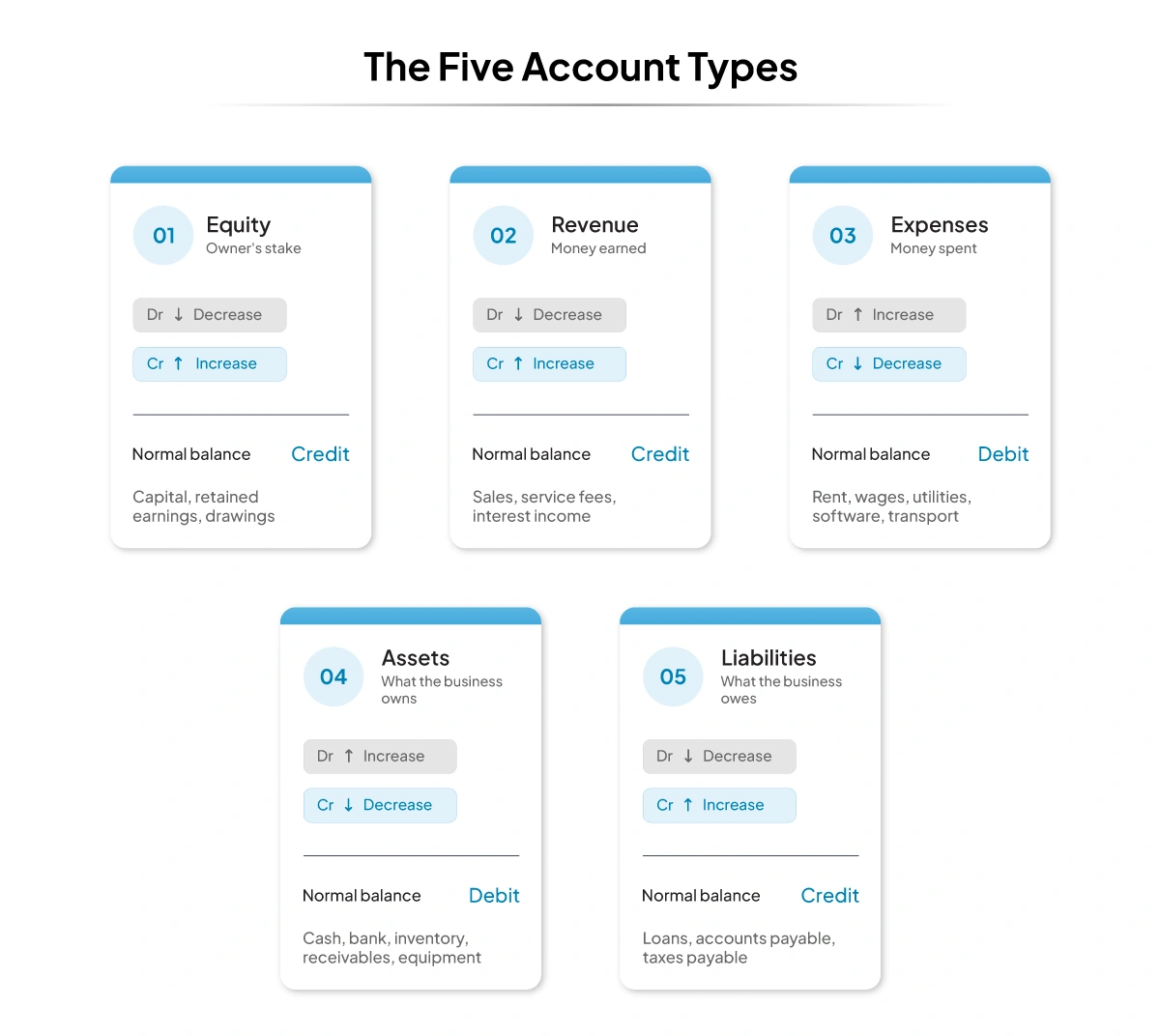
Key Terms: The Five Account Types at a Glance
Asset — Something the business owns or controls that provides future value (cash, inventory, equipment, receivables). Increases with a debit.
Liability — Something the business owes to others (loans, accounts payable, taxes payable). Increases with a credit.
Equity — The owner’s remaining stake in the business after liabilities are subtracted from assets (capital and retained earnings). Increases with a credit.
Revenue — Income earned from sales or services. Increases with a credit.
Expense — Costs incurred running the business (rent, wages, software fees). Increases with a debit.
At a basic level:
- Debits increase assets and expenses
- Credits increase liabilities, equity, and revenue
- The two sides must match in value for every transaction
This system gives bookkeeping its structure. It makes it easier to maintain accurate records, prepare reports properly, and trace how money is moving through the business.
Debits and Credits Across Five Account Types
To understand debits vs credits properly, it helps to look at the five account types used in most South African business records.
1. Assets: What the Business Owns
Assets are the resources a business has on hand or under its control. These usually include cash, inventory, equipment, furniture, bank balances, and money customers still owe. Asset accounts increase the debit side, while credits reduce the balance.
Say a customer pays for the business. Cash comes in, so the cash account is debited. When the business pays out cash, the balance drops, so the cash account is credited. Cash inflow and outflow are also recorded in the cash flow statement.
2. Liabilities: What the Business Owes
Liabilities refer to the amounts a business has to pay to other parties. These can include loans, accounts payable, taxes payable, and outstanding expenses. In the case of liability accounts, a credit raises the balance, and a debit lowers it.
If stock is purchased on supplier credit, accounts payable increase, so it is credited. When the supplier is paid later, accounts payable decrease, so it is debited.
3. Equity: Owner’s Stake in the Business
Equity is the owner’s share in the business after liabilities are deducted from assets. It includes capital introduced by the owner and retained earnings.
Equity balances grow when credited and fall when debited. If the owner adds money to the business, capital increases and is credited. If money is withdrawn for personal use, equity is reduced.
4. Revenue: Money Earned
Revenue is the income a business makes from sales or services. For revenue accounts, a credit adds to the account, and a debit takes from it. If the business makes a sale, sales revenue is credited because the income has increased.
5. Expenses: Money Spent
A business records expenses for the costs it takes on during normal operations. Common examples include rent, wages, power bills, software fees, and advertising costs.
For expense accounts, the usual rule is straightforward: a debit increases the balance, while a credit reduces it. If monthly rent is paid, the rent expense is debited because that cost has increased.
A Simple Rule to Remember Regarding Debits and Credits
A practical way to remember this is the following:
Debits increase assets and expenses. Credits increase liabilities, equity, and revenue.
It also helps to stop thinking of debit and credit as positive and negative, or good and bad. They are simply two sides of the accounting system. Once the account type is clear, the entry usually becomes easier to work out.
Interesting Fact 95% of small businesses surveyed use digital tools to help manage their business processes.
Source:Quick Books
Debits and Credits in Real-Life Examples
Here are a few debit and credit examples to show how the rules work in practice. For each example below, notice how the accounting equation: Assets = Liabilities + Equity always stays balanced.
Example 1 – Cash Purchase of Office Supplies
Suppose a business buys office supplies worth R950 and pays immediately in cash.
- Debit: Office supplies expense R950
- Credit: Cash R950
The expense increases, so it is debited. Cash decreases, so it is credited.
Impact: Assets (–R950 Cash) = Liabilities (R0) + Equity (–R950 Expense)
Example 2 – Making a Sale for Cash
A retailer sells goods for R3,800 and receives cash immediately.
- Debit: Cash R3,800
- Credit: Sales revenue R3,800
Cash, which is an asset, increases. Revenue also increases, so sales revenue is credited.
Impact: Assets (+R3,800 Cash) = Liabilities (R0) + Equity (+R3,800 Revenue)
Example 3 – Providing Services on Credit
A service business completes work worth R7,500, but the customer will pay later.
- Debit: Accounts receivable R7,500
- Credit: Service revenue R7,500
Accounts receivable increases because the customer now owes the business money. Revenue also increases.
Impact: Assets (+R7,500 Accounts Receivable) = Liabilities (R0) + Equity (+R7,500 Revenue)
Example 4 – Paying Monthly Rent
A business pays R5,500 in rent for the month.
- Debit: Rent expense R5,500
- Credit: Cash R5,500
Rent expense rises, while cash falls.
Impact: Assets (–R5,500 Cash) = Liabilities (R0) + Equity (–R5,500 Expense)
Example 5 – A SaaS Subscription Transaction
A business pays R650 for a monthly software subscription.
- Debit: Software subscription expense R650
- Credit: Bank/cash R650
The subscription cost is an expense, so it is debited. The payment account is reduced, so it is credited.
Impact: Assets (–R650 Cash) = Liabilities (R0) + Equity (–R650 Expense)
Example 6 – A SaaS Business Billing Annually in Advance
Say a South African software business sells a 12-month subscription for R12,000, billed upfront.
Since the service will be delivered over the full year, the business can’t recognise all R12,000 as revenue immediately as it still owes 12 months of service to the customer. So the payment is first recorded as a liability.
Step 1 – Recording the upfront payment:
- Debit: Cash R12,000
- Credit: Unearned revenue (liability) R12,000
Impact: Assets (+R12,000 Cash) = Liabilities (+R12,000 Unearned Revenue) + Equity (R0)
Step 2 – Recognising one month of revenue:
Each month, as the service is delivered, R1,000 shifts from unearned revenue into actual revenue.
- Debit: Unearned revenue (liability decreases) R1,000
- Credit: Subscription revenue R1,000
Impact: Assets (R12,000) = Liabilities (–R1,000 → R11,000) + Equity (+R1,000 Revenue)
This continues monthly until the full R12,000 has been recognised as revenue over the year, a common pattern for South African SaaS and subscription-based businesses.
These debit and credit examples are simple, but the same logic applies across routine business accounting. Billing, stock purchases, tax entries, software payments, and supplier transactions all follow the same double-entry principle.
Are Balance Sheet Accounts Debits or Credits?
Balance sheet accounts include assets, liabilities, and equity. These account types do not all behave in the same way.
- Assets normally carry a debit balance
- Liabilities normally carry a credit balance
- Equity normally carries a credit balance
That is why cash, inventory, and receivables usually increase with debits, while loans, payables, and owner’s capital usually increase with credits. So when someone asks if balance sheet accounts are debits or credits, the better answer is that each category has its own normal balance.
Debits and Credits in Income Statement Accounts
Income statement accounts mainly include revenue and expenses.
- Revenue accounts usually have a credit balance because revenue increases with credits
- Expense accounts usually have a debit balance because expenses increase with debits
So when a business earns income, it credits revenue. When it incurs rent, salaries, software costs, transport charges, or other operating expenses, it debits the relevant expense account. That is part of what gives the income statement its structure. It separates money earned during the period from money spent during the same period.
Special Case You Should Know: Contra Accounts
Contra accounts are tied to related accounts and reduce their reported value. They do this without removing the original account from the books.
A typical contra-asset account is accumulated by depreciation. Assets normally carry debit balances, but accumulated depreciation usually carries a credit balance. It reduces the recorded value of fixed assets over time.
Other common examples include:
- Allowance for doubtful accounts
- Sales returns and allowances
- Sales discounts
These accounts improve the quality of reporting. Instead of overstating assets or revenue, they show the reduction clearly within the records.
How Modern Accounting Software Manages Debits and Credits
The rules behind debit and credit are the same as they have always been, but the recording process has changed significantly. Manual debit and credit bookkeeping becomes harder to manage as transaction volume increases.
Sales entries, supplier bills, purchase orders, tax postings, stock movements, and subscription charges can build up quickly. That creates more opportunities for errors and more time spent checking the books.
A large part of this workload can be reduced with modern accounting software. Once the transaction is entered correctly, the system can handle much of the posting automatically. That means there is less need to write both sides of each journal entry manually, while the correct accounts, general ledger, and records stay updated.
It also improves reporting, receivables, payables, and audit tracking by keeping the entry trail easier to follow.
Debits and Credits in ERP-based Accounting
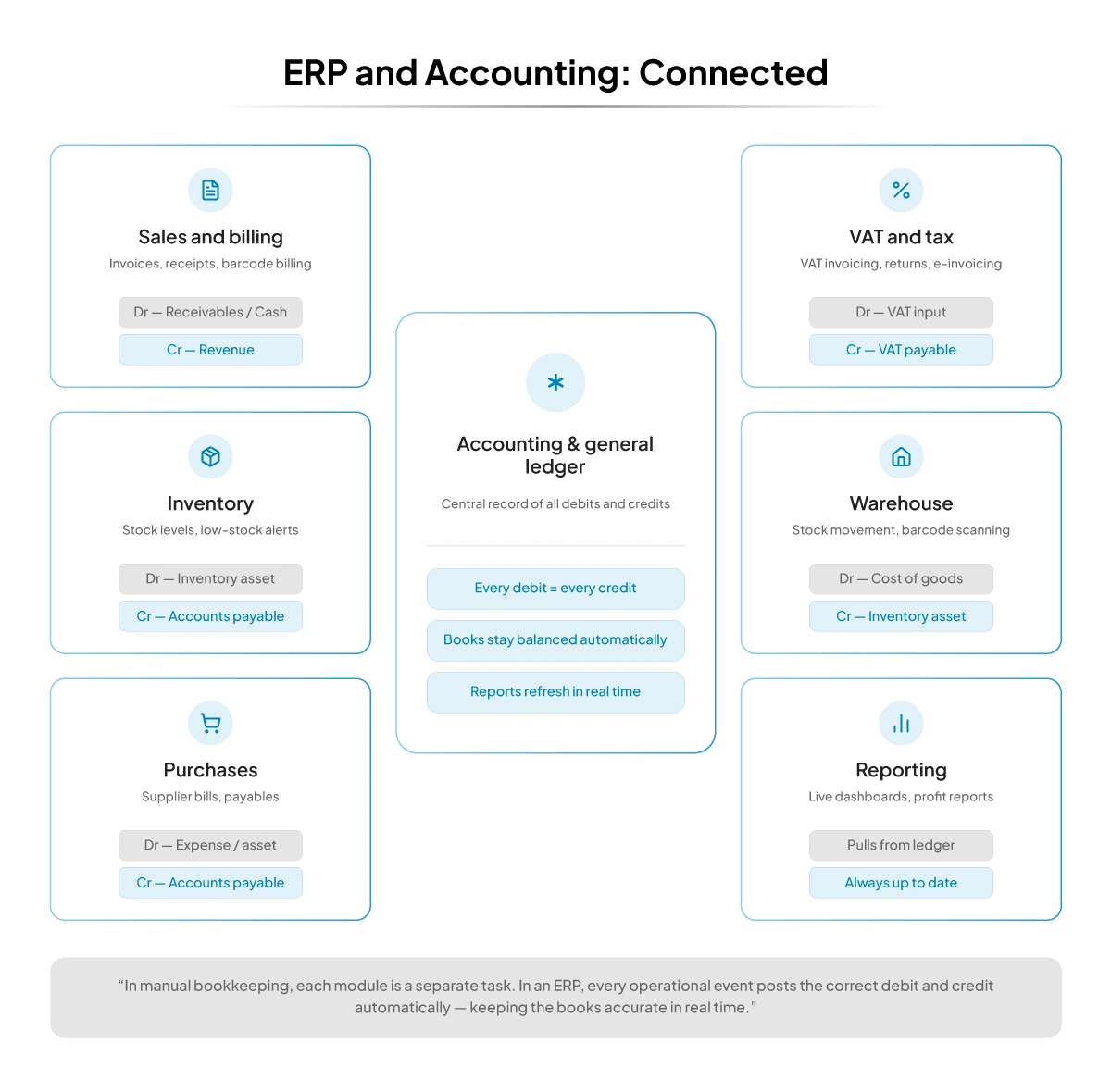
As businesses grow, recording debits and credits manually becomes harder to manage across billing, inventory, tax, and reporting. ERP-based accounting helps simplify debit and credit bookkeeping by linking financial entries to day-to-day business activity, so transactions are not recorded in isolation.
Why ERP-Based Accounting Matters
In an ERP environment, accounting connects with sales, purchases, inventory, billing, warehouse activity, tax calculations, and reporting. That means debit and credit entries are recorded alongside the operational activity behind them, which makes the records easier to maintain and interpret.
How This Works in Practice
For example, when a sale is processed through a POS machine, an ERP system automatically generates an invoice and receipt; in the backend, accounting and operational effects can happen together.
Revenue is recognised, cash or receivables are updated, stock levels can be adjusted, and reports can refresh without teams having to update them manually.
The same logic applies to purchases, VAT-compliant invoicing, warehouse movement, and business analytics. Instead of treating bookkeeping as a separate task after the transaction, the ERP system keeps financial entries aligned with the actual business event.
Final Thoughts: Once You Get This, Accounting Becomes Logical
Debit vs credits often sound harder than they are. Once the difference between debit and credit is clear, and once you know which account types increase on each side, the system starts to make sense.
That matters because accurate accounting improves clarity. When debits and credits are recorded properly in cloud-based accounting software, reports become more dependable, mistakes are easier to identify, and decisions can be made with better information.
In a connected ERP system such as VasyERP, billing, inventory, reporting, and accounting can stay aligned in a far more practical way.
FAQs Regarding Debits and Credits
Not at all, this trips up a lot of people. On your bank statement, a debit usually means money has gone out. In accounting, it just means the left side of an entry. It could mean cash coming in, or an expense being recorded. It all depends on which account is being affected.
It's a system where every transaction gets recorded in two places, one debit and one credit, always of equal value. So if something goes up on one side, something else must balance it on the other. This keeps your books accurate and makes mistakes much easier to catch.
It depends on which account you're looking at. Assets normally sit on the debit side, so they increase with debits. Liabilities and equity sit on the credit side, so they increase with credits. There's no single answer; each account type has its own normal balance.
Standard accounting software keeps your books. ERP-based accounting keeps your entire business connected. Instead of updating your records separately after a sale or purchase, an ERP does it automatically as part of the transaction, stock levels, receivables, VAT, and reports all update together in one go.
Last Updated on July 23, 2026