You’ll walk away knowing:
-
- What e-invoicing is and why UAE businesses need it now.
- How the new UAE e-invoicing framework works and who it applies to.
- How e-invoicing functions at the point of sale.
- The key features to look for in UAE e-invoicing software.
- What the future of retail billing looks like in the UAE.
The UAE has always had one of the more structured VAT frameworks amongst the Gulf nations. In a bid to improve it further, the country is now mandating that transactions in the UAE must be issued, exchanged, and reported electronically through an accredited provider on the Peppol network.
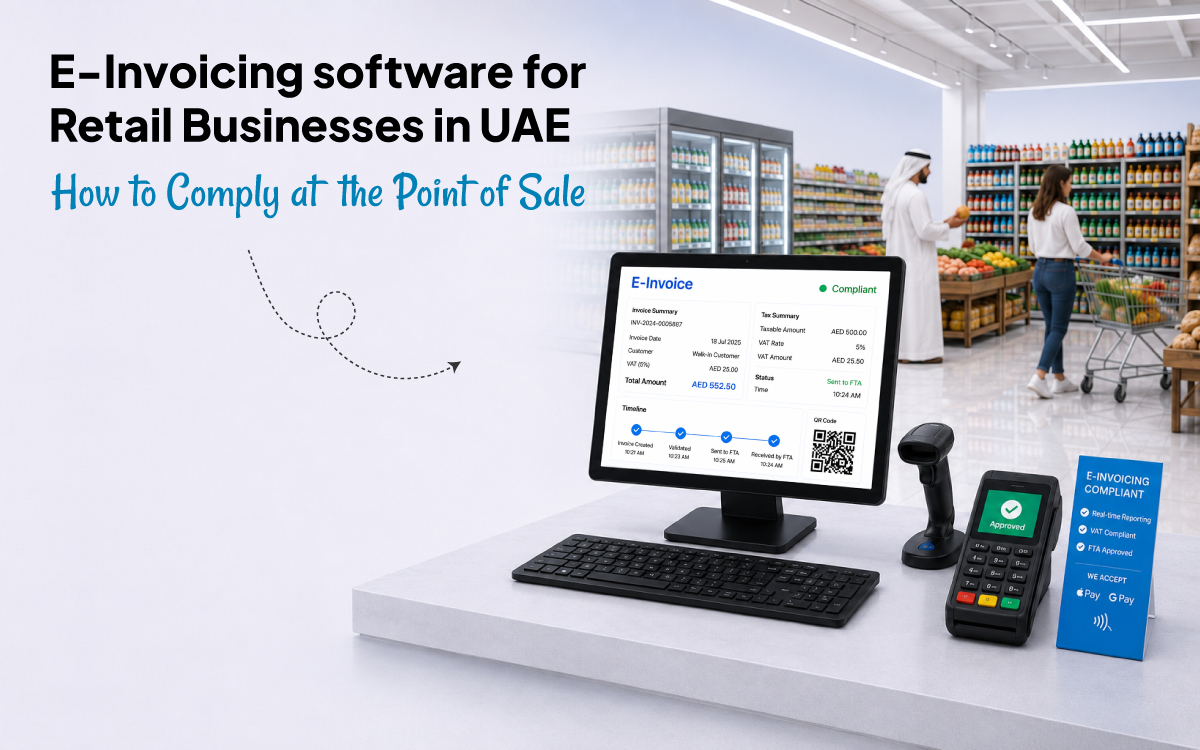
For a retail business, large or small, this change means that your journey towards being compliant starts from your POS. With the new e-invoicing mandate in place, a compliance event will now be generated, transmitted, and reported to the Federal Tax Authority in near real time.
In short, your POS system must generate compliant invoices automatically, and this guide tells you exactly what you need to do to make that happen.
What is E-Invoicing in the UAE and Why Do Businesses Need It?
E-invoicing, simply put, is the electronic replacement for manual invoices. They are generated, stored, and transmitted digitally. Per the mandate, all invoices need to be generated per the PINT AE standard, which is a specific machine-readable format that will allow the FTA to read and process them automatically.
As a business, this is soon to be a mandatory compliance requirement. That said, with the right POS system, the move will ensure fewer errors when generating invoices; fewer errors and discrepancies will mean lower chances of audits and compliance violations.
This push towards automating the till will also benefit your business directly with faster checkouts, easy integration with your digital accounting systems and the reduction of fraud.
Understanding The UAE E-Invoicing Framework
The UAE has adopted a Decentralised Continuous Transaction Control and Exchange (DCTCE) model, commonly referred to as the five-corner model: The five corners are:
- The supplier.
- The supplier’s Accredited Service Provider or ASP.
- The buyer’s ASP
- The buyer.
- The Federal Tax Authority
Under this framework, the supplier’s ASP reports tax data to the FTA in parallel with transmitting the invoice to the buyer’s ASP. The result allows for near real-time oversight for the FTA without acting as a bottleneck in the exchange.
For a retail business, this means your billing software must connect to an FTA-approved ASP which generates invoices in PINT AE structured XML format.
As of now, the implementation timeline for e-invoicing in the UAE is as follows:
- 1 July 2026: The Voluntary pilot phase opens, where any business in the UAE can begin issuing e-invoices voluntarily.
- 30 October 2026: The deadline for large businesses with annual revenue of AED 50 million or more to appoint an Accredited Service Provider.
- 1 January 2027: E-invoicing becomes mandatory for large businesses (AED 50M+ revenue).
- 31 March 2027: Deadline for smaller businesses and government entities to appoint an ASP.
- 1 July 2027: E-invoicing becomes mandatory for smaller businesses and new entities.
- 1 October 2027: E-invoicing becomes mandatory for government entities.

How E-Invoicing Works at the Point of Sale
Here is how e-invoicing works at the point of sale:
1. The Sale is Processed at the POS System
As soon as a cashier completes the transaction, the billing software captures all required invoice fields: seller TIN, buyer details (for B2B), line-item descriptions, quantities, VAT amounts, and total.
2. Invoice is generated in PINT AE XML format
The POS system or integrated ERP converts the transaction data into a structured PINT AE XML file. This is the machine-readable format the UAE e-invoicing system requires.
3. Invoice Is transmitted to the ASP
The structured invoice is sent to the retailer’s Accredited Service Provider via a secure API connection. The ASP validates the invoice against the UAE’s technical specifications.
4. ASP Reports to the FTA and Forwards to Buyer’s ASP
The supplier’s ASP simultaneously reports the tax data to the Federal Tax Authority and transmits the invoice to the buyer’s ASP. This parallel reporting is what makes the system continuous rather than periodic.
5. Electronic Confirmation Is Received
The retailer receives an electronic confirmation that the invoice has been transmitted and accepted. This confirmation is the compliance record for that transaction.

Key Features to Look for in UAE E-Invoicing Software
Not every billing software in Dubai or across the UAE is currently built to handle the technical and compliance requirements of the e-invoicing mandate. Look for these features specifically:
1. POS Integration
The software must integrate directly with your POS system. Avoid a standalone e-invoicing tool that requires manual data entry from POS transaction records.
The POS system should generate the invoice data automatically at the point of transaction, feed it to the e-invoicing engine, and transmit it to the ASP without any intermediate manual step.
2. ERP Integration
The e-invoicing solution must the must connect to the broader ERP system as well since purchase invoices received from suppliers also fall within the e-invoicing framework on the buyer side.
Your ERP needs to receive, validate, and store inbound e-invoices from your ASP in the same structured format as well.
3. Inventory Synchronisation
If you use an inventory management system, your e-invoicing software must integrate with it as well. If your billing software and inventory system are not synchronised, the transaction data reported to the FTA may not align with your actual stock movement records: a scenario that can trigger an audit.
4. VAT Automation
The PINT AE invoice format requires VAT to be correctly calculated and declared at the line-item level and not just as a total at the bottom of the invoice. It also needs to handle zero-rated, standard-rated, and exempt products correctly.
5. Real-Time Reporting
The five-corner model is built around near-real-time reporting to the FTA. Your billing software must be able to generate and transmit invoice data to your ASP with minimal delay after each transaction.
Preparing Your Retail POS System for UAE E-Invoicing Compliance?
VasyERP's integrated billing software connects your point of sale to FTA-compliant e-invoicing from the transaction level.
Future of Retail Billing in the UAE
Based on the UAE’s e-invoicing mandate, the direction of travel is pretty clear. We are likely to see:
1. A Lot More Automation
Manual invoicing will be phased out gradually. POS systems and billing software will automate everything from invoice generation to its transmission and storage.
2. AI-Powered Compliance
AI embedded within these tools will automatically flag compliance anomalies before they reach the ASP. This will significantly boost compliance and reduce businesses’ exposure to audits.
3. Digital Tax Reporting
The FTA’s access to real-time transaction data through the e-invoicing framework is the beginning of a shift toward continuous digital tax reporting.
We could see VAT returns in the future be pre-populated from e-invoice data held by the FTA, reducing the periodic filing burden on businesses.
Summing It Up
E-invoicing is here to stay, and the voluntary pilot is already live. The best way forward is to switch to a billing software with an e-invoicing capability now, rather than rushing to implement under the pressure of the deadlines in late 2026 or early 2027.
Doing so will also give you the added advantage of a smoother transition to the new system and will avoid any last-minute surprises when the FTA’s real-time visibility kicks in.
VasyERP‘s integrated POS and billing software is built for exactly this transition. It can generate FTA-compliant invoices at the point of sale that synchronise with inventory in real time.
With the latest updates, it now supports simultaneous pricing updates across product variants and enhanced VAT controls for multi-outlet businesses.
Book a free 30-minute demo to see how it can work for your business.
FAQs
- 0
- 0
- 0