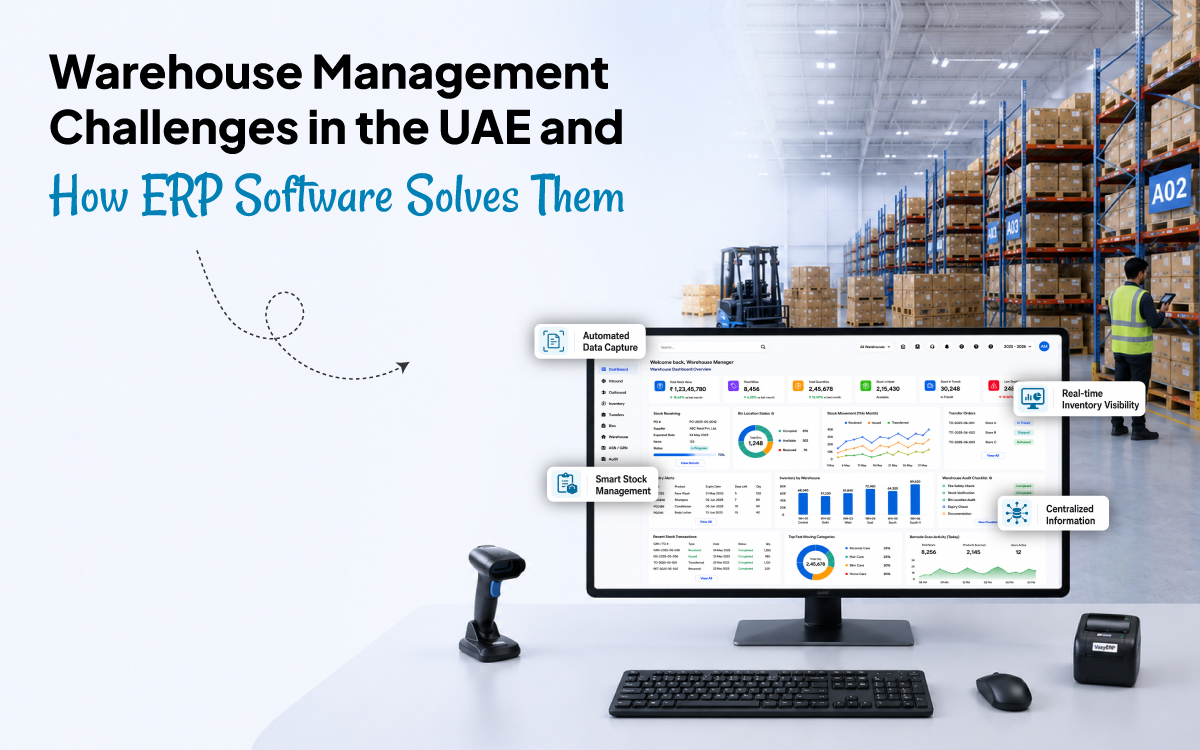
Warehouse management in the UAE needs close coordination between stock, purchases, sales orders, and transfers. When these records are split across different tools, the team may work with old numbers. ERP software with warehouse management system capabilities helps teams control stock, purchases, movement, expiry, billing, and reports from one place.
This blog will cover:
- Why inventory accuracy is difficult
- How manual work increases costs
- What changes during Ramadan and DSF
- How ERP software supports warehouse stock management
For a warehouse team in the UAE, the day can get messy very quickly. Orders come in from stores, online channels, and B2B buyers. New stock may arrive from suppliers or imports, while returns and branch requests keep changing the numbers.
When the records are handled in spreadsheets, stock books, basic billing tools, or separate inventory management software, updates don’t always happen on time. The sales team may show an item as sold, but the warehouse may still be working with yesterday’s stock count.
That gap creates confusion. With ERP software, stock, purchases, sales, accounts, and warehouse updates sit in one system. This also means fewer checks across separate files.
Why UAE Warehouses Still Struggle With Inventory Accuracy
Stock counts become harder to trust when the business has many products, suppliers, locations, and sales channels.
A supermarket is a simple example. Fresh stock comes in, items are sold at the counter, cartons move to another branch, and expired products may be removed later in the day. If each entry is updated manually, the closing stock rarely matches the real shelf or warehouse stock.
Common reasons for mismatch include:
- Purchase entries made after goods are already stored
- Sales, returns, and exchanges not updating stock at the same time
- Similar SKUs created with different names or units
- Expired or sample stock removed without an audit trail
- Stock transfers recorded by one warehouse but not confirmed by the receiving team
A warehouse management system helps by updating stock as transactions happen. It can track batches, item variants, near-expiry products, low stock levels, stock ageing, and location-wise availability.

Cost Of Manual Warehouse Operations And How ERP Reduces It
Manual warehouse operations cost more than the time spent on data entry. The bigger loss comes from errors that move across stock, purchasing, billing, and accounting records.
Where Manual Work Creates Extra Cost
A distributor may receive supplier invoices in PDFs, enter quantities into a spreadsheet, update the accounting software, and then inform the warehouse team. If one quantity or price is entered incorrectly, the mistake can affect stock levels, supplier payments, and profit reports.
Manual work also creates hidden costs through:
- Repeated data entry across different tools
- Delayed stock updates after purchase or sale
- Extra time spent checking mismatched records
- Wrong purchase planning because reports are outdated
How ERP Reduces These Errors
ERP software brings purchase orders, material inward, supplier bills, sales, and accounting into one place. Your team can update the record once and use the same details across departments.
VasyERP also supports OCR-based purchase automation. It can read supplier invoices from PDFs or images and capture product names, quantities, prices, and supplier details. This cuts down manual entry and keeps stock records easier to check.
ERP also helps managers track wastage, samples, internal use, expired goods, and purchase returns. Each entry adjusts stock and creates a clear record for review.

What Problems UAE Warehouses Face During Ramadan And DSF
Ramadan and the Dubai Shopping Festival can change warehouse planning quickly. Demand rises for some categories, order patterns shift, and stock movement becomes harder to predict.
1. Seasonal Demand Is Hard To Forecast
Ramadan usually puts more pressure on food, gifting, household, and personal care stock. Warehouses may need to prepare earlier than usual, especially when supplier schedules and working hours change.
DSF can create sudden movement in fashion, electronics, beauty, perfume, and lifestyle categories because of discounts and campaign-led sales. This creates pressure on picking, packing, dispatch, and replenishment.
2. Promotions Can Distort Stock Availability
The main challenge is uneven stock movement. One branch may sell out of a fast-moving SKU while another branch holds extra stock. Online orders may also pull from the same stock pool as retail stores.
Returns after promotions can add another layer of confusion. If returned items are not updated properly, the system may show stock as available even when it still needs checking.
3. Reorder Planning Becomes Unreliable
Regular monthly averages may not work during Ramadan or DSF. A product that usually sells slowly can move faster during a campaign, while another item may sit longer than expected.
This makes purchase planning difficult. Teams may order too late, overstock the wrong products, or miss branch-level demand changes until customers start asking for unavailable items.
Set separate reorder levels for Ramadan and DSF instead of using regular monthly averages.
Problems In Multi-Warehouse Operations
Many UAE businesses operate across Dubai, Abu Dhabi, Sharjah, Ajman, or free zone locations. Some businesses also use one central warehouse to supply several retail outlets. This setup supports growth, but it needs tighter control.
1. Stock Visibility Becomes Limited
Multi-warehouse work gets harder when every location keeps its own stock sheet or local record. The owner may not be able to quickly check where an item is available, which branch needs stock, or which transfer is still open.
This can result in fresh purchases even when the same item is sitting in another warehouse. It can also delay dispatch when the team cannot quickly find the right location.
2. Stock Transfers Need Clear Verification
A common issue is one-way transfer recording. The sending warehouse may mark the goods as sent before the receiving team checks the quantity.
If the shipment arrives late, has missing items, or includes damaged stock, the main record can become wrong. Small differences like this can turn into larger stock mismatches later.
3. SKU And Item Data Can Become Inconsistent
Item data can get messy when every warehouse maintains its own records. The same product may be entered with a different name, unit, or barcode at each location.
That creates problems in warehouse stock management. The team may not catch duplicate item records. Reports also lose accuracy when names, units, or barcodes are different across locations.
Keep item names, units, barcodes, and SKU codes the same at every location.
How ERP Software Solves Warehouse Management Challenges
ERP software puts warehouse entries, purchases, sales, billing, accounting, and reports in the same place. So when one team updates a record, the next team is not working with old or mismatched data.
For UAE businesses, this can include:
- Real-time stock updates across stores, warehouses, and online channels
- Batch and expiry tracking for better stock control
- Purchase order, material inward, and supplier invoice tracking
- Stock transfer requests with verification between locations
- Reports for low stock, stock ageing, top-selling items, and slow-moving items
This setup helps managers check available stock faster, plan replenishment with cleaner data, and avoid the confusion created by delayed manual updates.
How To Choose The Right ERP With WMS
The right ERP should match your warehouse process, not force your team into a complicated setup. Start with the work your team handles every day.
Check these areas before choosing:
- Inventory Fit: Make sure it can handle batches, variants, expiry dates, barcode scans, old stock, and low-stock warnings
- Multi-Location Control: For branches and warehouses, it needs clear stock views, transfer records, and one central report for managers
- Purchase Workflow: Purchase orders, material inward, supplier bills, returns, and invoice automation should fit into the same flow
- Sales Connection: POS bills, online orders, field sales, and B2B orders should update the same stock record
- Local Business Needs: UAE businesses should check VAT support, AED reports, role-based access, and implementation support
Warehouse staff should be able to handle daily tasks without moving through too many screens. Receiving goods, scanning items, checking stock, and confirming transfers should feel clear from the start. VasyERP connects these warehouse tasks with purchases, POS, accounting, CRM, omnichannel sales, reports, and multi-location control.
In the demo, check how quickly your team can completea stock inward, transfer, and stock lookup.
Conclusion
Warehouse management in the UAE can get complicated when every update sits in a different place. Stock, purchases, sales, returns, and transfers may be easy to track in the early stage, but manual records become less dependable as SKUs, suppliers, branches, and seasonal sales increase.
ERP software with warehouse management system features helps your business improve inventory accuracy, reduce manual entries, control multi-warehouse movement, and prepare better for Ramadan and DSF.
VasyERP brings these workflows together with inventory, purchases, billing, accounting, reports, and multi-location control in one connected system.
FAQs :
UAE warehouses usually have to manage stock mistakes, late updates, expiry checks, supplier delays, branch transfers, seasonal rushes, and orders coming from more than one sales channel.
A WMS changes the stock count whenever there is a purchase, sale, return, transfer, wastage entry, or stock adjustment. This helps teams check available stock by item, batch, and location.
Yes. ERP software can track stock across warehouses, stores, and branches in different UAE locations. It can show branch-wise stock, pending transfers, received quantities, and central reports.
WMS pricing in Dubai changes with the setup. Users, warehouse count, modules, integrations, data migration, training, and support can all affect the final quote. Ask the vendor for AED pricing based on your own warehouse process.
ERP software helps reduce costs by cutting manual work, preventing duplicate buying, showing what stock is already available, and making reorder planning easier for managers.
- 0
- 0
- 0