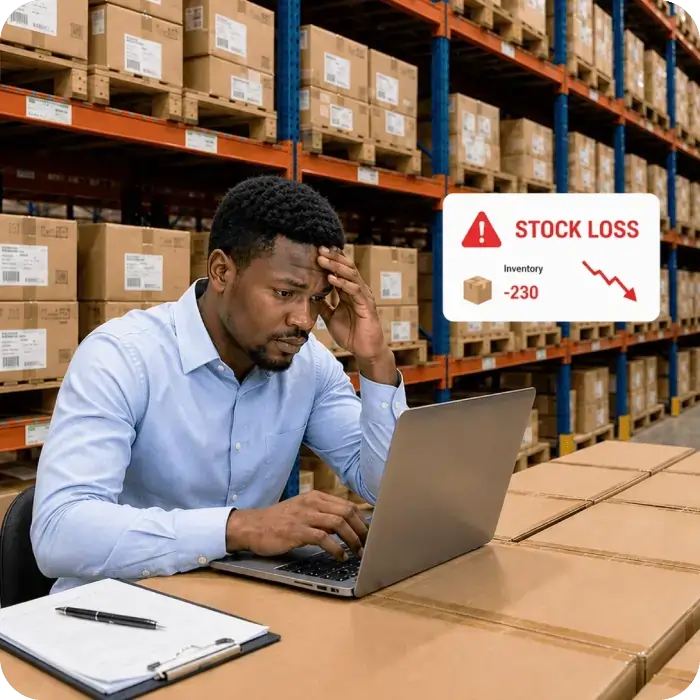
Quick Summary:
Any business that holds inventory needs a reliable way to manage it. Poor inventory management leads to one of two outcomes, locked cash flow or lost revenue. This guide covers how to avoid both through proper inventory management.
You'll walk away knowing:
- What is inventory management, and why is it important for every business to implement it?
- The most effective inventory management techniques in use today.
- Common trade payables examples businesses deal with every month
- Metrics to track the state of your inventory.
- The most common stock management challenges and how to overcome them.
For any business that sells physical goods, you need to hold stock in bulk. For most South African businesses, the value of the stock they hold is often higher than the cost of the warehouse it sits in.
This, however, is only half the picture. Physical stock is capital tied up and waiting to be recovered through sales or clearances. Such losses erode not just the value of the stock itself, but also the associated profit margins.
We can avoid this through systematic inventory management.
What is Inventory Management?
Inventory management covers all physical stock from the moment it enters your warehouse, through storage, to the point it is shipped out for sale. 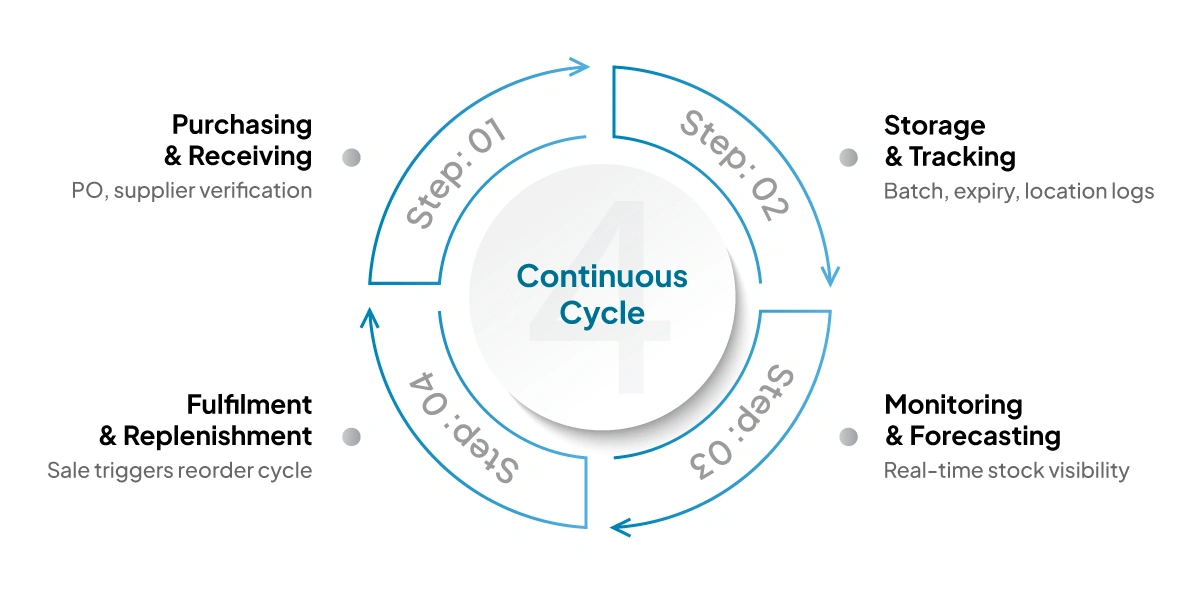 If you are a manufacturing firm, this involves the management of raw materials, individual components, and the final finished product. While the concept sounds simple on the surface, it is a complex process, and the complexity only grows with the scale of your business. A well-equipped inventory management system ensures your business has the following:
- You have adequate stock available at all times.
- Your inventory levels are accurate.
- Most importantly, you don’t have unnecessary capital locked in the inventory.
Why is Inventory Management Critical for Businesses?
Proper inventory management is critical for businesses, both small and large, especially in South Africa, because it directly impacts your finances in multiple ways. Here is how:
1. To Avoid Overstocking
When you have an inventory tracking system in place, you know the real-time status of the stocks at hand. Having this information on hand helps you avoid overstocking, which in turn prevents additional capital from being tied up in dead stock.
2. To Avoid Stockouts
On the other end of the spectrum, understocking or stockouts have their own costs as well. When you run out of stock, you don’t just lose one sale; you can end up losing a customer altogether: that’s their entire lifetime value gone.
3. To Minimise losses
With real-time store and inventory management, you also avoid the losses that occur due to expired stock or other forms of shrinkage.
4. You Make Better Decisions
Systematic inventory management alone is not enough to address these challenges. When you run the right stock management software, you also gain the capability to run reports in real-time. This, in turn, helps you make better decisions overall.
How Inventory Management Works
Inventory management is a complex loop where each stage impacts the next. Here is how it works in practice:
1. Inventory Purchasing and Receiving
Supply chain inventory management begins with the procurement stage. Here, the business identifies the stocks it needs and raises an internal requisition request. Once approved, a PO is raised and sent to the supplier. Incoming goods are verified to ensure they match the quality and quantity per the PO, and invoices are clearly posted with three-way matching. Any discrepancies at this stage create a ripple effect of errors across your order management system in your organisation.
2. Inventory Storage and Tracking
Once the goods are received, the focus shifts to storing them in a manner where they are safe, accessible, and traceable. For businesses dealing with products with expiration dates or batch numbers, this stage also involves logging that information so it is available throughout the product’s lifecycle. If you run multiple stores, operate via multiple channels, or own multiple warehouses, your inventory tracking system should also track inter-store transfers and monitor inventories of individual stores or warehouses.
3. Inventory Monitoring and Forecasting
Perhaps the most important aspect of inventory management is real-time visibility into your stock levels. As touched upon earlier, it helps you avoid over- and understocking. More importantly, it allows you to forecast your inventory needs so that you can always keep your stock levels in the optimal range for individual SKUs.
4. Order Fulfilment and Replenishment
This is where inventory directly impacts customer experience. The moment a sale is made, the same should update the inventory, and if stocks are running low, they are replenished before they run out, starting the cycle over again.
Types of Inventory Businesses Manage
Contrary to popular belief, inventory management doesn’t just apply to end products that are sold to end customers. It includes a wide range of products (industry-dependent), such as: 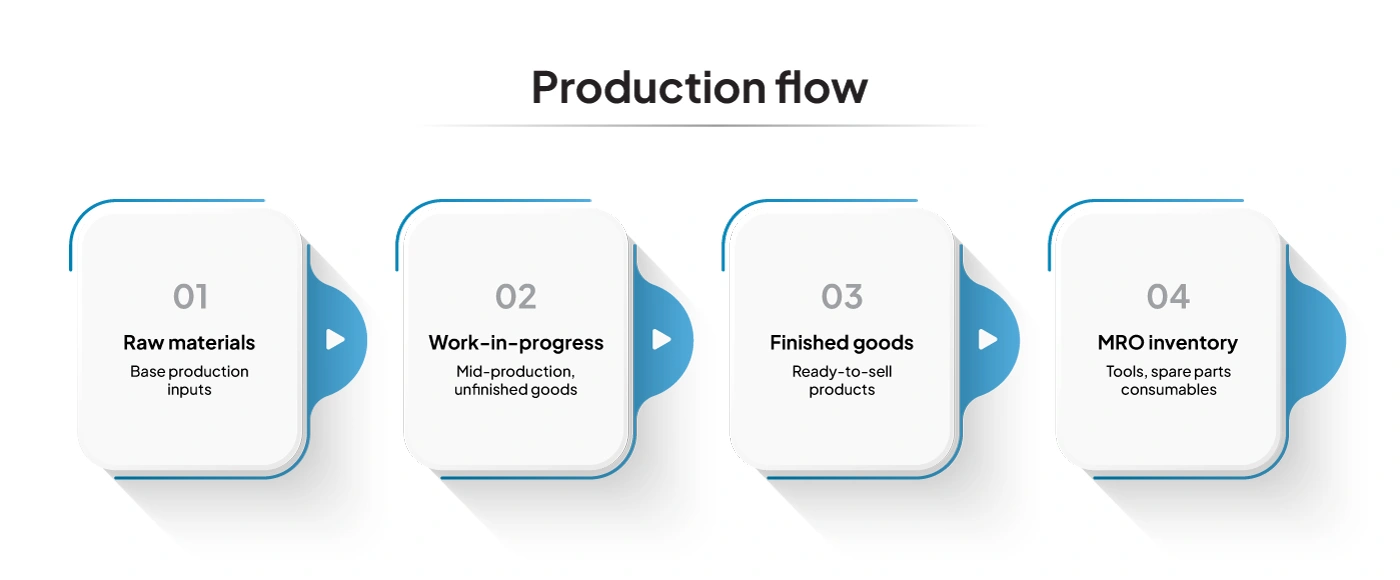
1. Raw Materials
Raw materials are all the base inputs required for production in a manufacturing business. These, too, need to be managed because they impact production schedules directly.
2. Work-in-progress
Work-in-progress products are those that are mid-production. Tracking them in real-time gives you a bird’s-eye view into the various production stages and helps you identify bottlenecks in the process. It also gives you insight into how much unfinished goods mid-production costs you.
3. Finished Goods
These are your ready-to-sell products. For retail and wholesale businesses, these goods are effectively all of their inventory.
4. Maintenance, Repair, and Operations (MRO) Inventory
Another category of goods that doesn’t pop up when you think of inventory management is MROs. There are essentially things like tools, spare parts, office stationery, and other consumables like lubricants and cleaning supplies that are critical to keeping operations running.
Popular Inventory Management Methods
Now, there is no one “best” method for inventory management. There are several in use today, and the decision on which one to follow depends on your industry and business model.
1. Just-In-Time (JIT) Inventory Management
Just-in-time inventory management is a technique employed when businesses want to minimise holding buffer stock and reduce the costs associated with it. Here, orders for stocks are placed in a manner where they arrive precisely when needed. The downside, however, is that any disruption in the supply chain or an unexpected spike in demand can land you in trouble. Pro Tip: Use this technique only if you have multiple reliable suppliers with solid delivery track records you can fall back on.
2. Economic Order Quantity (EOQ)
Economic Order Quantity is a maths-based inventory management system that uses a formula to order just the right amount of stock you need to avoid over- and understocking. It helps you strike a perfect balance between holding adequate stocks and having adequate cash flow. It was calculated using the formula EOQ = √(2DS/H), where:
- D = annual demand
- S = cost per order
- H = holding cost per unit
It’s an inventory control system that works best for a business where demand is relatively consistent.
3. ABC Analysis of Stock
ABC analysis categorises inventory into three groups based on revenue impact:
- A items: High-value, low-frequency products that require tight management.
- B items: Sitting in the middle.
- C items: Low-value, high-frequency products where the cost of close management would outweigh the benefit.
With this method, you distribute your inventory management efforts exactly as much as is needed for each SKU.
4. FIFO and LIFO Inventory Methods
First In, First Out (FIFO) is an inventory management method where the oldest stock you hold is used first. This method is almost used in businesses that deal with goods with short shelf lives or expiry dates. LIFO, short for Last In, First Out, is the exact opposite of FIFO.
Interesting Fact Both FIFO and LIFO are also accounting methods used to calculate the cost of inventory. Of the two, FIFO, endorsed by the International Financial Reporting Standards (IFRS)is followed in over 140 countries, including South Africa.
5. Safety Stock and Reorder Point
Safety stock and reorder point are inventory management techniques where you hold additional “safety stocks” to safeguard your businesses against unexpected demand spikes. The reorder point, here, is a pre-defined stock level at which a new order should be placed, which is calculated using demand data and supplier lead times. Pro Tip: Never depend solely on one inventory management technique. For example, you can apply FIFO to your perishable stock and ABC analysis to prioritise high-value SKUs.
Key Inventory Management Metrics Businesses Should Track
No matter which or how many of the inventory tracking systems mentioned above you use, you need objective data to evaluate if they are working or not. To do that, you must start tracking the following metrics:
1. Inventory Turnover Rate
The inventory turnover rate tells you how many times you sold and replaced your inventory over a specific period of time. The formula is cost of goods sold/average inventory. A high ratio indicates healthy demand and efficient stock management, while a low ratio signals that you have too much capital sitting in slow-moving inventory.
2. Days Sales of Inventory (DSI)
DSI tells you how many days, on average, it takes you to sell your current inventory. The formula is (Average Inventory ÷ Cost of Goods Sold) × 365 A rising DSI figure can indicate overstocking or declining demand. If you deal with perishable goods, a high DSI number means you are looking at impending write-offs.
3. Carrying Cost of Inventory
This metric tells you how much it’s costing you to hold your current inventory. This includes insurance, storage costs, and the capital tied up here as well. The formula is (Capital Costs + Risk Costs + Storage Costs + Service Costs) ÷ Total Inventory Value × 100. Ideally, these values should be below 25% of the total value of your inventory.
4. Stockout Rate
The stockout rate measures how often a product is unavailable when a customer wants to purchase it. You would ideally want this figure to be as close to zero as possible to avoid losing customers.
Common Inventory Management Challenges
Inventory management is a complex process, even with the right techniques being followed, especially while keeping track of key metrics. The reasons are as follows: 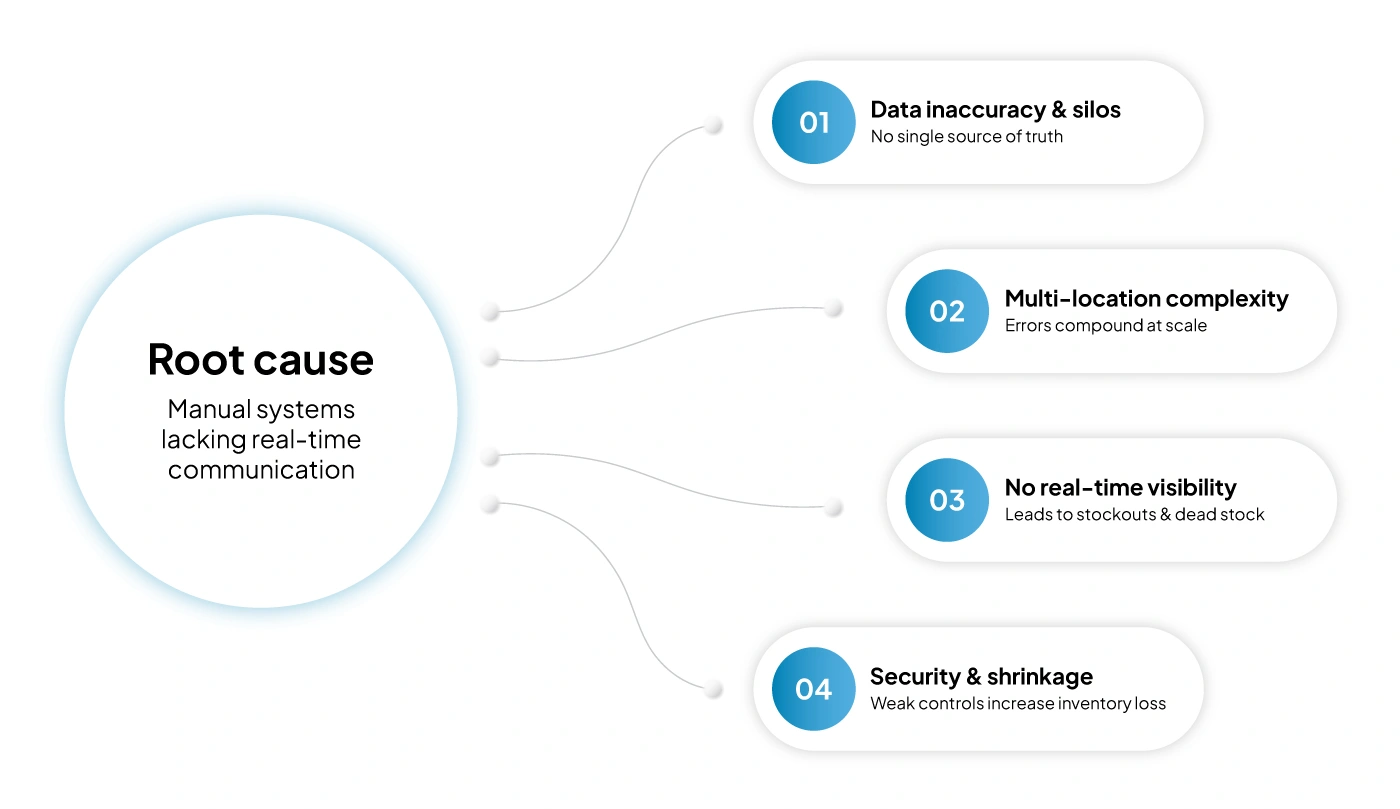
- Data Inaccuracy and Silos: If you are attempting to manage your inventory and track metrics manually, there are bound to be errors, and data will be siloed. This lack of a “single source of truth” in most cases leads to poor inventory management decisions.
- Difficulty Managing Multi-Location Stock: Apply the same manual processes to a multi-location business, and the errors and lack of visibility only compound.
- Lack of real-time visibility: The biggest downside of a manual process is the lack of real-time visibility into your stock levels. The results surface as stockouts, or dead stock.
- Security and Shrinkage: The lack of real-time tracking also increases the possibility of shrinkage due to theft or external losses.
How Does VasyERP Help Businesses Manage Inventory Efficiently?
All the above challenges have one thing in common, manual systems that don’t talk to each other in real-time. VasyERP addresses these factors. 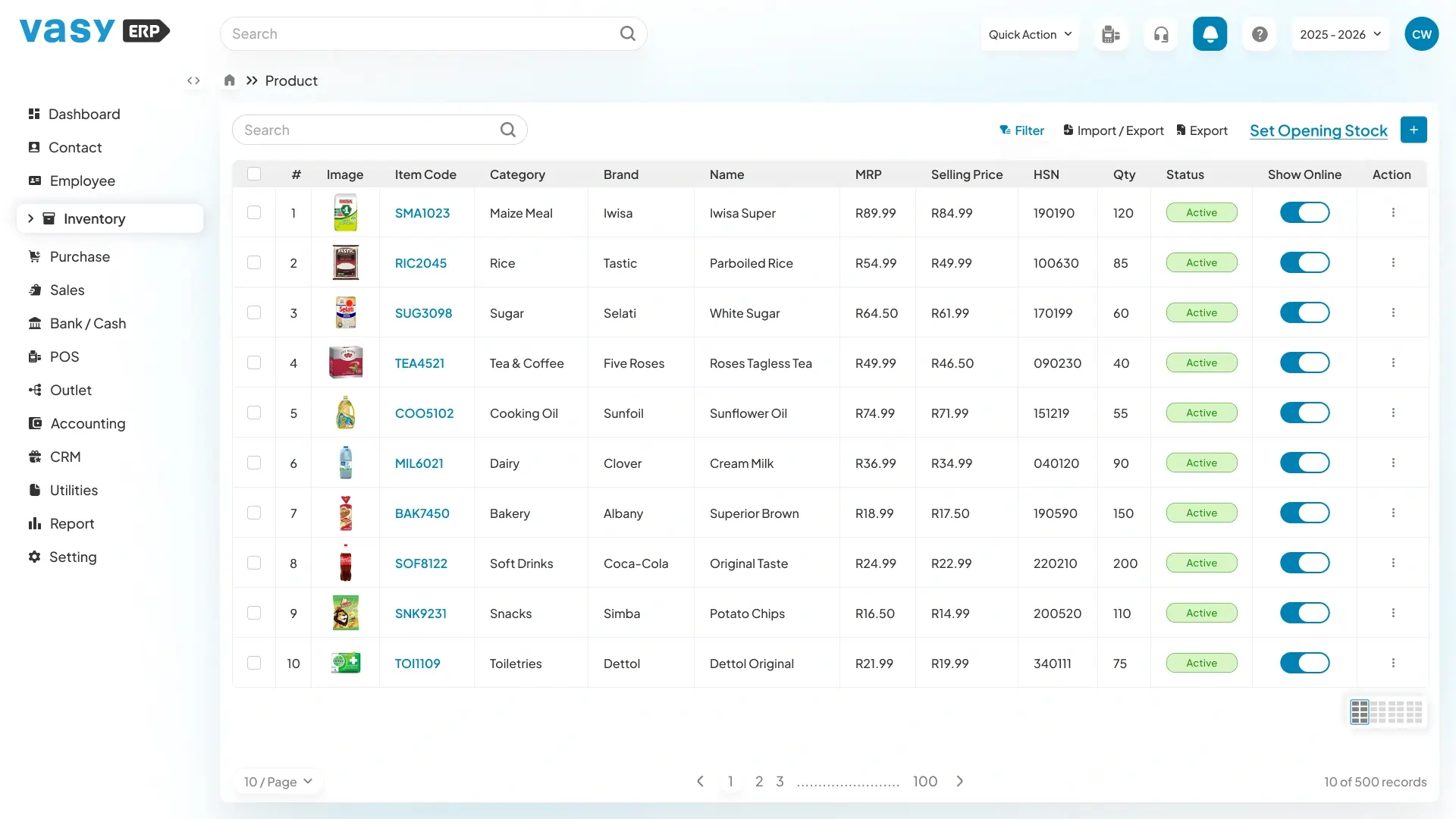 With VasyERP, all your data goes into one centralised database and is updated in real-time across all systems that tap into it. For example, the moment a delivery against a PO arrives, details are automatically verified and captured via OCR. Once there, every sale, return, internal transfer, or write off updates the stock levels automatically. Raw material consumption, batch tracking with expiry management, and low stock alerts ensure that production never comes to a halt or you lose a sale due to phantom stock. On the security side, user roles and permissions restrict what each staff member can access and action within the system. Every action is logged against a user, which gives you an audit trail to track. All of this feeds into the reporting system, with over 150 reporting templates available right out of the box. This integration of stock management software with real-time analytics allows you to move away from guesswork and toward data-driven growth.
FAQs Regarding Inventory Management
The main goal is to ensure the right products are available at the right time while minimising costs and avoiding excess stock.
Inventory management focuses on what stock a business holds, how much stock is available, and how it moves through the business. Warehouse management focuses on the physical storage and handling of that stock.
Many small businesses use ABC analysis together with FIFO as an effective way to manage inventory efficiently and reduce stock-related losses.
Yes, ERP systems like VasyERP can automate inventory tracking, stock updates, reporting, and replenishment processes in real time.
Last Updated on June 28, 2026