Quick Summary:
A bill of materials is the backbone of any manufacturing operation. It lists every single component required to manufacture a finished product. This guide will explain what they are and why they are essential to keep your production line running smoothly.
You'll walk away knowing the following:
- What a bill of materials is and what it contains.
- Why BOMs are critical for manufacturing businesses in South Africa.
- The main types of bills of materials and when to use each.
- How a BOM works in practice.
- Which South African industries rely on BOMs and why.
- Which South African industries rely on BOMs and why.
- How to create a BOM.
- How ERP software simplifies BOM management at scale.
A single critical component, not in your inventory, be it a humble washer or a more complex electronic component, can bring your production line down to a grinding halt.
Depending on the size or scale of your business, the losses due to a stalled production line can range in the thousands or millions of Rand.
With the South African manufacturing sector already in a state of crisis with a year-on-year decline, according to the South African Federation of Trade Unions (SAFTU), businesses cannot afford these additional losses.
The solution to avoiding the aforementioned scenario of missing components is careful management of the bill of materials for each individual production cycle. This post will tell you how.
What is a Bill of Materials?
A bill of materials, usually abbreviated to BOM, is a detailed list of every raw material, component and sub-assembly along with each of their quantities required to manufacture a finished product.
In manufacturing specifically, a BOM, along with the individual components, describes the relationship between each of those individual parts. Also known as a manufacturing bill of materials (MBOM), they also include details of the tools and equipment required for assembly and any other consumables needed.
A bill of materials is hierarchical in nature. The finished product sits at the primary level. Subassemblies, components, and other parts sit at lower levels.
Bill of materials example:
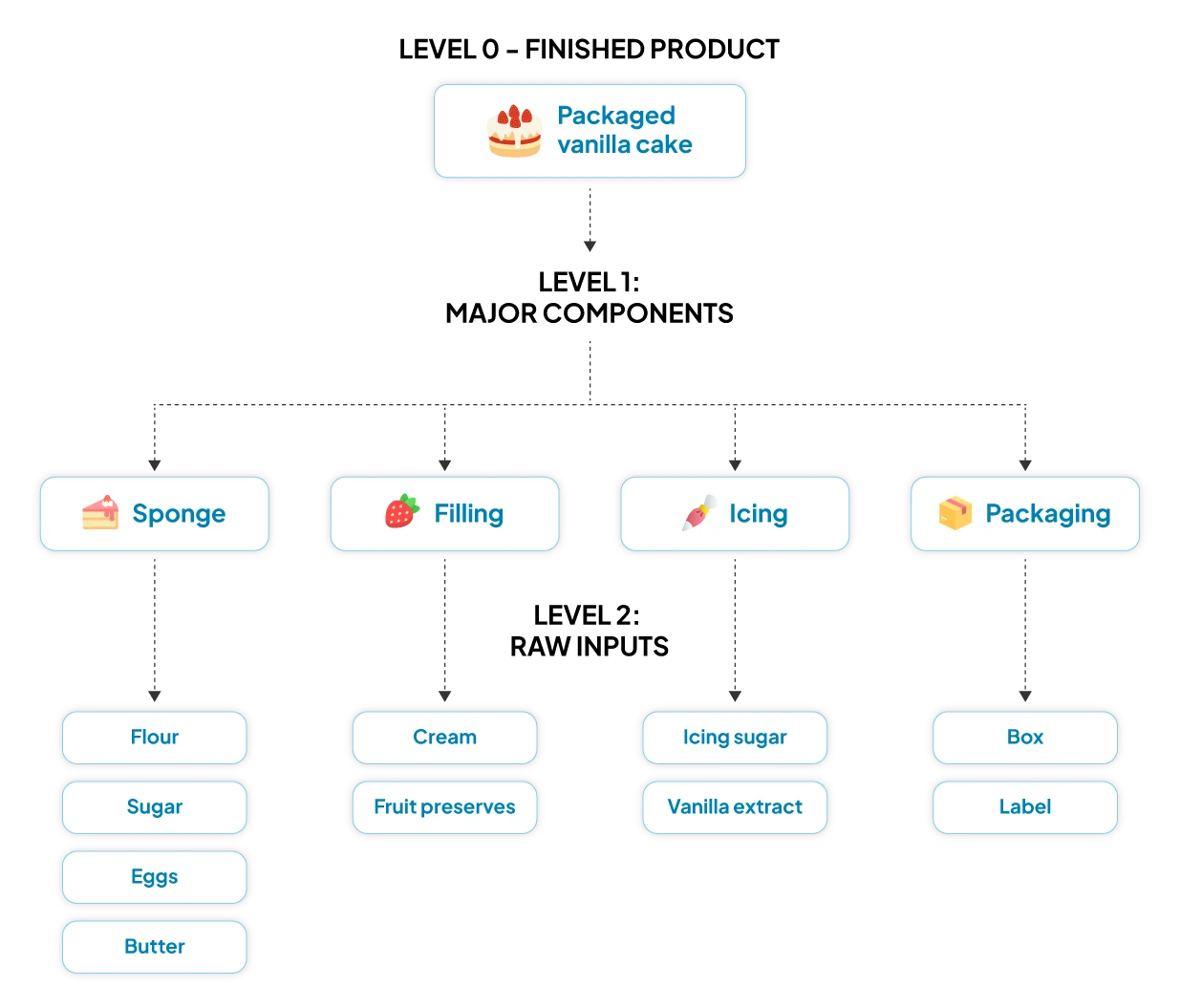
Assume the product being manufactured is a vanilla cake. The highest level in the BOM is the finished cake. Subassemblies and other modules are listed in subsequent levels down to the packaging required.
At Level 0 sits the finished, packaged cake. Level 1 breaks it down into its major components: the sponge, the filling, the icing, and the packaging. Each of these has its own Level 2 inputs. The sponge requires flour, sugar, eggs, and butter. The filling needs cream and fruit preserves, and so on.
This hierarchy tells the bakery exactly what to prepare first and what to pull from inventory at each stage.
Why is a Bill of Materials Important for Manufacturing Businesses?
A bill of materials is important for manufacturing businesses because it facilitates the following:
1. Prevents Production Delays
If you are someone who owns a manufacturing business, you know what a stalled production line can cost you. With an accurately maintained bill of materials, you will always have all the raw materials, individual components and clear assembly frameworks at hand at all times.
This puts you in a situation where nothing interrupts the production run, apart from external factors that are out of your control, like power outages.
Interesting Fact: The BOM market reached $9.64 billion in 2025 as per a report published by the Business Research Company.
Source:Business Research Company
2. Improves Inventory Accuracy
BOMs serve as a pick list of all items issued in production. They tell you exactly what materials to pull from inventory for each production run. When documented correctly, BOMs help with costing finished products.
They also reduce your stock for the components used in manufacturing. Inventory accuracy improves because every component is tracked against a specific production order. You know what was used, what remains, and what needs reordering.
3. Reduces Material Waste
A bill of materials establishes the standard consumption for every input. Because of this, you avoid over-ordering raw materials and components and over-producing sub-assemblies.
They also reduce the likelihood of ordering the wrong materials. In South Africa, where margins are already thin, waste reduction has a direct and major impact on your profitability.
4. Helps Control Manufacturing Costs
Cost control in manufacturing requires knowing what a product should cost before you make it. A bill of materials makes this calculation possible because each line item carries the quantity and the per-unit cost.
BOMs also account for additional costs, such as labour, so they give you a clearer picture of what each product costs to make. Since BOMs detail every component, it helps you identify cost-saving opportunities. This makes them a valuable tool for accurate cost estimation and budgeting.
5. Supports Better Production Planning
BOMs are the foundation for production planning, procurement, and cost estimation. They ensure all stakeholders have a unified reference for the product structure.
Everyone from production schedulers to procurement teams and finance teams can use BOMs to determine lead times, plan orders, and calculate margins, respectively.
Types of Bill of Materials Explained
There are several different types of BOMs. The most commonly used by South African manufacturers are:
1. Single-Level Bill of Materials
A single-level BOM contains a list of components or materials and quantities needed to manufacture or assemble a product. It is used for simple products or one-stage production. Single-level BOMs contain only direct components, not sub-assemblies.
2. Multi-Level Bill of Materials
A multi-level BOM (or indented BOM) is required for more complex assemblies. It contains both assemblies and sub-assemblies. Sub-assemblies are placed on different “levels”. Components are organised in parent-child relationships from left to right.
Multi-level BOMs detail every level of components needed, including subcomponents and the final product.
3. Service Bill of Materials
A service BOM lists the parts and components needed to service or repair a finished product. It is used by maintenance and service teams rather than production teams.
4. Manufacturing Bill of Materials (MBOM)
The MBOM includes details of the tools, equipment, and consumables needed for assembly. It is specific to the manufacturing process.
5. Engineering Bill of Materials (EBOM)
The EBOM comes from the engineering department. It defines the product design and structure. It may differ from the MBOM because it does not consider manufacturing constraints.
6. Sales Bill of Materials (SBOM)
A sales BOM is a variant used specifically for quoting and order processing. It represents the finished product as it is sold to the customer, which may include optional components or configurations.
For example, a furniture manufacturer might have a base chair design with optional fabric choices. The sales BOM captures these options for pricing purposes without altering the underlying manufacturing BOM.
How Does a Bill of Materials Work?
A BOM works by defining the relationship between raw materials and finished goods. It displays the exact quantities of components required for each level of assembly. Here is how the process works:
- Define the product structure from the top down: The process starts with the finished product. You define the product structure from the top down. Each component is linked to the product through parent-child relationships.
- Calculate material requirements for production: When you plan a production run, the system uses the BOM to calculate material requirements. It determines what raw materials to pull from inventory and identifies what sub-assemblies need to be built first.
- Track consumption and manage changes: When production is complete, the BOM helps you track material consumption so that you know exactly what was used and what remains. BOMs can be dynamic and evolve as products change.
BOMs also require careful version control. Anytime you change a component supplier or update a product design, the BOM must be revised to reflect the same. Without it, you risk manufacturing products using outdated specifications.
Industries That Use Bill of Materials
Bills of Materials are used across industries that either manufacture or assemble products such as:
1. Food and Beverage Manufacturing
In the F&B industry, say a manufacturer of juices relies on precise quantities to create specific products. The BOM lists the exact values of fruit premix, water, sugar, and lemon juice that go into it, along with packaging materials like bottles and labels.
BOMs help keep track of actual usage, as opposed to theoretical usage. They also account for yield variance. Ingredients may have different moisture content or quality grades, affecting how much finished product they yield.
2. Furniture Manufacturing
Furniture manufacturing in South Africa spans a wide range. Bills of materials in furniture manufacturing are particularly complex because the same product can be manufactured using different materials depending on specification, customer requirement, or raw material availability.
Due to this, furniture BOMs often include product options and finishes. The timber supply chain in South Africa adds another layer of complexity, like different timber grades, moisture content, and dimensional tolerances, all of which affect the final product.
3. Textile and Apparel Manufacturing
Textile BOMs are uniquely complex due to size and colour variants; a single design can yield dozens of unique SKUs. Each variant requires specific fabric quantities, thread colours, and packaging.
Furthermore, manufacturing must account for fabric width, cutting yield, and inherent material waste. Managing these variables accurately is essential for precise costing and production planning in the apparel industry.
4. Footwear Industry
Footwear production demands a highly granular BOM to manage the assembly of diverse, rigid, and flexible components, i.e., from uppers, liners, outsoles, and shanks of different materials. Manufacturers here must track not only materials but also specialised consumables like adhesives and primers.
Effectively managing these multi-stage assembly processes across varying sizes and technical performance standards is essential for controlling both high material costs and labour-intensive workflows of the industry.
How to Create a Bill of Materials
There are two routes you can take to create a bill of materials, depending on the number of SKUs you manufacture and their complexity.
Creating a Bill of Materials Using Excel
If you are a small-scale manufacturer with a limited number of simple-to-assemble SKUs, you can work with Excel-based BOMs. The process essentially starts with the finished product and works backwards. You document every input required to produce one unit at every stage, along with the correct quantities and specifications of the individual components.
In Excel, the preferred structure to maintain a BOM is as follows:
| Column | Data to be Added in the Column |
|---|---|
| BOM Level | 1 for direct inputs; 2 for sub-assembly components. |
| Part Number | Unique identifier, consistent with your inventory coding. |
| Description | Name of the component with its grade and specification. |
| Quantity Per Unit | Exact quantity required to produce one finished unit. |
| Unit of Measure | kg, litres, metres, each, etc. |
| Unit Cost (ZAR) | Current cost per unit of measure. |
| Extended Cost | Quantity × Unit Cost. |
| Supplier | Primary supplier for this component. |
| Lead Time (days) | Number of days from order to delivery. |
| Notes | Substitutes, tolerances, or process notes. |
Now, Excel is easy to use, and it’s relatively simple to create a bill of materials in it. That said, the advantages of this method end here. BOMs created here are ultimately static and lack version control.
Creating a Bill of Materials Using an ERP Software
ERP software replaces the manual, disconnected nature of spreadsheet-based BOMs with an integrated system where each bill of materials is directly connected to inventory, procurement, production, and accounting.
Now, while the exact steps to create a BOM using ERP software may differ from one software package to another, the basic principle is the same as that used when creating it in Excel.
The primary difference here is that when a BOM is created in an ERP system, it is built from the same product master that drives the rest of the business. The advantages of this way of operating are that there is no longer any risk of duplication and version conflicts.
How ERP Software Simplifies Bill of Materials Management?
ERP software, like VasyERP, simplifies BOM management in ways spreadsheets just cannot match. Here is how it does that:
1. Automated Material Consumption
Anytime you start a production run, the system automatically deducts the exact amount of raw material needed to complete it from your inventory. Materials that fall below a preset threshold trigger a purchase requisition automatically.
This gives your procurement teams advance notice to acquire the shortfall before the production run starts.
2. Multi-Level BOM Support
Unlike Excel-based bill of materials, VasyERP can handle complex, multi-level BOMs with ease. It can track parent-child relationships across multiple levels and manage sub-assemblies as separate BOMs that roll up into the final product.
3. Batch Tracking and Expiry Management
For manufacturers handling ingredients with limited shelf lives or expiry dates, the expiry management feature ensures that ingredients past their prime don’t end up in the final product.
Batch tracking ensures that if a batch of raw material is later found to be non-conforming, the traceability records can show you exactly which finished products that batch entered and can trigger a recall instantly.
4. Costing and Budgeting
Since all the components and raw materials in VasyERP reference the same item records used throughout purchasing, receiving, and stock management, a price change on a purchased component reflects on the BOM automatically, without needing a separate process to update them.
Stay On Track With BOM
A bill of materials delivers value only when it is up-to-date with accurate information. Spreadsheets don’t always meet these two requirements.
In South Africa, where load shedding, logistics bottlenecks, and rising input costs are already things manufacturers have to face on a daily basis, accurate BOM management is not optional.
ERP software gets it right by design, tying every component to live inventory and cost data. It is what stands between a profitable production run and one that quietly erodes your margins without anyone noticing until month-end.
If you want to see how VasyERP’s Bill of Materials and production module handles your specific manufacturing setup, book a 30-minute demo with our team.
We will walk you through the full workflow, i.e., from BOM creation to production order to how to generate cost variance reports, for your product type.
FAQs for Bills of Material
The primary purpose of a bill of materials is to document every input required to produce a single unit of a finished product, including raw materials, components, and sub-assemblies, along with their quantities. It also supports material requirements planning and cost calculations.
Yes. Small businesses often benefit significantly from BOM software because they cannot afford losses caused by production delays, stock shortages, or planning errors. Reducing these risks can have a major impact on profitability.
Excel can be sufficient for BOM management when a business has a small number of SKUs and simple product assemblies. However, because it relies on manual updates, it increases the risk of data entry errors, version conflicts, and inaccurate records.
A single-level BOM lists only the direct components needed to make a product in a flat structure. A multi-level BOM organises components and sub-assemblies into a hierarchy that reflects the actual assembly process and relationships between parts.
A recipe focuses on ingredients and their proportions. A BOM includes the recipe but also covers packaging, labour, and other inputs needed to produce a finished product. A recipe explains what goes into a product, while a BOM explains everything required to deliver that product to the customer.
Last Updated on July 1, 2026