ABC vs XYZ Analysis – Which Works Better for Retailers?
December 15, 2025

Retailers have a large number of SKUs; therefore, smarter inventory management decisions are necessary. This blog explains ABC vs XYZ Analysis and how retailers can use both methods to manage thousands of SKUs efficiently The blog also explains how using both methods will improve the retailer's ability to forecast, budget and control stock levels by automating the process through an ERP system. Additionally, examples and additional resources are provided to assist retailers in determining when and how to implement each of these analysis types.
Retailers are faced with managing thousands of SKUs in multiple categories and seasons at different price points. Without any way of categorising inventory, it is hard to see what products really matter. Retailers require scientific classification systems.
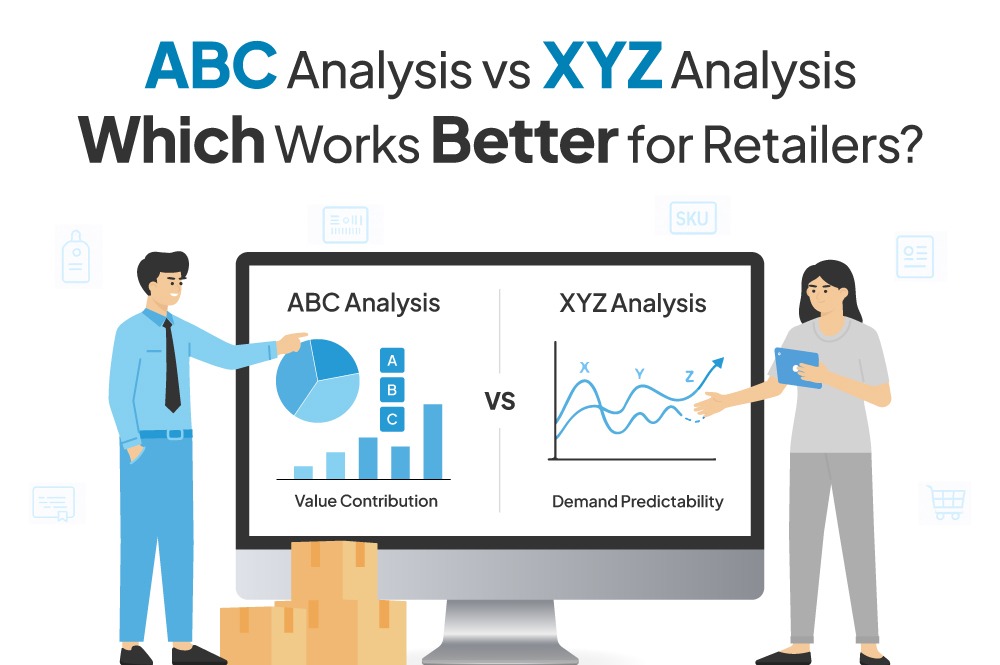
Two of the most influential techniques used globally are ABC analysis for retail products. The other is the XYZ analysis for inventory. ABC analysis for retail allows for the understanding of which products yield the most value. XYZ analysis will help understand which products sell in a consistent or unpredictable nature. Both will provide clear direction of how much, how often, and how to spend procurement budgets on product inventory.
This blog will compare ABC vs XYZ analysis, provide examples, outline benefits, and offer guidance on when to use each method.
ABC Analysis is a value-based categorising method that groups products into three categories based on their revenue or profit contribution. The ABC Analysis works by categorising products based on monetary impact.
This is very useful for retailers when looking to determine the priority for money and attention. Retailers should consider ABC Analysis when they want to identify the top SKUs and make better purchasing budget decisions. It allows the retailer to prioritise and focus on the items with the most value. It also avoids tying cash up over low-value items and develops item-specific stocking rules for each class. ABC is well-suited for procurement planning, safety stock and to identify items that create the best profit potential.
In the example of an apparel store, high-value bridal lehengas would be categorised as A products, in terms of their contribution to revenue. Festive kurtas would be classified as B items. Items like socks and budget accessories would fall under C since they are low-value products that sell in high volume to support daily sales.
XYZ Analysis is a forecast-based method that categorises inventory according to demand predictability and demand variability in inventory behaviour. XYZ sorts products according to their demand stability or instability with respect to a time period.
This system helps create efficient replenishment cycles and decisions about safety stock. Retailers can use XYZ for improved forecasting accuracy and replenishment planning. It will help lend insight into which items would require closer monitoring. Also, help understand when to plan for seasonal purchases and inaccuracies in stock planning.
In a supermarket, milk and bread become X items with fixed demand. Soft drinks become Y items as they will typically show demand spikes during the summer. Festive gift hampers are zoned Z items. Now this is because the demand for these items significantly fluctuates based on the number of festivals occurring that season.
Understanding ABC vs XYZ Analysis helps retailers differentiate value-based and demand-based classification
| Factor | ABC Analysis | XYZ Analysis |
| Basis | Value | Demand variability |
| Focus | Profit impact | Forecast accuracy |
| Helps With | Budget, stocking priority | Replenishment & safety stock |
| Best For | High-value categories | Seasonal or volatile items |
| Example | Apparel, electronics | Grocery, FMCG |
Both perspectives will look at inventory, but from different viewpoints, one monetary and one based on demand.
Today’s integrative retailers use both methods in tandem to enhance overall inventory decisions. While ABC discusses “which items matter financially” XYZ discusses “how those items behave in demand.” Together, these inform stocking rules that minimise risk, enhance service level, and steer good buying decisions. The matrix is common vernacular for speciality stores and apparel. It is also common for lifestyle retail as a resolution between value and demand stability.
Using the matrix allows retailers to treat every product based on value and behaviour. This is the core of ABC XYZ analysis in retail, helping reduce risk while improving profit. Both methods in ABC vs XYZ Analysis offer unique benefits and together give retailers a complete inventory strategy.
Modern ERP systems automate the classification process by assessing sales history and SKU performance. ERP generally differentiates the auto-classification tags. It also differentiates instant replenishment triggers and flags fast & slow-moving products. This provides solutions to curb manual work. It also provides an opportunity to achieve superior inventory benchmarks. This is done without having to learn a complex formula.
Utilising both means the optimal results will be achieved. ABC will assist the retailer in deciding where to use the money. XYZ will assist in determining the quantity to be ordered, when to order, and the frequency to reorder. Apparel retailers will maximise selling profit by focusing on high-value products. They can also work on their inventory while forecasting for other seasonal styles.
Electronics stores will reduce overstock risk with the price-sensitive consumer for greater opportunity. The FMCG stores will enjoy replenishment effectively and productively. Home décor retailers will not need to invest in bulk inventory for unpredictable product demand. This means instead of choosing one or the other as an opportunity, Thus, combining both methods is the ideal ABC XYZ analysis in retail strategy.
Real-World Retail Scenario
Retailers who use an ERP software like VasyERP to track inventory will receive automatic ABC-XYZ tagging based on real-time sales data. In addition, they will receive reorder suggestions based on these recommendations. They will also get slow-moving product alerts and cash-flow impact reports. They also get dashboards for forecasting. Retailers no longer have to guess. This is because they are historically tracked, where planned stock levels are managed throughout the year. This is done with a greater degree of advanced stock management techniques.
The impacts of ABC and XYZ analyses offer a continually balanced, practical method to modern inventory planning. ABC makes the modern retailer accountable for SKU tracking revenue, whilst XYZ assists in forecasting and replenishment. When retailers utilise Inventory software compared to manual processes, they will achieve even better visibility. They will also be able to record smoother operations and have healthier cash flow. In order to remain competitive in retail today, using both methods is necessary. This is because it helps achieve accuracy and accountability like no other.
1. What is the primary reason for performing ABC analysis in retail?
The primary reason for performing ABC analysis in retail is to allow businesses to determine which products are the most significant contributors to revenue and profit. This is done so that all of the resources can be allocated appropriately. By categorising items into groups labeled A, B, and C based on their value, retailers can spend more time and effort on high-value SKUs. This will streamline adding products to inventory and avoid money being tied up in cash blockage. It also helps maintain better in-stock levels. This leads to increased financial efficiency and enhanced planning of overall procurement inventory.
2. What is the primary goal of XYZ analysis?
The primary goal of XYZ analysis is to gain a clear understanding of the predictability of each product. Once retailers classify items as X, Y, or Z. Here, X items have stable demand and Y items having seasonal demand variation and Z items having variable demand. This adds value because it minimises stockouts and prevents overstocking. It also helps improve forecasting.
3. Is it practical for a small retailer to do ABC/XYZ?
Yes, it is actually very easy for small retailers to do ABC/XYZ analysis. This is because it only requires basic sales and stock movement data. Even simple spreadsheets can let a small store analyse products by category, which will help the store control its stock even better. Furthermore, many modern ERP systems will remove the calculations from the retailers completely. This offers a really easy solution.
4. When should I update ABC and XYZ Classification in retail?
ABC/XYZ classification should be conducted periodically. This is because consumer demand and product value change throughout time. Sectors like groceries, beauty, and apparel that move a lot faster may require updates every month. But a slower, slower-changing sector may require quarterly updates.
5. Is there any possibility of automating ABC and XYZ analysis for retail stores?
Yes, currently, many different ERP systems perform an ABC or XYZ analysis, which is quick and error-free. These systems can smartly analyse historical sales patterns along with tracking the movement of the inventory. They can also forecast and set up an accurate ABC, XYZ category for each specific SKU. These systems also provide reorder alerts and trend dashboards. They also provide insights into slow-moving products.


Lack of proper solutions when handling a warehouse caus...
May 29, 2026

Smart inventory management is critical for Indian retai...
September 22, 2025

July 10, 2026

July 8, 2026

June 15, 2026

June 5, 2026

June 1, 2026