10 Inventory Management Mistakes Indian Retailers Make (And How to Fix Them)
July 10, 2026

July 10, 2026

Summary:

Your inventory is your biggest asset and your biggest liability. Get it wrong, and you tie up crores in dead stock. Get it right, and you unlock working capital, improve margins, and keep customers coming back. This guide breaks down the ten most common inventory management mistakes Indian retailers make and shows you exactly how to fix each one. You will learn the business impact of each error, receive a practical checklist for better control, and see exactly how real-time systems change the picture by solving stock mismatches, overstocking, and lost sales opportunities.
India’s retail industry is booming. It is, in fact, on course to hit INR 190 trillion in the next decade, according to the Retailers Association of India. Despite this, nearly one-third of retailers across retail segments are operating at a loss. The common denominator: a leaking margin through the same set of stock management errors.
To understand the true cost of these inventory management mistakes retail in India faces, consider this: if a retail outlet doing ₹2 crore annually experiences just 0.5% shrinkage, it amounts to ₹10 lakhs in losses. What’s worse, this loss compounds with each outlet.
For multi-chain businesses, not having real-time visibility into their inventories means you get to know about it a little too late. Now, before you can fix these issues, you need to identify them. This guide breaks down the ten most common inventory mistakes and shows you exactly how to fix them.
The following are the specific, recurring patterns observed across kirana chains, supermarkets, and FMCG distributors across India.
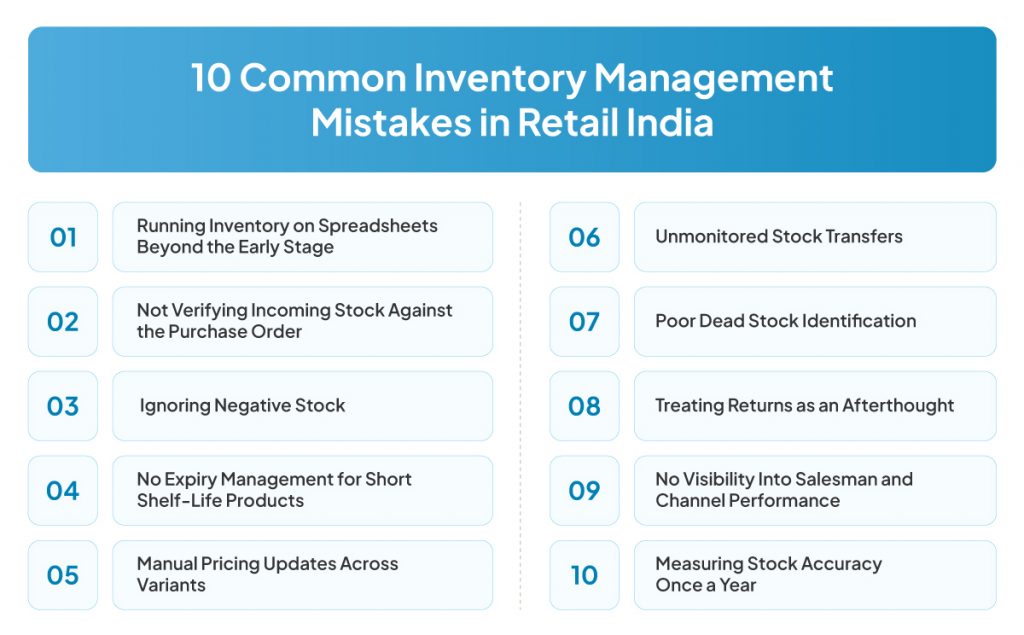
Tracking inventory on spreadsheets makes sense for smaller businesses with about 50 or so SKUs in a single location. However, most retailers continue to use this method to track their inventories long after this number, be it the SKUs or the number of locations they operate, doubles.
And the after effects of doing so are siloed information, version conflicts and reliance on manual reconciliation, at which point, stock discrepancy has already affected purchasing decisions for that cycle.
The second most common inventory management mistake in retail in India is skipping the crucial step of verifying the incoming stock against the purchase order. In India, business relationships are built on trust, and sometimes that leads to complacency.
In a majority of cases, suppliers don’t intend to cheat their customers, but honest mistakes do happen. These can be in the form of wrong products being sent, wrong quantities, or some goods being damaged. You either pay stock you didn’t receive, and it enters your books as phantom stock that never physically arrived.
Negative stock is a system showing that more units were sold than are physically recorded in inventory. On the surface, it may seem like an accounting failure, but in reality, it’s an early warning signal of a larger process failure.
This could occur if the stock was received without being entered, a return was processed incorrectly, or a billing error occurred.
For Indian retailers selling FMCG goods, namkeen, dairy, pharmaceuticals, or fresh produce, expired stock on the shelf is a direct write-off. More damaging is selling expired stock that reaches a customer, which creates both a compliance liability and a trust problem that is hard to recover from.
Without expiry tracking, you do not know which batches are approaching their end. You cannot run targeted promotions to clear them. You end up throwing away stock that could have been salvaged.
Most FMCG products come in multiple variants, each with its own pricing. When the supplier revises pricing, updating each variant manually across every outlet is a slow, error-prone process. A single missed update means customers will get billed at the wrong price.
The bigger risk is when pricing is updated in one outlet but not others. If a customer sees one price at your Andheri outlet and a different one at your Bandra outlet, they now have reasonable grounds to dispute the more expensive outlet selling the same product at the higher cost.
In a multi-outlet chain, stock transfers between branches are a daily operational necessity. They are also a consistent source of stock discrepancy when not properly controlled. One outlet might end up with a shortage, the other shows a surplus, and neither of these actual numbers tally up with actual stock levels.
Dead stock, inventory that has not moved in 90 days or more, is another inventory management mistake common with Indian retailers. They know it exists, but cannot quantify it accurately because their system has no way to surface it automatically.
Returns processing is another common retail inventory issue in most Indian retail operations. A customer return at a busy outlet might be scanned back into any stock location, given a discount without recording the reason, or written off informally without a credit note. The result is almost always a stock discrepancy.
In distributors and multi-channel retailers, stock committed to a sales channel or field salesman is often invisible in the central inventory record until it is either sold or returned. During that window, the same stock may be allocated to another order, creating a fulfilment failure. The same problem applies to promotional stock given to salesmen for demos or samples, which often goes unrecorded as consumption.
Annual stock counts are insufficient, as by the time the count is done, the data is already outdated. By this time, months of purchasing decisions, pricing decisions, and promotional campaigns have already been built on inaccurate data. What’s worse is that you are counting errors from the last 12 months without knowing when they happened or why.
Inventory errors do not just affect your stockroom. They ripple through your entire business in different ways:
In short, stock management errors have far-reaching consequences and deferring to fix them to a later date should not even be a consideration.
Did you know:
Key pitfalls in inventory management mistakes include multi-channel synchronisation, poor demand forecasting, and strict GST and marketplace fines.
Fixing inventory issues requires a systematic approach that starts at the transaction level.
The difference between a spreadsheet and a real-time inventory system is not just the “real-time data updates”. They also function as a single source of truth for your entire retail operations.
They also give you granular visibility into and control of your retail operations. They let you set up verification checks at critical junctures and set up real-time alerts to ensure nothing falls between the cracks.
For Indian retailers that manage multiple outlets across different cities or operate during high-velocity periods like Diwali or IPL-season promotions, such a setup can mean the difference between a stock discrepancy and happy customers.
Use this checklist to keep your inventory under control.
Inventory management is the difference between a profitable and a struggling retail business. Start with the basics to work towards fixing these common inventory management mistakes in retail in India. The retailers who build systems that prevent the discrepancies from being created in the first place are the ones that overcome these issues the quickest.
VasyERP‘s inventory management software is built around exactly this logic. Transaction-level controls, real-time multi-outlet visibility, batch tracking, GST audit trails, and automated alerts work together to keep your stock data accurate from the point of entry.
Book a 30-minute demo with our team to see how it handles the specific mistakes relevant to your retail operation.
What is the most damaging inventory management mistake for Indian retailers?
Systematic stock discrepancies that compound over time without triggering any immediate alert. These are the biggest inventory management mistakes made. It creates a gap between recorded and actual inventory on day one, and every subsequent transaction builds on that inaccurate baseline.
How does negative stock affect GST compliance in India?
Negative stock indicates that more units were sold than your system recorded as available. When this coincides with a GST filing period, your sales records may reflect transactions that your inventory records cannot support, triggering an audit.
Can cycle counting replace annual stocktakes for Indian retailers?
Cycle counting does not replace an annual stocktake entirely, but it reduces the stocktake’s role from “first time we discover discrepancies” to “final verification of a well-controlled system.”
How often should Indian retailers conduct a stock audit?
Indian retailers should run a stock audit weekly if they deal with fast-moving goods. For retailers that deal in slower-moving stock, an audit once a month is sufficient. That said, a full physical stocktake must be done annually as well.
Does inventory management software help with demand forecasting In Indian retail?
A system with real-time sales data by SKU, outlet, and season can provide the foundation for accurate demand forecasting during periods when sales tend to spike, such as Diwali, Navratri, and school reopenings.


Smart inventory management is critical for Indian retai...
September 22, 2025
Inventory management is becoming critical for Indian re...
June 1, 2026

July 10, 2026

July 8, 2026

June 15, 2026

June 5, 2026

June 1, 2026