FOFO vs FOCO vs COCO – Which Retail Expansion Model Works?
January 11, 2026

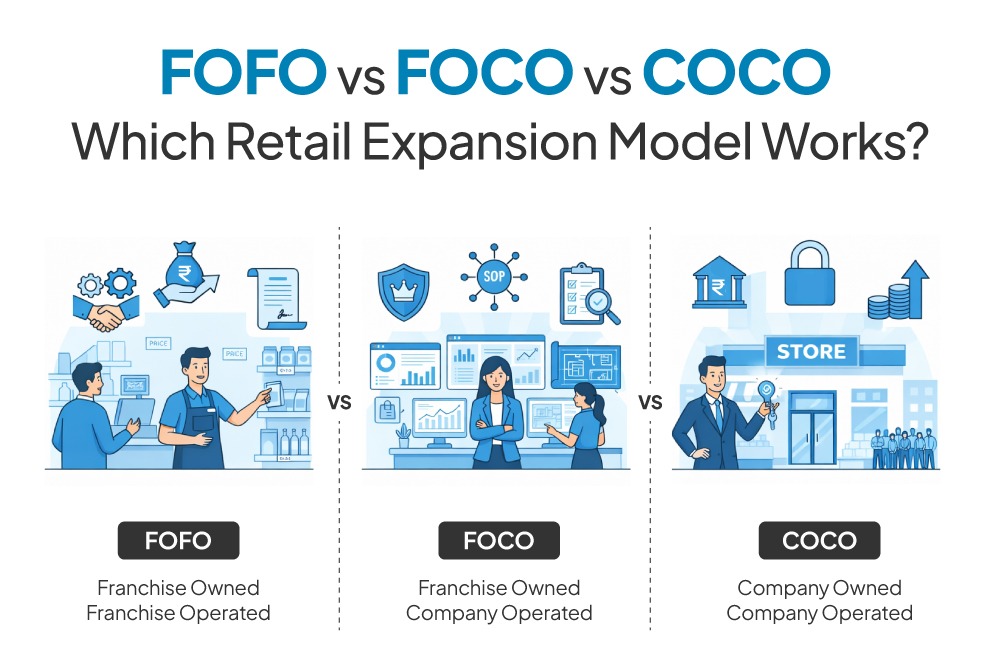
This blog explains the differences between the three major retail expansion strategies FOFO, FOCO, and COCO and helps brands understand which structure suits their growth plans. It highlights how each model works, their pros and cons, and how factors like investment capacity, operational strength, and the need for speed vs. control influence the right choice for long-term retail success.
Choosing how to extend a retail business is one of the most important decisions a company can make. This is because the way in which a retail business expands will either lead to success or difficulty with profitability. When a company begins its growth phase it is essential that there be sufficient resources allocated to ensure that all aspects of growth. This can cover right from investment opportunity to risk sharing to brand management. It can also help control all lead to positive long-term profitability. Most companies looking to expand retail businesses today are looking at the same three structures of growth. This includes the FOFO which is the Franchise Owned Franchise Operated. Then comes the FOCO, which is the Franchise Owned Company Operated. Followed by COCO which is the Company Owned/Company Operated. All three structures have very distinct differences.
The fundamental differences between these franchise models is very important to understand. This is because it helps assist the companies in developing a successful long-term retail business model.
One of the most popular forms of retail expansion is the FOFO model that is Franchise Owned Franchise Operated. It is a model that provides brands with the ability to expand quickly with very little financial commitment. Here, in this model, the franchisee pays for the store and runs all day-to-day operations. The brand then provides the necessary training, branding tools, products, and marketing assistance. In essence, this model creates a form of entrepreneurial ownership at the outlet level. However, the scope of control and the degree of uniformity may differ from location to location.
Pros:
Cons:
The FOCO model approach (Franchise Owned Company Operated) represents an amalgamation of the benefits of both an investment structure and an operational management model. It is a model where the franchisee invests in the store setup, but the company manages all daily operations. The way this works is that the franchisee invests in outfitting the store. Further, the franchisor provides management services including staffing, inventory, and customer service. The consistency of experience across all locations of a particular brand enhances brand credibility.
Pros:
Cons:
The COCO model (Company Owned/Company Operated) is the most tightly controlled method of retail growth, where a company owns and manages each individual store, from beginning to end. The company will cover all the costs associated with running each store, such as bank loans. It also covers the costs associated with hiring employees and providing training for employees. Additionally it also covers the costs related to the stocking of products and handling all the day-to-day operations. The centralized nature of the COCO model allows for consistency in how the brand is presented to consumers.
Pros:
Cons:
To identify the most suitable model for your business, it is important to look at several specific factors. Examples of these include: Who owns it? How much control does it have over its operations? How quickly will it be able to respond to changes in the market? How much capital must an investor put into the venture?
The following table identifies some areas that you should examine when you are selecting a business model.
| Factor | FOFO | FOCO | COCO |
| Investment | Franchisee provides investment | Franchisee provides investment | The company provides investment |
| Operational Control | Low | Moderate-High | Very High |
| Risk | Low risk for brand | Shared risk | High risk for brand. |
| Profit Share | Franchisee retains majority share | Shared between Franchisee and Brand | Brand will retain all profit |
| Speed of Expansion | Fastest | Moderate | Slow |
The comparison of FOFO vs. FOCO vs. COCO models can simplify an organisation’s decision-making process; however, what is practically suitable for an organisation will depend on its long-term strategic objectives.
Choosing the correct format requires a clear understanding of the company’s scale, its financial capabilities, and what it wants from the brand. Here are three main criteria to consider.
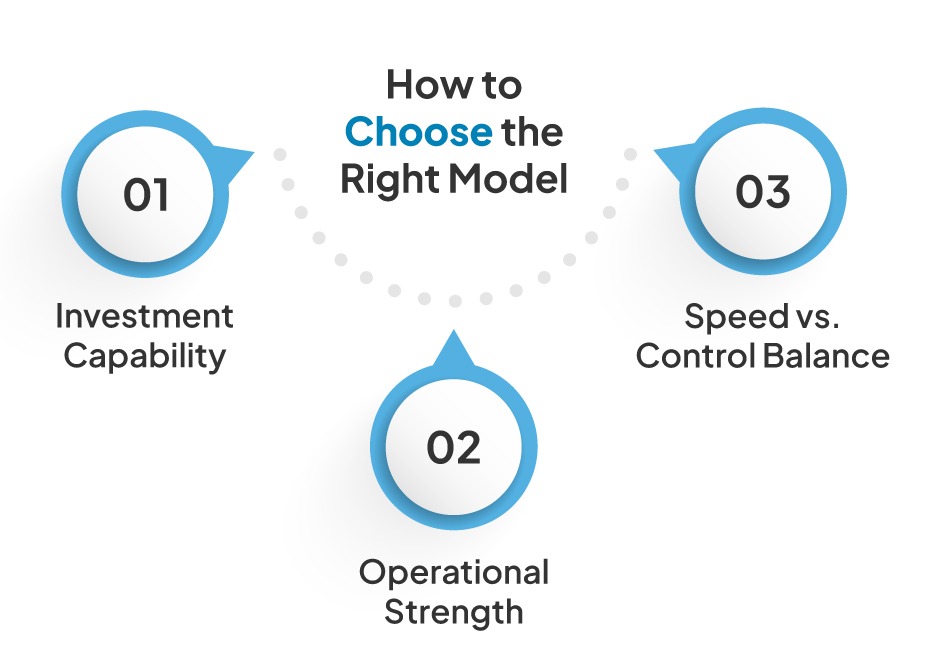
The investment capacity of a company will determine how to expand its brand. For example, if a brand has minimum available capital, it will likely opt for a franchise-first model (FOFO). This is because it allows a brand to expand relatively quickly without taking on a lot of financial risk. On the flip side, brands that have large amounts of capital or are backed by an investment partner will likely prefer COCO. This is because it gives them full control and the ability to retain their long-term profits. It is important to know how much capital is available today without jeopardizing the long-term stability of the business.
The operational capacity of a brand determines how well it can operate multiple locations in a consistent fashion. If a company has strong back-end processes, an efficient supply chain, trained employees, and enough management manpower to support both FOCO and COCO, those models would be the best option. This is because they provide more consistency.
Choosing between the best retail franchise model will depend on the importance of either growth speed, operational consistency or profitability. The FOFO model allows for fast growth due to the fact that many different franchisees can open their stores at once. However, this model is associated with low levels of operational oversight. This kind of oversight can further lead to inconsistencies in customer experiences. It can also lower brand quality in many instances. The FOCO and COCO business models also provide a level of operational oversight. This further increases the likelihood of a varied customer experience.
Brands’ strategic priorities ultimately will dictate the model that is best suited for them.
There’s no single solution that works for every business alike as to which retail expansion model is “best” since the right model for each brand will be based on many factors, including the brand’s financial, operational, and strategic goals; the brand’s resources; and the brand’s risk appetite. Therefore, every brand will define the best way to implement the retail expansion model depending on its long-term vision and plan. The FOFO model is ideal for rapidly scaling with little financial investment. The FOCO model on the other hand, provides a balance between shared investment and control. The COCO model further allows for complete control. But it requires a large investment of both capital and operational resources. This is why brands should always analyse their financial commitment.
Retail growth strategies consist of not just opening stores but also opening the correct stores for long-term success.
1. What are the franchise business model advantages?
One of the most significant strengths of a franchise business model would be the ability to share investments. It would also be around providing for rapid expansion and limiting the financing burden on the franchisor. For franchises, the proven systems offer a low-risk opportunity for ownership. For the franchisor, being able to expand quickly without large amounts of capital allows for more predictable and efficient growth. All of this is carried out while maintaining consistent brand marketing through multiple locations.
2. Which expansion model is best for new or small retail brands?
For new and small retail brands, the development of the FOFO model tends to provide the best way into retail. The FOFO model requires less investment on behalf of the franchisor. This is done while allowing the franchisee to quickly take over the business. Once a solid foundation is established, then the franchisors may want to transition to either the FOCO or COCO model. They usually transition for greater alignment of brand standards, increased revenue through improved margins, and greater oversight of their brand.
3. How much control does a brand get in FOFO, FOCO, and COCO models?
There is considerable variation in the level of control exercised in the three systems of operation. The least amount of control lies with the FOFO model, where franchisees run the day-to-day operations of their businesses. In comparison, the FOCO model shares control between the franchisor and franchisee. Finally, with the COCO model, the brand has complete oversight of its stores because it has total ownership and control of its operations.
4. Can a retail business use a mix of FOFO, FOCO, and COCO models together?
Yes, a number of retail companies successfully implement a hybrid business model. This is done by combining the benefits of the three operating models. A hybrid approach enables companies to enter new markets using the FOFO model. They can also provide consistency within specific regions through the FOCO model. Companies can further establish high-performing locations via the COCO model. This hybrid strategy is beneficial for achieving an optimal balance between investment and growth.


With the Mera Bill Mera Adhikar Reward Scheme, the gove...
September 26, 2023
https://youtube.com/shorts/kPdW1ZGLUKQ?si=lfcV9sm6yjHYY...
February 13, 2026

June 15, 2026

June 5, 2026

June 1, 2026

May 29, 2026

May 22, 2026