How to Save Tax Before March 31st: 10 Proven Tips for SMEs
February 22, 2026

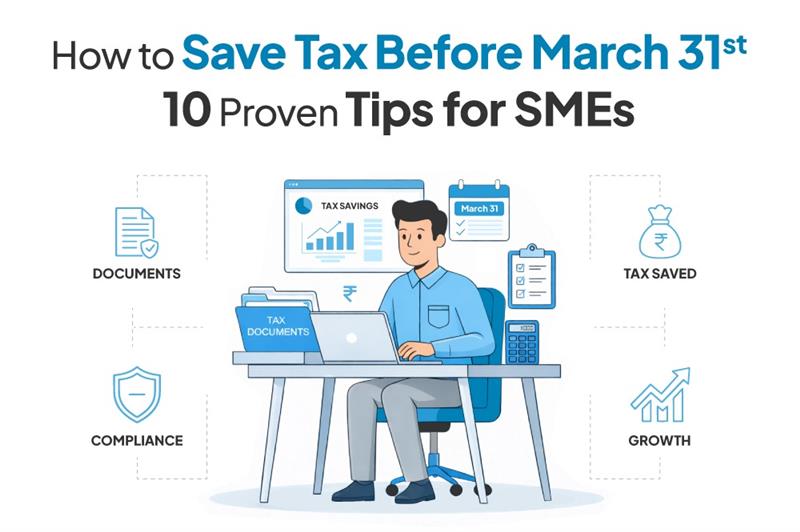
Companies with fewer than 500 employees, known as SMEs, can save tax before March 31st with proper financial year-end planning. The blog discusses reviewing financial statements, taking advantage of all possible deductions, managing their advance tax payments, optimizing their expenses, and complying with the tax law. Companies that act quickly and seek the assistance of an accountant or bookkeeper can legally lower the amount of taxable income and improve cash flow and create a more solid financial base for long-term sustainable growth.
As the financial year draws to a close, SMEs have a critical window to make smart financial decisions. This guide covers 10 actionable strategies to legally reduce your tax liability, improve cash flow, and set your business up for stronger growth next year.
Remember that tax savings is not about panicking and making unplanned investments at the last minute; it is about careful planning through proper documentation and making legally sound decisions that will allow you to reduce your taxable income while remaining compliant with tax laws.
This guide provides an overview of some of the most effective ways to save tax for SMEs prior to March 31st.
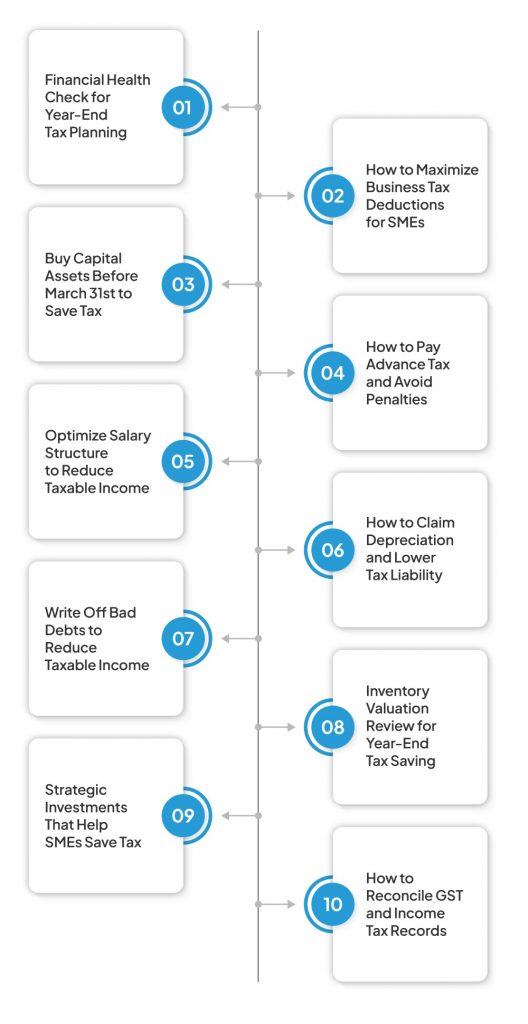
To do tax saving things, Before taking any tax-saving steps, every SME should conduct a complete financial health check. Check your profit and loss statement, balance sheet, outstanding receivables, unpaid liabilities, and advanced taxes paid already to see what your total assets are.
This gives you a clear and accurate view of your current taxable income. Many SMEs make the mistake of estimating profits casually, which can lead to poor tax decisions. Instead, calculate your projected profit until March 31st and determine your approximate tax liability in advance.
A clear understanding of your numbers forms the foundation of effective financial year-end tax planning and helps you make informed, strategic decisions.
To save on taxes and to maximize your deductions for tax purposes, you must claim ALL of your eligible business tax deductions.
Commonly deductible business expenses include:
Be sure to record all invoices by the end of March, even if they are unpaid but are related to an expense incurred in the current financial year; these should still be properly recorded in accordance with accounting standards. Unclaimed deductions will result in increased tax liability for your business. Good recordkeeping (bookkeeping) is critical to managing your business’s taxes as an SME effectively.
If you plan to purchase new machinery, computers, vehicles, or manufacturing equipment, purchasing those new capital assets prior to March 31 allows you to claim depreciation expense for the current financial year; consequently, reducing your taxable profit while at the same time increasing your operational efficiency.
For retail and manufacturing SMEs, purchasing capital assets prior to March 31 is also a strategic way to replace outdated capital assets with new ones; improve productivity through new capital investment; and update your technology infrastructure. However, be sure to have an actual need for the assets you are purchasing.
Purchasing new capital assets merely to save taxes is not a good reason for making expenditures. Proper planning may make this one of the most successful strategies to save on taxes at year’s end.
When you owe more than the required amount of taxes, you should make timely advance payments in order to avoid incurring additional interest under the Income Tax Act.
On or before March 31st:
Making timely advance payments will not only allow you to avoid incurring penalties but will also allow you to retain your clean record of compliance with your tax obligations. The principal reason why many small and medium-sized enterprises (SMEs) lose money is that they pay interest on their owed taxes and incur penalties due to late payment of taxes, rather than due to high tax rates.
If you are an SME that is either a private limited company or a LLP, you can optimize your salary structures/director’s compensation performance bonuses before the close of the financial year.
You may declare performance bonuses in addition to paying any outstanding incentives to your directors, as well as allocate the appropriate amount of remuneration to directors within the parameters of law. You may also have the opportunity to reduce the taxable profits of your business and compensate promoters and key employees relatively.
In order to maintain compliance with tax laws and corporate laws, it is imperative that the appropriate board resolutions be adopted where applicable, document the payments made appropriately, and ensure complete compliance with tax laws and corporate laws. If you are compliant in how you structure the salary/wage/bonus arrangements, you will be able to reduce taxable income and at the same time, provide support and reward to your business stakeholders.
Claiming depreciation for capital assets such as machinery, equipment, vehicles, and furniture can significantly reduce taxable income.
As a business owner, you want to ensure that you have:
If you claim inappropriate depreciation amounts, you can either pay more tax than necessary or have your claims scrutinized. You should perform an annual review of the fixed asset register as part of any structured tax planning at the end of the financial year.
If you determine that certain receivables are uncollectible, write off those balances as bad debt prior to the close of the financial year.
Generally, you will want to ensure that:
Writing off uncollectible receivables reduces your taxable income and provides a proper financial statement.
When writing off uncollectible receivables, be careful not to aggressively or improperly write them off. Be sure to have proof of exigency in case your write-offs would later come under scrutiny.
Inventory valuation needs to be reviewed prior to the end of your financial year, as it has a direct impact on the reported profit and tax owed. For example, if you overstate your closing stock, then you will have increased taxable income, which could result in paying more tax than necessary.
It is important that SMEs properly identify slow-moving or obsolete inventory. Ensure that you properly account for any damaged or unsellable inventory in your records. It is also imperative that you follow the accepted accounting standards for the value of your inventory to ensure compliance and accuracy.
Even small errors when calculating the value of stock can mean material differences to overall profitability and tax calculations. Therefore, having an accurate valuation of inventory is one of the most critical elements of efficient SME taxation and year-end financial statement preparation.
When an SME has cash reserves available, it may want to look into investing them in tax-effective ways allowed according to taxation guidelines.
Consider the following types of options available for investing:
By matching investment choices with long-term goals, it will help ensure that any last-minute decisions regarding investments are being made only to save taxes, without analyzing how much the investment will return or what liquidity requirements exist. Tax strategies developed by an SME that emphasizes effective tax planning will create a balance between saving taxes and retaining financial stability in the business.
Before you begin tax preparations at the end of the year, you need to reconcile your GST against your Income Tax. Failing to do so can often lead to an audit, additional scrutiny and/or penalties from tax authorities if what you report for your GST does not match your income tax.
To effectively reconcile an SME’s sales amounts reported for GST compared to their account book, ensure that you are accurately matching all numbers, verifying any claimed input tax credits, and checking to see if the reported amounts for your overall turnover match your books of account. If you fail to reconcile your taxes, any discrepancies found later can be difficult to resolve.
You must ensure that your financial records are consistent and protect yourself against future issues. This becomes critical for SMEs operating in the retail, distribution and manufacturing industries where the number of transactions each month increases the likelihood of reporting errors against your GST on your Income Tax.
As you prepare to close your books for the year, it’s essential that you understand what not to do, as many small to medium enterprises (SMEs) make mistakes that result in having to pay excessive amounts of taxes or, ultimately, having a higher risk of incurring penalties. Some of the common errors that SMEs may encounter include:
| Common Mistake | Why It’s Risky for SMEs |
| Ignoring advance tax deadlines | Increases total tax outlay due to interest, and places an unnecessary additional burden on the SME. |
| Not reconciling GST and income data | Mismatch could trigger any number of tax notices, increased scrutiny and additional issues regarding compliance. |
| Missing depreciation claims | Unclaimed depreciation results in additional taxable rental income and a higher total tax assessed than should have been paid. |
| Failing to record year-end expenses | Documenting expenses not only helps to lower the total taxable rental income but also inflates profits. |
| Making random tax-saving investments | Lack of planning can result in a cash-flow strain (especially during the year-end) and result in the acquisition of unproductive assets. |
| Not consulting professionals | Not using an expert to assist with tax matters will likely result in missing deductions; creating compliance mistakes, or most concerning, creating a liability. |
Avoiding these mistakes is as important as implementing strategies to save on taxes. Proper planning, proper documentation and assistance from a qualified professional can provide a safeguard against incurring unnecessary penalties and/or financial strain on the SME.
Saving your taxes before this coming March 31st is not about quick fixes or rushing into the last minute (hasty) investment. It is about developing a well-structured and thought-out financial plan that will help you to identify appropriate financial strategies that align with your overall business goals. The benefit of saving each rupee legally tax saved by SMEs will result in improved working capital, improved cash flows and provide opportunities for reinvestment or growth.
SMEs can reduce their tax exposure significantly by implementing strategies to maximise the eligible business tax deductions; carefully assessing their capital expenditure plans; determining the best salary structures; and ensuring compliance with tax regulations. The most effective way to accomplish this is by starting early, creating and maintaining an organised record of receipts and documents (the basis for tax deductions), and not making panic decisions in the last few weeks prior to year-end.
When coupled with appropriate documentation and professional assistance, year-end financial tax planning can provide a strategic edge for all businesses to focus towards a stronger disciplined financial foundation for the next twelve months as well as utilising business tax losses in the future.
1. When should SMEs start tax planning before March 31st?
Tax planning for SMEs should actually start around three to four months before year-end for optimal results. Early tax planning allows for accurate forecasts of expected tax liabilities which will allow the business to better manage their cash flow, allowing for proper timing of investments and providing enough time to make rational business decisions instead of rushing to get everything done at the last minute.
2. Can tax planning improve business cash flow?
Yes, tax planning helps SMEs better manage cash flow through the structured management of their tax liabilities. By knowing the expected amount of tax they will owe, SMEs can coordinate the timing of their tax payments with their cash inflows, which alleviates pressure on their finances and increases working capital from one day to the next on a year-round basis.
3. Is it risky to make last-minute tax-saving decisions?
Yes, last-minute tax savings decisions often result in poor investments, poor documentation, and/or non-compliance with tax regulations. Moreover, by failing to properly evaluate those decisions, SMEs run the risk of tying up their capital in unproductive investments and/or causing themselves future financial strain.
4. How important is documentation for tax savings?
Proper documentation is very important for tax savings – invoices, proof of payments, agreements, and statutory documents. This is done to justify deduction claims and protect the business if audited or scrutinised. If you are missing any documents, this could mean your expenses are not deductible and your tax liability is increased.
5. Do SMEs need professional help for year-end tax planning?
SMEs can perform basic year-end tax planning internally, however professional services can assist to ensure that you have correctly interpreted tax laws, identified all eligible benefits or deductions, and complied with all requirements. Professionals can also assist businesses to avoid penalties and missed opportunities.
6. How does proper tax planning support long-term growth?
Proper tax planning will help an organisation develop better financial discipline, build greater retained earnings, and develop a greater capacity to reinvest in the business. The improved financial stability will ultimately lead to expansion, renewed creditworthiness, and more informed strategic decision-making, which will provide the framework for sustainable business growth over time.

Retailers, micro, small, and medium enterprises (MSMEs)...
November 23, 2025
E-invoicing in 2026 has become an important requirement...
October 31, 2025

June 5, 2026

June 1, 2026

May 29, 2026

May 22, 2026

May 20, 2026