GST Filing Mistakes Retailers Should Fix Before Filing Returns
July 8, 2026

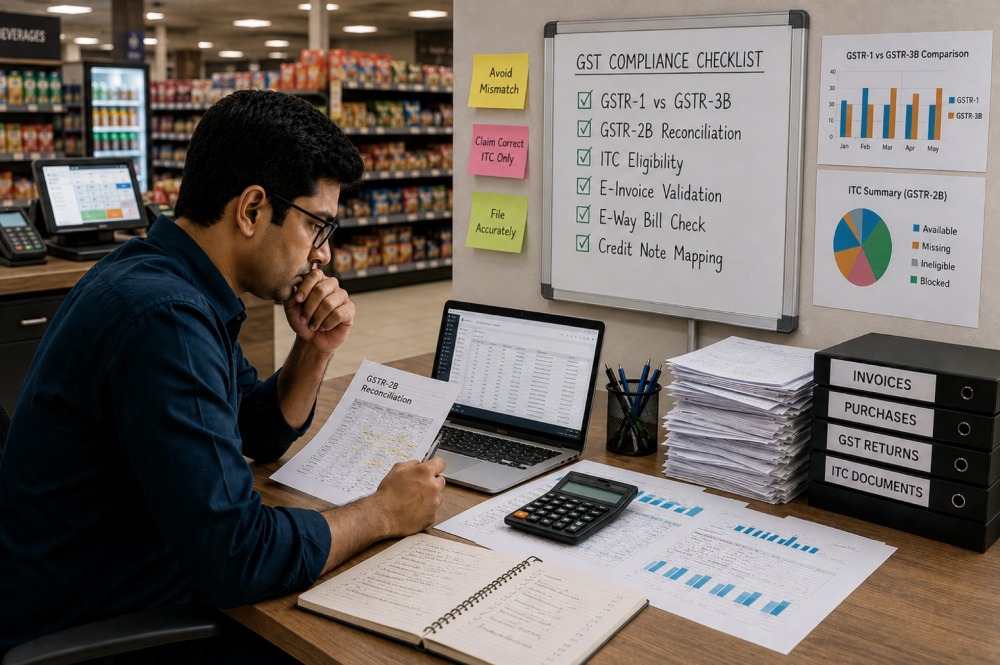
GST notices often come from mismatches in sales, ITC, credit notes, e-invoices, e-way bills, and filed returns. These GST filing mistakes requires accurate product masters, regular reconciliation, proper credit note mapping, GSTR-2B checks, and connected accounting data. In this blog, you will learn the most common GST notice reasons for Indian retailers, GST return errors that happen in POS, purchase, inventory, and accounting records, how wrong GST rates, HSN codes, ITC claims, and credit notes lead to filing issues, what GST penalties and notices can cost a retail business, and how ERP automation can improve GST compliance in India for retail stores.
GST notices in retail usually come from records that do not match. The common trouble spots are GSTR-1 and GSTR-3B values, ITC checked against GSTR-2B, credit notes, e-invoice details, and e-way bill records.
The risk is higher for retailers because GST data comes from more than one place. Stock may update later, the payment may settle the next day, and the accounting entry may be posted after store closing. If nobody checks these entries on time, the gap is harder to trace during filing.
GST filing works best when the records behind the return are clean. In retail, billing, purchases, inventory, payments, and accounts all feed into the final return.
A bill can be correct at the counter but still create a filing problem if the return, payment, or credit note is handled later without proper mapping.
Retailers should treat these forms as connected records, not separate filing tasks.
GST notice reasons usually fall into a few clear areas that retailers should check before filing.
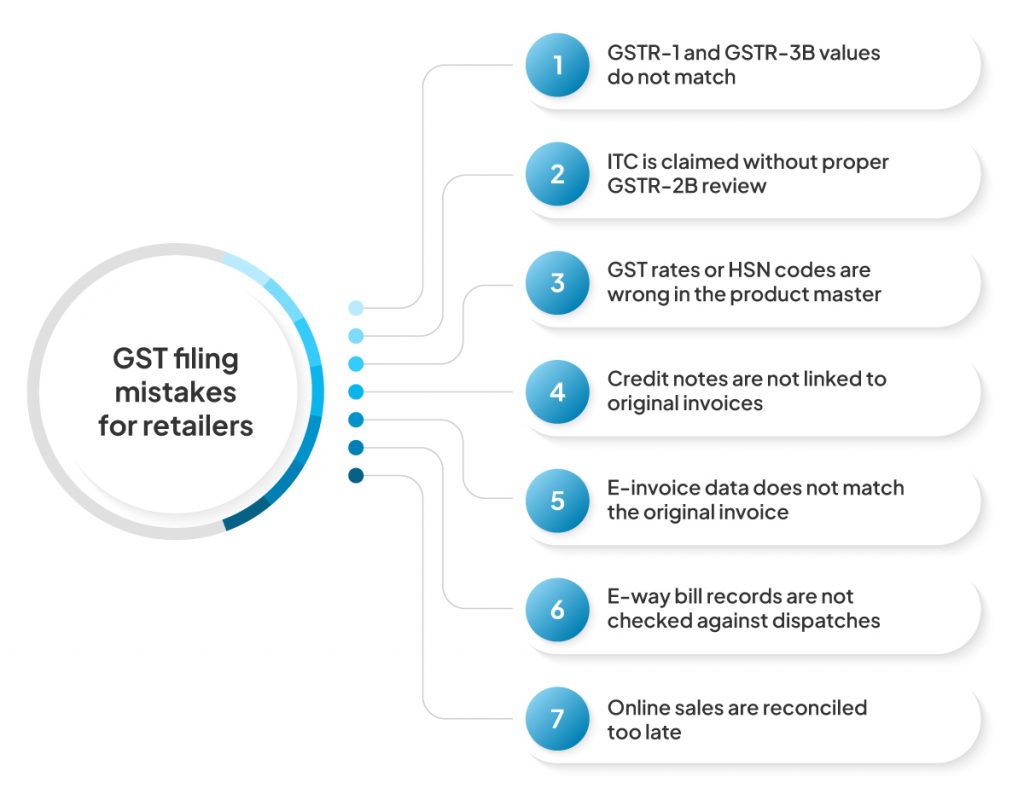
GSTR-1 carries the sales invoice data, while GSTR-3B carries the final tax summary for the period. Both should tell the same story. If the sales value changes between the two, the difference needs a clear reason.
GSTR-1A can be used to correct or add records after GSTR-1 and before GSTR-3B for the same period. It should be treated as a backup, not the usual way to clean sales data. A proper sales check before GSTR-1 filing saves more time than correcting the return later.
GSTR-2B shows ITC availability based on supplier-reported documents. If a supplier invoice is missing from GSTR-2B, the ITC claim needs review before GSTR-3B is filed.
This issue is common in retail because purchase entries often move faster than supplier filing. A simple ITC review should mark invoices under four heads:
This makes the final ITC claim easier to check and easier to explain later.
Product master mistakes repeat until someone catches them. If the wrong GST rate or HSN code is saved for an item, every bill for that item can carry the same error.
This usually happens when new SKUs are created without a tax review. Product names and selling prices may change often, but GST rate and HSN code fields need tighter control.
Sales returns are routine in retail, but GST reporting needs a proper trail. The customer may receive the right refund or exchange, but the GST record may remain incomplete. This mistake is common in apparel, footwear, lifestyle, and gifting stores.
If credit notes are not mapped properly, sales figures in the books and returns may drift. The issue becomes harder to resolve once the return is filed.
For businesses covered under e-invoicing, B2B invoice details have to be reported on the Invoice Registration Portal. Once accepted, the system assigns the IRN and returns the signed invoice with a QR code.
The details used for billing should be the same details reported for e-invoicing. Mismatches often appear when teams make changes after invoice creation. If billing, dispatch, and accounts do not work from the same final record, e-invoice reconciliation becomes difficult.
The ₹50,000 limit is an important checkpoint for goods movement under GST. Before a high-value dispatch leaves, the team should review the e-way bill requirement along with the invoice.
The value, GSTIN, delivery address, vehicle number, and dispatch status should be checked at the same time.
Online orders should be reviewed before GST filing data is finalised. Marketplace reports, website orders, payment gateway settlements, cancellations, and refunds can all affect taxable value.
Retailers selling through offline and online channels should close both sets of records together. One sales review is easier to manage than separate corrections after filing.
GST penalties are only one part of the cost, as a notice also takes up staff time. The business may need to collect invoices, sales reports, purchase registers, GSTR-2B workings, payment records, e-invoice data, and e-way bill details.
If these records sit in separate systems, the reply takes longer. The accountant has to rebuild the transaction trail instead of reviewing one clean file.
Section 47 of the CGST Act covers late fees for delayed returns. Section 50 covers interest on delayed payment of tax, with the rate not exceeding 18% as notified by the government.
Retailers should watch four cost areas closely:
Wrong ITC claims can also lead to penalties. Section 122 of the CGST Act covers cases where input tax credit has been wrongly availed or utilised, with penalty provisions depending on the nature of the case.
Retailers can reduce GST return errors by improving checks before filing. The process needs clear ownership and regular review.
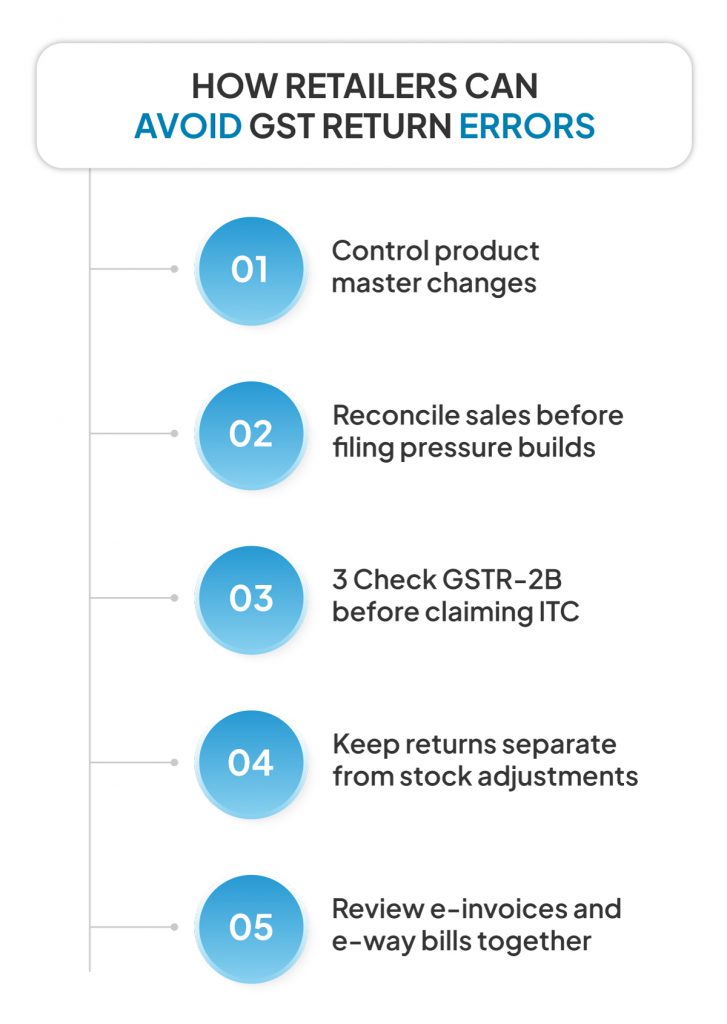
GST rate, HSN code, unit, item category, and barcode should not be open to casual edits. New products should go live only after tax fields are checked.
This control is especially important for supermarkets, apparel stores, hardware stores, and other businesses with frequent SKU additions.
Sales reconciliation should cover POS reports, cancelled bills, credit notes, online orders, and payment settlements. A weekly review works better than a rushed monthly check.
High-volume stores may need a daily close. Smaller retailers can still maintain a fixed weekly routine.
Match the purchase register with GSTR-2B before filing GSTR-3B. Missing supplier invoices should be marked and followed up before the deadline.
Do not rely only on purchase bills in the books. ITC should be supported by supplier-reported data.
Customer returns, damaged stock, expired stock, samples, and internal consumption should be recorded separately. They may all affect inventory, but they do not carry the same GST treatment.
Sweet and namkeen stores should be careful here because wastage and expiry can be frequent. Mixing those entries with sales returns makes GST review harder.
E-invoice and e-way bill checks should be part of the filing review. Invoice number, GSTIN, date, value, place of supply, IRN status, QR code, and transport details should agree with the transaction record.
Manual GST filing becomes harder when retail records sit in different places. ERP automation reduces this back-and-forth by keeping related entries connected from the start. For GST compliance in India, ERP helps with retail GST filing issues through four practical areas:
A GST billing software setup also gives finance teams a cleaner base for return preparation. Instead of pulling figures from separate POS reports, purchase files, stock sheets, and accounting entries, the team can review GST data from records that are already linked during daily work.
Use this checklist before filing GSTR-1 and GSTR-3B.
GST filing mistakes for retailers are easier to avoid when store records are checked before the return is prepared. The most common problems sit in sales values, ITC claims, credit notes, product tax setup, e-invoice data, and e-way bill records.
A cleaner GST close starts with a few fixed checks each month. Review item tax settings, sales totals, GSTR-2B, credit notes, e-invoices, e-way bills, and supporting records before the return is filed.
VasyERP helps retail teams keep billing, inventory, accounts, e-invoicing, e-way bills, and store reports connected during daily work. That gives the finance team fewer scattered records to clean up at filing time.
1. Can a Retailer Receive a GST Notice Even After Filing Returns on Time?
Yes. Filing by the due date only covers the timing part. The numbers still need to match the books, supplier data, and GST portal records.
2. Should Small Retailers Reconcile GST Data Every Month?
Yes. Even a basic monthly check is useful. Sales, purchase bills, credit notes, tax rates, and GSTR-2B should be reviewed before the return is filed.
3. What Should Retailers Do if a Supplier Invoice Is Missing From GSTR-2B?
Keep that invoice on a pending list and ask the supplier to report it. The ITC claim should be checked before adding it to GSTR-3B.
4. Can Discounted Sales Create GST Filing Issues?
Yes. Offers, bundles, and festive discounts can create errors if the taxable value and GST amount are not shown correctly in the bill.
5. Why Do Multi-Store Retailers Face More GST Filing Risk?
They handle sales, returns, stock transfers, and payments across locations. If branches follow different processes, GST data becomes harder to reconcile.


If we are talking about how to choose the right account...
December 12, 2024

In 2026, organizations require rapid and intelligent fi...
June 5, 2026

July 8, 2026

June 15, 2026

June 5, 2026

June 1, 2026

May 29, 2026