GSTR-1 vs GSTR-3B: What’s the Difference and When to File
May 22, 2026

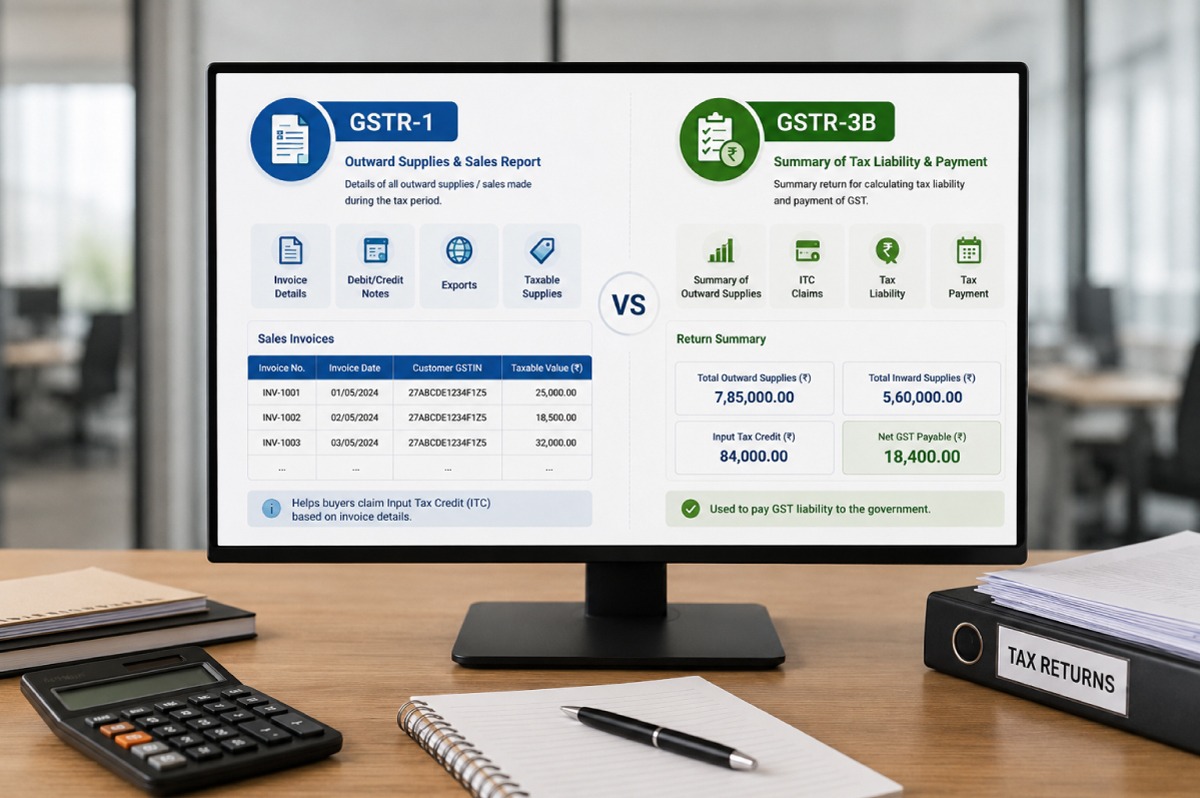
GSTR-1 vs GSTR-3B are essential GST returns that every registered business must understand. GSTR-1 contains detailed sales invoice data, while GSTR-3B is a summary return used for GST tax payment and ITC claims. Knowing the differences, due dates, and filing rules for both returns helps businesses stay GST compliant, avoid penalties, and manage tax filing smoothly.
GSTR-1 is a GST return used to report all sales made by a registered business in a particular period. It has particulars such as sales invoices, debit notes, credit notes, exports, and other taxable supplies . The information filed in GSTR-1 helps the buyers to claim Input Tax Credit (ITC), hence it is important to report accurately.
Most of the registered taxpayers are required to file GSTR-1 on a monthly or quarterly basis depending upon their turnover and eligibility under the QRMP scheme. However, composition dealers and some exempt taxpayers are not required to file this return. Simply put, GSTR-1 is a way to keep the sales transactions under the GST system transparent.
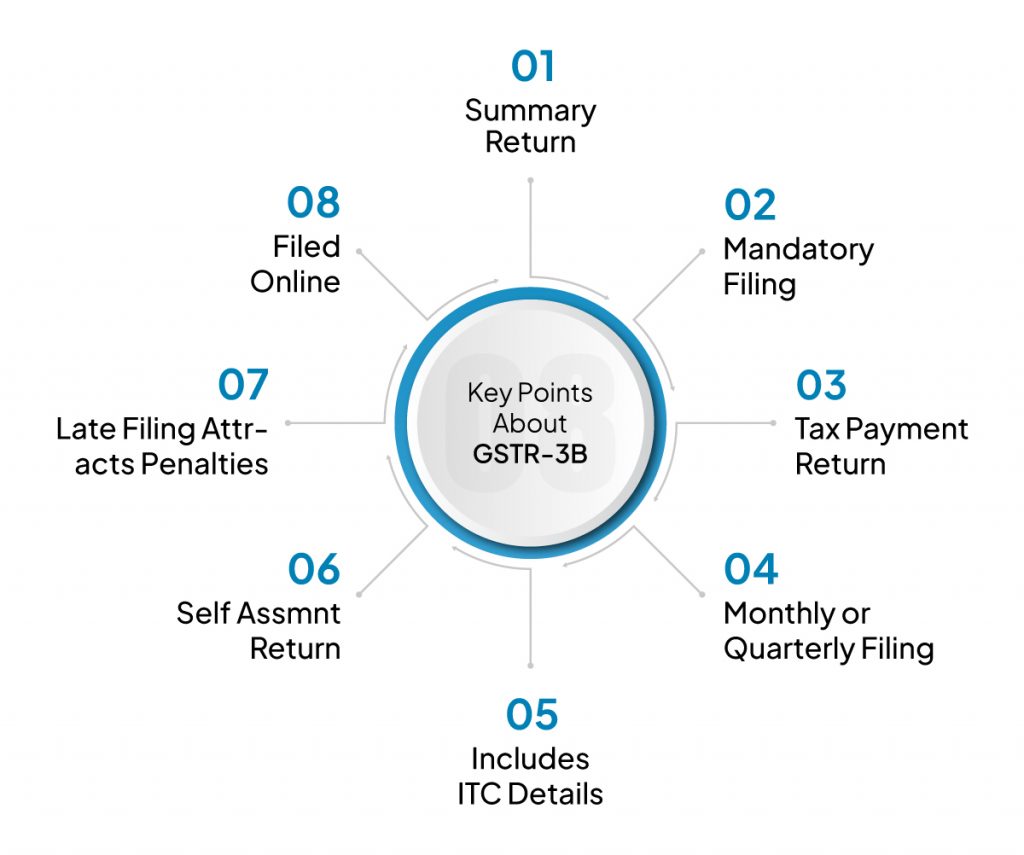
GSTR-3B is a monthly statement that businesses registered under the Goods and Services Tax (GST) must submit. This statement outlines the details of their income, expenses, and tax liabilities for a specific tax period. It is a simplified form that enables businesses to declare their GST liabilities for the month on a self-assessment basis, allowing them to pay the tax due and claim input tax credit (ITC) for the same period.
GSTR-3B is a simplified summary GST return that is filed to declare the total sales, purchases, Input Tax Credit (ITC) and GST payable for a reporting period. Unlike GSTR-1, businesses are not required to upload invoice level details while filing GSTR-3B. This return is primarily to calculate and pay GST liability on time and stay compliant with GST rules.
| Basis of Difference | GSTR-1 | GSTR-3B |
| Purpose | Reports outward supplies and sales invoices | Reports summary of tax liability and tax payment |
| Nature of Return | Detailed return | Summary return |
| Information Required | Invoice-level sales details | Consolidated figures only |
| Tax Payment | No direct tax payment | Used to pay GST liability |
| Filing Frequency | Monthly or quarterly | Monthly or quarterly |
| Input Tax Credit | Does not include ITC claim details | Includes ITC claims |
| Impact on Buyers | Helps buyers claim ITC | Mainly affects seller compliance |
| Complexity | More detailed and time-consuming | Simpler compared to GSTR-1 |
| Applicability | Regular taxpayers | Regular taxpayers |
| Revision | Cannot be revised directly | Cannot be revised directly |
| Return Type | Filing Frequency | Due Date |
| GSTR-1 | Monthly | 11th of the following month |
| GSTR-1 | Quarterly (QRMP) | 13th of the month following the quarter |
| GSTR-3B | Monthly | 20th of the following month |
| GSTR-3B | Quarterly (QRMP) | 22nd or 24th of the month following the quarter, depending on state |
Quick Fact: GSTN and GST Portal guidelines state that typically you cannot submit GSTR-1 without having submitted your last quarter’s GSTR-3B. This procedure makes it much easier for taxpayers to obey the rules when receiving multiple types of GST returns.
If the GSTR-1 and GSTR-3B do not match, the GST department will examine and solve the problem that causes the difference between GSTR-1 and GSTR-3B. The reason for these two returns not matching could be because of non-compliance, as GSTR-1 has all sales information, and GSTR-3B shows the total tax liability amount.
If there is an underreporting of tax liability on GSTR-3B, the taxpayer can receive a GST notice, find discrepancies, and limit the amount of Input Tax Credit (ITC) they can claim. Businesses should ensure that their sales, purchases, and GST returns records are accurate before they file their returns to prevent issues like this from occurring.
When you file your GSTR-1 or GSTR-3B late, penalties will apply according to the goods and services tax statute (GST). If the deadline to file a return has passed and the business hasn’t submitted its return, the business will be liable to pay both late filing penalties and interest on any outstanding taxes. This inhibits the business by increasing the cost of operations and decreasing the business’s rating for compliance.
In the case of GSTR-3B, interest will be calculated on any unpaid taxes beginning on the due date and continuing until all taxes have been paid. Late filing penalties will be based on a daily rate for the number of days the return is overdue, up to the maximum amount of penalties allowable under the GST Regulations. Even a Nil return must pay a penalty for late filing if it is submitted after the deadline
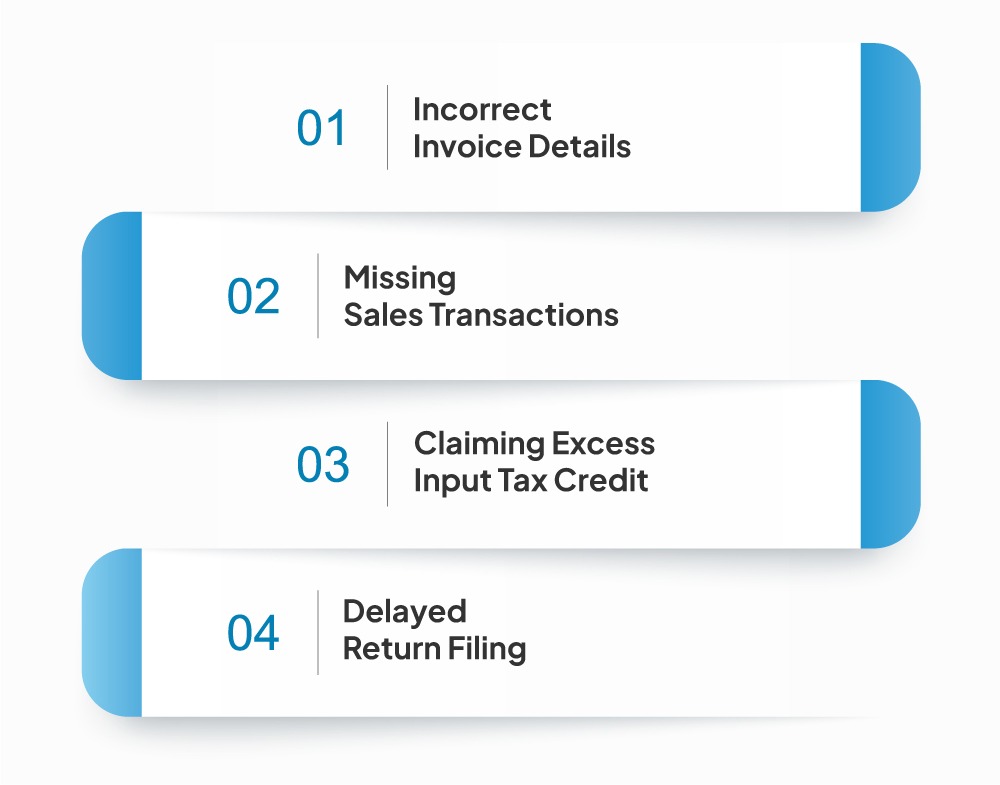
GST compliance problems plague many businesses because of easily avoidable mistakes made while filing the GST returns. Small errors made on GST returns will cause mismatches, penalties, and problems when claiming ITCs. By knowing what these common mistakes are, businesses can keep accurate records for the GST and have a much easier time filing their GST returns.
Incorrectly inputting invoice numbers, GSTINs, and values into the GSTR-1 by mistake has the potential to result in mismatched data between the supplier’s and buyer’s records. This may cause a disruption to an ITC (input tax credit) being claimed by the buyer or may result in receiving a notice from the GST department during the reconciliation and assessment process.
Certain businesses will accidentally leave out sales invoices when completing their GSTR-1. Missing these sales transactions means that you’re underreporting the amount of sales and tax that you owe, causing inconsistencies between your GSTR-1 and GSTR-3B returns, and increasing the likelihood of facing penalties or scrutiny from the GST office.
GST regulations allow businesses to only claim input tax credits (or ITC) for eligible purchases and those supported by valid purchase invoices. When businesses claim ITC, they must adhere to all the requirements outlined in GST legislation regarding claiming ITC for an eligible purchase. Therefore, businesses wishing to claim input tax credits must ensure they have correctly examined their purchase records and have reconciled those records against the supplier’s tax invoices.
Late filing of GST returns may incur penalties and interest charges and can create compliance issues. If GST returns are delayed, future filings on the GST portal may be restricted, and their overall business operations will be disrupted, imposing an unnecessary financial burden on taxpayers.
GST software helps businesses file GST returns and accurately calculate their tax obligations more efficiently by allowing them to streamline the filing and reconciliation process. Businesses with a large number of invoices would find filing GST returns manually to be a time-consuming process that is often filled with errors.
With modern GST software, invoice information can be imported automatically for tax liability calculations, input tax credit tracking, and return preparation (GSTR-1 and GSTR-3B), while identifying any mismatches between the various returns prior to any filing and enabling businesses to avoid receiving a notice or incurring penalties.
Many GST software solutions provide automatic notifications of upcoming due dates to help prevent late filings. Now, these GST software products can be integrated with your existing accounting applications to help simplify bookkeeping and tax compliance.
With the reduction in time spent performing manual work and an increase in data accuracy through the use of GST software, businesses can reduce compliance risk and continue to conduct smooth GST operations during the financial year.
GSTR-1 and GSTR-3B are part of the GST filing process. GSTR-1 records and keeps track of all your sales, while GSTR-3B includes how much GST you owe and how much GST you have paid. Filing both of the returns on time and accurately will help businesses avoid penalties, maintain compliance, and receive input tax credits.
Businesses can mitigate the risk of non-compliance by regularly reconciling the information in both returns, which helps prevent discrepancies and requests from the GST office, while also keeping adequate records, filing punctually, and using GST software.
By being educated on the distinctions between these two different reports (GSTR -1 and GSTR -3B) as well as how they’re interrelated, businesses can meet their GST obligations with greater ease while topics related to fiscal integrity and accountability will be managed successfully for the entity on a day-to-day basis.
No. GSTR-1 is mandatory only for businesses registered under GST that need to report outward supplies (sales). Businesses under the Composition Scheme do not file GSTR-1.
Yes, GSTR-3B can be filed independently of GSTR-1. However, GSTR-1 cannot be filed if the GSTR-3B for the previous period is overdue — not the other way around.
If GSTR-1 and GSTR-3B values do not match, the GST department may send notices, and businesses may face penalties, interest, or scrutiny. It can also create issues in ITC claims and GST reconciliation.
Late filing of GSTR-3B attracts a late fee of ₹50 per day (₹25 CGST + ₹25 SGST). For NIL returns, the late fee is ₹20 per day. Interest at 18% per annum may also apply on outstanding tax liability.
After you submit your GSTR-1 you won’t be able to revise it. However, if you find mistakes on your GSTR-1 after you have filed it, you can fix them in your next return, assuming the GST regulations allow you to do so, by submitting corrected invoice information in your GSTR-1 for your current reporting period.


For small business owners, retailers, MSMEs, and wholes...
October 11, 2024

In 2026, organizations require rapid and intelligent fi...
June 5, 2026

July 10, 2026

July 8, 2026

June 15, 2026

June 5, 2026

June 1, 2026