How
- Prashant Corner
- Prashant Corner
Unified Production, Kitchen & Inventory Operations with VasyERP
- Prashant Corner
- Prashant Corner
Learn how Prashant Corner unified production, kitchen management, stock transfers, and retail operations through one connected Cloud ERP platform built for food businesses.
Summary
VasyERP helped Prashant Corner connect production, kitchen, inventory, warehouse, and outlet operations through one centralized multi-location food ERP system. By automating production planning, stock movement, kitchen workflows, and inventory tracking, the business improved operational visibility, reduced manual dependency, and streamlined daily execution across all locations.
About the Client

Prashant Corner is a multi-store food company, specializing in traditional Indian Mithai and similar product lines, managed end-to-end through VasyERP's dedicated ERP for sweet, namkeen, and bakery businesses.The company operates from one central production facility and supplies several retail stores daily. Prashant Corner emphasizes quality and consistency and requires strong coordination between production, inventory, and sales to ensure the smooth operation of all locations.
Sector
Operating In
Business Model
Challenges
Problem Statement
Prashant Corner faced operational challenges with its production, kitchen, inventory and outlet processes, challenges that are common in food businesses operating without a dedicated ERP solution. The manual workflows and lack of systems to control and provide visibility to the business created inefficiencies. It also created delays and inconsistencies during daily operations.

Disconnected Production Planning & Execution
- No structured production planning system.
- Manual calculation of batches and scheduling.
- Production is not linked to customer demand.
- No recurring automation of production.

Inefficient Kitchen Operations
- No real-time production tracking in the kitchen.
- Manual raw material calculations for recipes.
- No workflow to manage all stages of the production process.
- No visibility to the status of production.

Lack of Automated Stock Transfer Intelligence
- Manual requests for outlet stock created delays.
- Ordering by case quantity became problematic.
- No request lifecycle based on expiry dates.
- No demand aggregation based on product.

Inventory Visibility Gaps
- No real-time tracking of inventory across all locations.
- Difficult to manage raw materials and finished goods.
- No shortage/excess visibility to facilitate planning.
- Replenishment cycles were reactively managed.

No Batch & Raw Material Traceability
- Unable to track raw material batches across the production process.
- No link exists between raw materials and finished goods batch numbers.
- Material usage during production cannot be tracked.
- No visibility to track stock movement by batch number.

No Repacking & Packaging Process Control
- No standard process for product repackaging and conversion.
- Packages are manually handled via packaging and labeling activities.
- No history of quantities of repackaged product.
- Existing packaging standards were not applied consistently across all warehouse locations.

Limited Warehouse & Storage Visibility
- Warehouse staff cannot easily access up-to-date inventory counts across all storage locations.
- Difficult tracking of inventory at a sub-location or rack level.
- No method for monitoring storage-wise inventory allocation.
- No central control of all warehouse operations.

Disconnected Customer Ordering System
- Customers could not self-order.
- All manual counter billing created inefficiencies and delays.
- Menu control was not available across the outlet device.
- There was no integration of POS and kitchen flow.
Unify production, inventory, kitchen and customer ordering with one complete intelligent ERP system to streamline your operations.
Book a DemoSolutions Offered
VasyERP’s food manufacturing ERP has helped Prashant Corner connect their operations through a unified system for production, kitchen operations, cloud-based inventory management, and the ordering process.
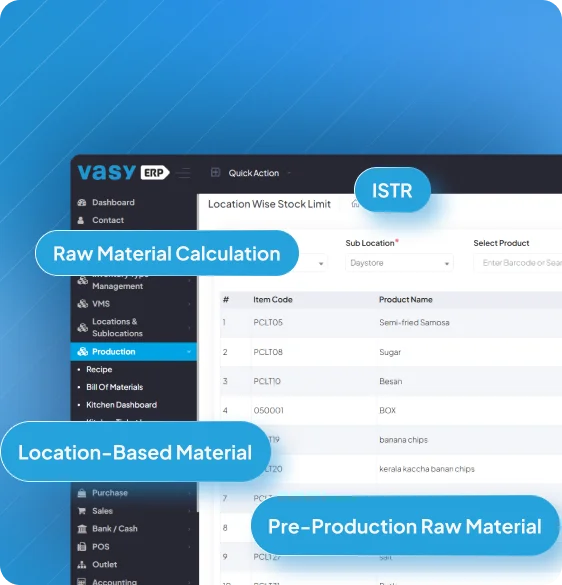
Generates a calculated amount of required raw materials for production by using the number of items in the planned order.
Automatically generates an internal stock transfer request (or ISTR) when materials are required for production..
VasyERP uses the configured location (and sub-location) to identify where raw materials should be sourced from, based on the production requirements.
Provides an available ‘raw material’ report prior to production to ensure that raw materials/equipment will be available for production.
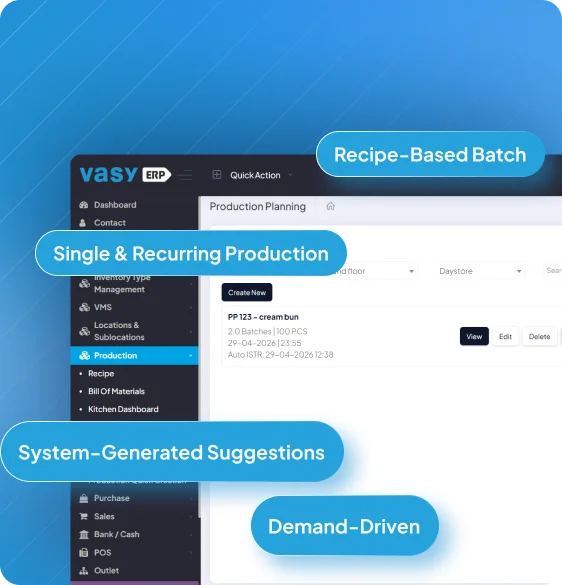
Provides production planners with the ability to perform one-time production planning as well as the ability to perform recurring production planning, a core capability of any ERP for food production based on the demand cycle.
Recipe-based batch calculations automatically batches of product, as specified in defined recipes and the ratios of the standard amount of ingredients to each batch.
This system suggests the amount of production based on sales data captured by the POS system and pending orders.
This allows for production planning to match up with what customers are actually buying..
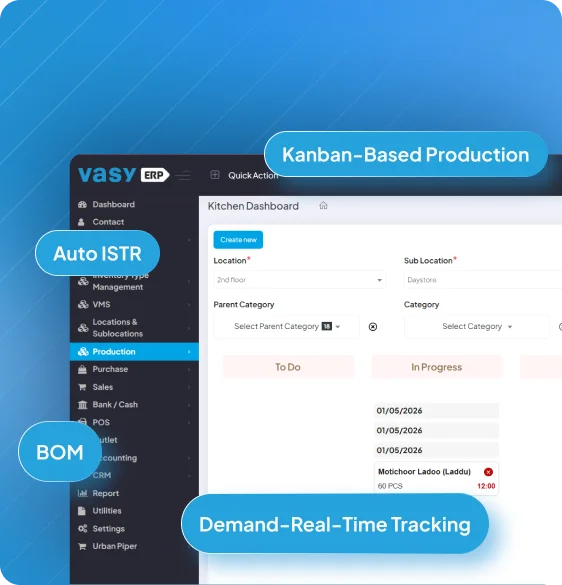
Production assignments are broken down into parts so they can be tracked visually and managed effectively throughout the entire process.
As soon as production starts (during execution) an internal stock and transfer request is automatically generated.
Raw materials consumed during production are automatically deducted from inventory based on Bill of Materials (BOM) specifications.
You can view what step of the kitchen production process you are currently working on, as well as how long it is taking to complete that process, at any time.
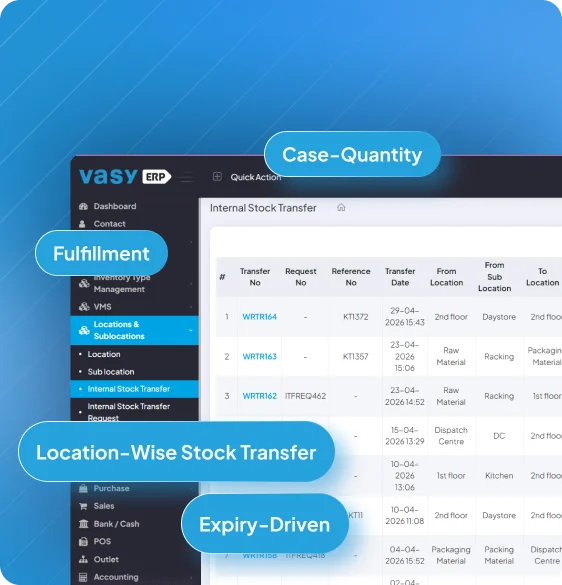
Allows requesting for individual stock verification and transfers for all locations separately.
Stock requests are always created by following pre-established rules for ordering case quantities.
Permits the routine fulfilment of orders either on a product basis or on an aggregate basis of the entire routine order fulfilment.
Automatically closes stock requests when a specified expiration date has been attained.
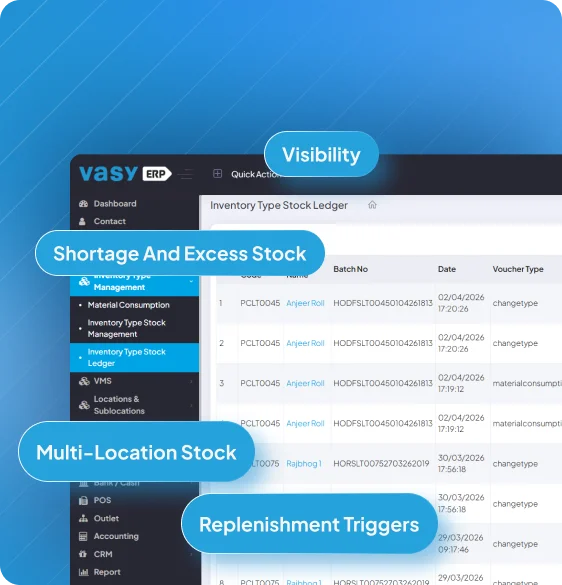
Prashant Corner gained real-time visibility into raw materials and finished goods across production units and retail outlets, helping teams reduce shortages and improve stock planning.
Calculates stock shortages or excess stock amounts by location and by item automatically.
Tracks the movement of inventory products among warehouses and each of the places they are sold.
Alerts when stock hits a predetermined stock level.
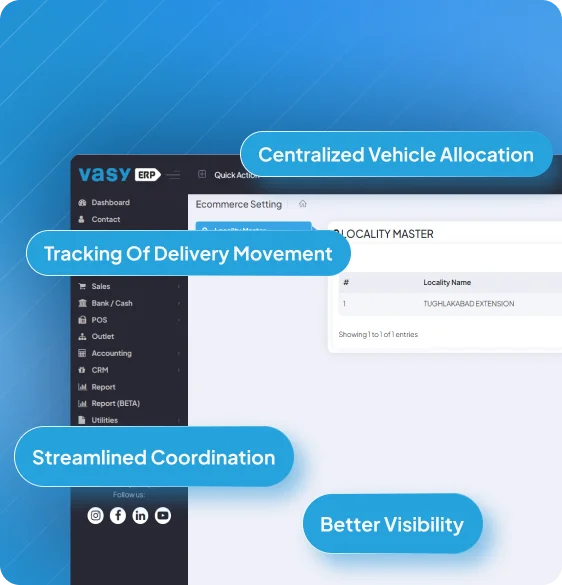
The centralised transportation workflow system now allows for the administration of the assignment and dispatch of vehicles to fulfill delivery routes.
Provides increased visibility to monitor the movement of delivery vehicles from the warehouse to the kitchen to the outlet.
Allows for streamlining the coordination of the activity related to stock transportation between the multiple operational and delivery teams.
Allows for the monitoring of both the status and the end-to-end cycle of delivery execution.
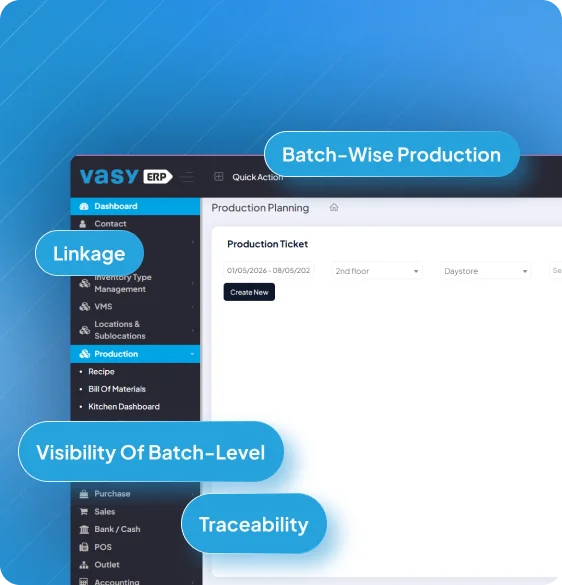
Provides a means to manage production output by tracking the individual batches of production.
Establishes a link between the raw materials that were consumed during production and the batch of finished goods produced.
Allows for sufficient tracking of the inventory as it moves through the various transactions occurring for that batch of inventory.
Provides visibility from the time that the raw materials are received through to the time that the finished products are received.
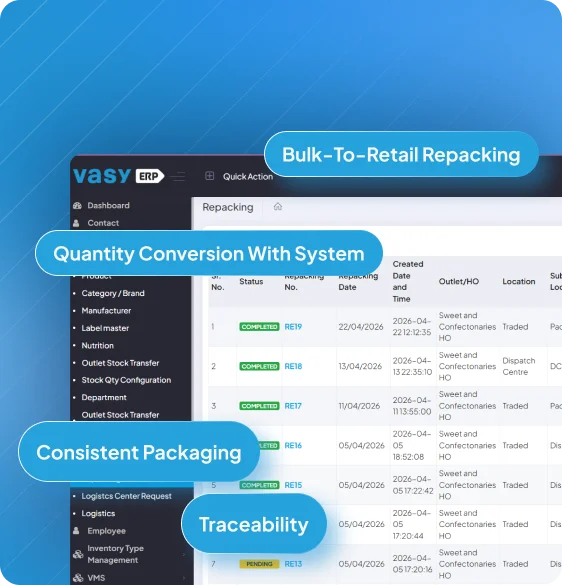
Specifies a structured standard procedure by which bulk items are transformed into retail-ready units.
The system logic ensures that an accurate quantity can be obtained based on system-defined rules and validation criteria.
Repackaging maintains complete visibility throughout an entire physical inventory warehouse movement.
The packaging from all locations and all storage areas must be uniform to maintain consistent quality throughout the marketplace.
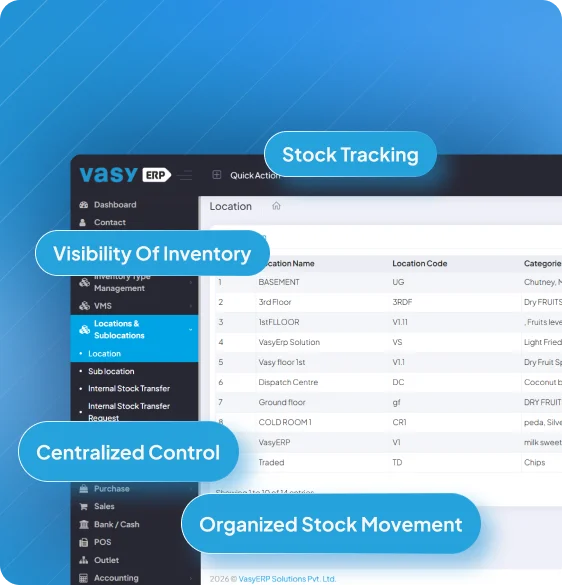
Enables accurate inventory tracking across multiple specified locations and sub-locations.
Creates comprehensive visibility by displaying the location of stock at the rack and warehouse level.
Provides organized and accountable movement of goods between warehouses, outlets, and points of sale.
Creates a single point of access for centralized viewing and management of warehouse operations and transfers for all locations separately.
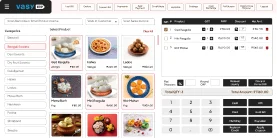
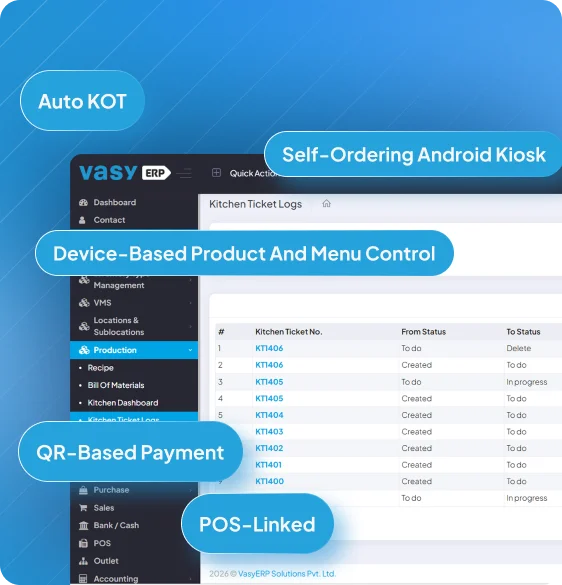
Customer self-service ordering with an Android-based kiosk provides an avenue for customers to order directly through the use of an Android-powered kiosk.
Devices will display specific products and menus based upon the configuration.
QR code-based payment support enables customers to make quick payments via the scanning of a QR code on the kiosk.
Links the kiosk transaction directly to the cashier register for ease and accuracy of operational management.
Kitchen orders are generated automatically through product labels using Kitchen Order Tickets whenever a specific set of criteria is met.
Generates a calculated amount of required raw materials for production by using the number of items in the planned order.
Automatically generates an internal stock transfer request (or ISTR) when materials are required for production.
VasyERP uses the configured location (and sub-location) to identify where raw materials should be sourced from, based on the production requirements.
Provides an available ‘raw material’ report prior to production to ensure that raw materials/equipment will be available for production.
Provides production planners with the ability to perform one-time production planning as well as the ability to perform recurring production planning, a core capability of any ERP for food production based on the demand cycle.
Recipe-based batch calculations automatically batches of product, as specified in defined recipes and the ratios of the standard amount of ingredients to each batch.
This system suggests the amount of production based on sales data captured by the POS system and pending orders.
This allows for production planning to match up with what customers are actually buying..
Production assignments are broken down into parts so they can be tracked visually and managed effectively throughout the entire process.
As soon as production starts (during execution) an internal stock and transfer request is automatically generated.
Raw materials consumed during production are automatically deducted from inventory based on Bill of Materials (BOM) specifications.
You can view what step of the kitchen production process you are currently working on, as well as how long it is taking to complete that process, at any time.
Allows requesting for individual stock verification and transfers for all locations separately.
Stock requests are always created by following pre-established rules for ordering case quantities.
Permits the routine fulfilment of orders either on a product basis or on an aggregate basis of the entire routine order fulfilment.
Automatically closes stock requests when a specified expiration date has been attained.
Prashant Corner gained real-time visibility into raw materials and finished goods across production units and retail outlets, helping teams reduce shortages and improve stock planning.
Calculates stock shortages or excess stock amounts by location and by item automatically.
Tracks the movement of inventory products among warehouses and each of the places they are sold.
Alerts when stock hits a predetermined stock level.
The centralised transportation workflow system now allows for the administration of the assignment and dispatch of vehicles to fulfill delivery routes.
Provides increased visibility to monitor the movement of delivery vehicles from the warehouse to the kitchen to the outlet.
Allows for streamlining the coordination of the activity related to stock transportation between the multiple operational and delivery teams.
Allows for the monitoring of both the status and the end-to-end cycle of delivery execution.
Provides a means to manage production output by tracking the individual batches of production.
Establishes a link between the raw materials that were consumed during production and the batch of finished goods produced.
Allows for sufficient tracking of the inventory as it moves through the various transactions occurring for that batch of inventory.
Provides visibility from the time that the raw materials are received through to the time that the finished products are received.
Specifies a structured standard procedure by which bulk items are transformed into retail-ready units.
The system logic ensures that an accurate quantity can be obtained based on system-defined rules and validation criteria.
Repackaging maintains complete visibility throughout an entire physical inventory warehouse movement.
The packaging from all locations and all storage areas must be uniform to maintain consistent quality throughout the marketplace.
Enables accurate inventory tracking across multiple specified locations and sub-locations.
Creates comprehensive visibility by displaying the location of stock at the rack and warehouse level.
Provides organized and accountable movement of goods between warehouses, outlets, and points of sale.
Creates a single point of access for centralized viewing and management of warehouse operations and transfers for all locations separately.
Customer self-service ordering with an Android-based kiosk provides an avenue for customers to order directly through the use of an Android-powered kiosk.
Devices will display specific products and menus based upon the configuration.
QR code-based payment support enables customers to make quick payments via the scanning of a QR code on the kiosk.
Links the kiosk transaction directly to the cashier register for ease and accuracy of operational management.
Kitchen orders are generated automatically through product labels using Kitchen Order Tickets whenever a specific set of criteria is met.
Implementation Highlights
Key milestones showcasing how VasyERP food business ERP unified Prashant Corner’s operations.

Recipe-Based Kitchen Production System
Developed & implemented recipe based production using defined recipe BOM logic. It helped provide better quality of the produced product. This also eliminated manual calculations and provided standardization for executing production across different batches and cycles in the kitchen.

Auto Internal Stock Transfer on Production Flow
Automated the process for requesting raw materials during production by automatically requesting raw materials when work begins. The automated process reduced the need for manual orders and ensured that the materials were available on time to produce finished products.

Recurring Production Planning Engine
Developed a recurring production planning process with defined scheduling. Users can select the planning cycle end date and recurring time intervals. The system automatically creates weekly production plans, reducing manual entry and improving planning consistency.

Case-Controlled Outlet Stock Requests
Each case order created a standardized outlet stock request by case quantity. This improved ordering accuracy at the outlet level, reduced quantity errors, and established a consistent process for transferring stock between locations.

Self-Service Kiosk Ordering System
Facilitated technical self-service ordering through kiosks where customers could select products, complete payments, and submit orders independently. Orders were directly linked with kitchen and point-of-sale systems to increase order speed and reduce staff workload.

Real-Time Kitchen Workflow Tracking
Established a systematic way of tracking kitchen production workflows using the production order tracking system. Users can monitor production stages from ‘To Do’ to ‘In Progress’ and ‘Done’, improving visibility, coordination, and task management.
The Impact
Prashant Corner achieved a fully connected and operational system to bring production, kitchen, inventory, and outlet functions together. Increased accuracy of production improved recipe planning through batching controls. Manual errors in kitchens have decreased by providing structured tracking of tasks.
Internal stock transfers have increased both speed and reliability through automated internal transfer requests. Stock order requests from the outlet have improved through requested cases rather than boxes for items based on demand (demand visibility) and through improved stock planning.
Visibility of inventory with regard to both raw materials and finished goods has improved. This provided an opportunity to plan and control inventory more effectively.
Reduced Operational Errors
Improved Process Efficiency
Centralized Operations Control
Improvement in Raw Material Planning Accuracy
Better Inventory Visibility Across Locations
Accuracy in Recipe-Based Production Execution
Prashant Corner has developed a connected operational framework. VasyERP eliminated the need for manual coordination and disconnected procedures. All functions are now operating according to systematic process flows. Moreover the production facility now aligns its output to demand (executed by defined kitchen workflows).
Conclusion
Prashant Corner has successfully improved clarity and confidence within the core of its operations through recent system enhancements. Production planning now utilizes actionable inputs and system-generated calculations, while kitchen personnel operate through established workflows that enable faster processing times and reduce operational confusion.
Store teams can now process stock requests accurately with better visibility into inventory and demand requirements. Management has gained real-time visibility into operations along with the ability to make informed decisions based on accurate operational data instead of reacting to issues after they occur. Another major benefit of the VasyERP implementation is the seamless coordination it created across departments, supporting all operational activities through connected workflows.
Prashant Corner is now positioned to scale without operational friction. Expanding into new locations and managing increased demand is no longer a constraint due to the strong foundation established through a purpose-built ERP system for food manufacturing and multi-store retail operations.